How Long Does It Take Rice to Grow? 105 to 145 Days Explained
Rice keeps a heat clock, not a calendar. So how long it takes rice to grow depends on the variety, the planting date, and the summer it meets. Here is how US extension data splits that time by growth stage, variety, and region.
Rice takes 105 to 145 days to grow from germination to harvest in US fields. That range comes from the University of Arkansas System Division of Agriculture. Long-grain cultivars in Arkansas trials mature about 118 to 126 days after emergence.
How Long Does It Take Rice to Grow From Seed to Harvest?
Most rice needs 105 to 145 days from germination to maturity. The University of Arkansas System Division of Agriculture gives that range in its Rice Production Handbook. Variety and weather decide where a field lands inside it.
That count is biological, though. Calendar time from planting runs longer. Emergence alone takes 5 to 28 days, depending on field conditions, per the Division’s Arkansas Rice Quick Facts.
Two recent seasons show the calendar view. Fields in the Division’s Rice Research Verification Program averaged April 22 planting, May 3 emergence, and September 10 harvest in 2024. That is 141 days from planting and 130 days from emergence.
California ran a little longer. UC Cooperative Extension reports the 2024 crop hit 50 percent planted on May 15 and 50 percent harvested on October 8. That season lasted 146 days.
So a fair planning figure is four to five months in the field. Rice sown into cold soil, or heading into a cool September, ends up near the long end.
Also know: Rice Come From
How Rice Growth Stages Split the Time
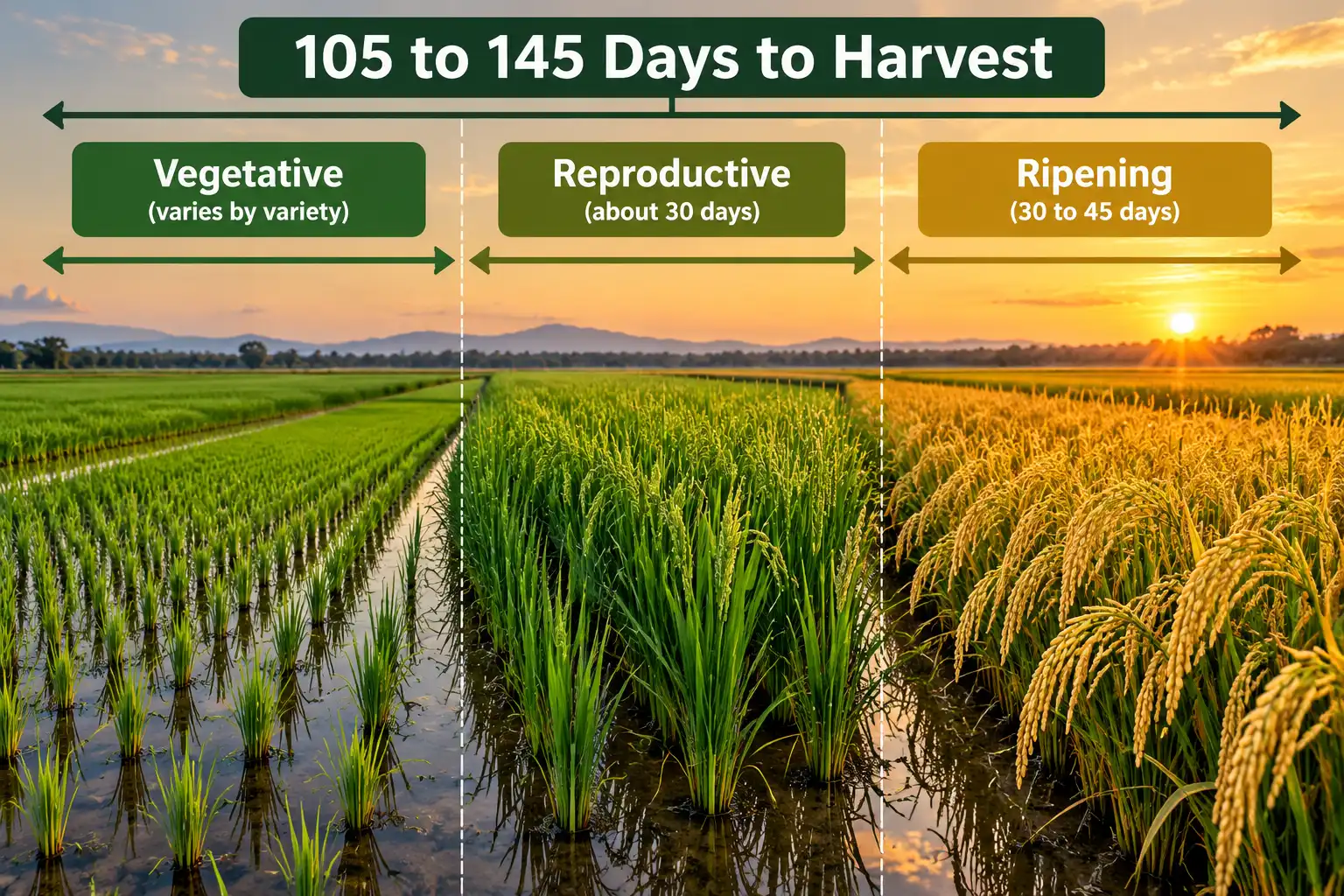
Rice moves through three phases, and varieties differ most in the first one. The Arkansas Rice Production Handbook divides the season this way:
- Vegetative: germination to panicle initiation
- Reproductive: panicle initiation to heading
- Ripening: heading to maturity
The reproductive phase lasts about 30 days in most cultivars, per the Handbook. Ripening also runs at a steady pace for each grain type. As a result, most of the gap between a 105-day rice and a 145-day rice opens before heading. The Division’s DD50 program adds that varieties take about the same time to reach the 4- to 5-leaf stage.
| Stage | What happens | Typical length |
|---|---|---|
| Emergence | Shoot breaks through the soil | 5 to 28 days |
| Leaf stages 1 to 4 | About one new leaf per week | 15 to 25 days |
| Tillering | Side shoots form | 24 to 42 days |
| Panicle initiation to 50% heading | Head forms inside the sheath, then emerges | About 30 days |
| 50% heading to harvest moisture | Grain fills and dries to about 20% | 30 to 45 days |
Stage lengths come from the Arkansas Rice Quick Facts and the Rice Production Handbook. Because stages overlap, the rows do not add up to one total.
Growers bring up the permanent flood near the fifth leaf or first tiller, per the same Quick Facts. That timing, and the reasons for flooding a rice paddy, fall early in the vegetative phase.

Days to Maturity by Rice Variety
Days to 50% heading is the figure to compare between varieties. After heading, each grain type ripens at a fairly fixed pace, so heading date sets harvest date.
The University of Arkansas 2026 Rice Management Guide lists heading days, counted from emergence, for each recommended cultivar. It then estimates maturity by adding 35 days for long grains or 40 days for medium grains. The table below applies that rule.
| Cultivar | Grain type | Days to 50% heading | Estimated days to maturity |
|---|---|---|---|
| RTv7231 MA | Long | 83 | 118 |
| RT 7221 FP (hybrid) | Long | 83 | 118 |
| Diamond | Long | 87 | 122 |
| RT 7321 FP (hybrid) | Long | 87 | 122 |
| Ozark | Long | 90 | 125 |
| CLL16 | Long | 91 | 126 |
| Titan | Medium | 85 | 125 |
| Taurus | Medium | 88 | 128 |
One catch applies to medium grains. The guide’s printed medium-grain totals add 35 days, not the 40 its own footnote states. Plan on the later date. LSU AgCenter also finds that medium grains need five to seven more days after heading than long grains.
California rice follows a similar clock. In UC Cooperative Extension’s 2023 statewide trials, the medium-grain standard M-206 averaged 81 days to 50% heading.
How Planting Date and Heat Change the Count
Rice develops by accumulated heat, so a cool spring stretches the calendar and a hot summer shortens it. The University of Arkansas tracks this with its DD50 program, which counts degree days above 50°F.
The daily formula is simple:
DD50 = (daily high + daily low) ÷ 2, minus 50
The program caps the high at 94°F and the low at 70°F. So no single day earns more than 32 units.
Run two days through it:
- Cool April day, 72°F high and 50°F low: (72 + 50) ÷ 2, minus 50, equals 11 units.
- July day, 92°F high and 72°F low: the low counts as 70, so (92 + 70) ÷ 2, minus 50, equals 31 units.
That July day does almost three times the work. For that reason, the program raises early-stage targets by 50 units for rice emerging before May 1. It also adds five days between heading and 20 percent grain moisture for rice heading after September 1. Panicles dry more slowly in fall.
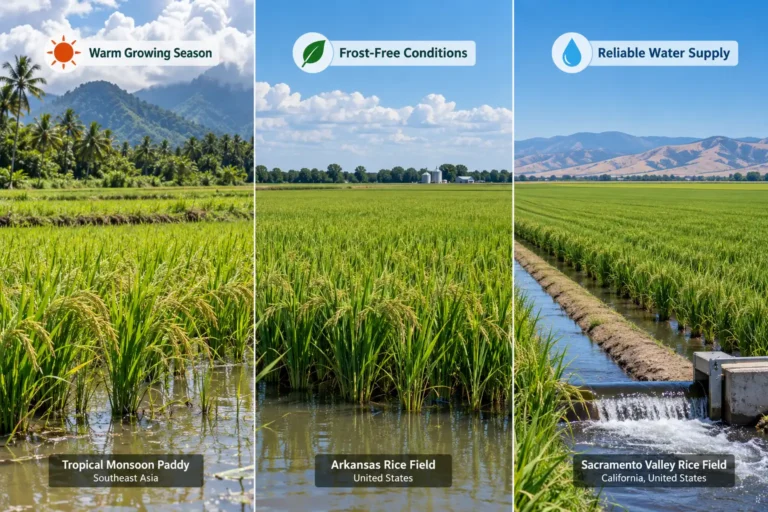
Heat cuts both ways, though. The Rice Production Handbook notes that high temperatures shorten grain fill and can lower grain weight. Cool weather does the opposite and lengthens ripening. Germination needs temperatures above 50°F, and Arkansas Extension advises planting once soil holds 60°F at a 4-inch depth. Those thresholds explain the warm climate rice needs to finish on schedule.
Rice Growing Season by US Region
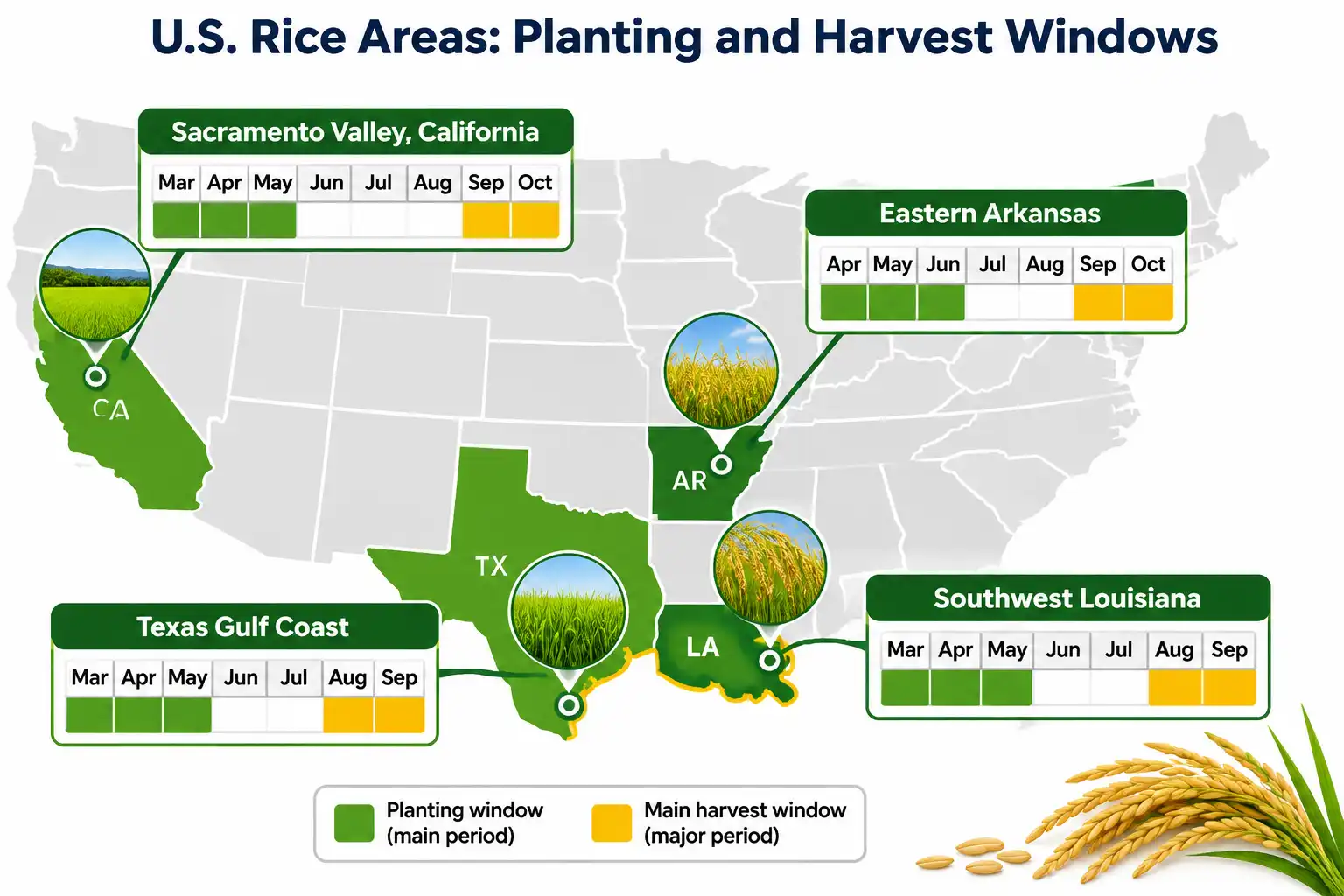
Gulf Coast fields plant first and harvest first, while California plants last and harvests in October. Each extension service publishes its own window. So the table keeps them separate instead of blending them into one national date.
| Region | Planting window | Main harvest | Source |
|---|---|---|---|
| Southwest Louisiana | March 10 to April 15 (optimum) | July to mid-August | LSU AgCenter |
| Texas Gulf Coast | Late February to early March (typical) | July to mid-August | Texas A&M AgriLife |
| Arkansas | March 25 to May 15 in the south; April 5 to May 5 in the north (optimum) | September (2024 verification average: September 10) | Arkansas Extension |
| Sacramento Valley, California | Late April to May | Late September to October | UC Cooperative Extension |
The season length stays close to four to five months in every region. Southern fields simply start and finish earlier. That early finish matters, because it leaves enough warm weather for a second crop.
How Long Does a Ratoon Crop Take?
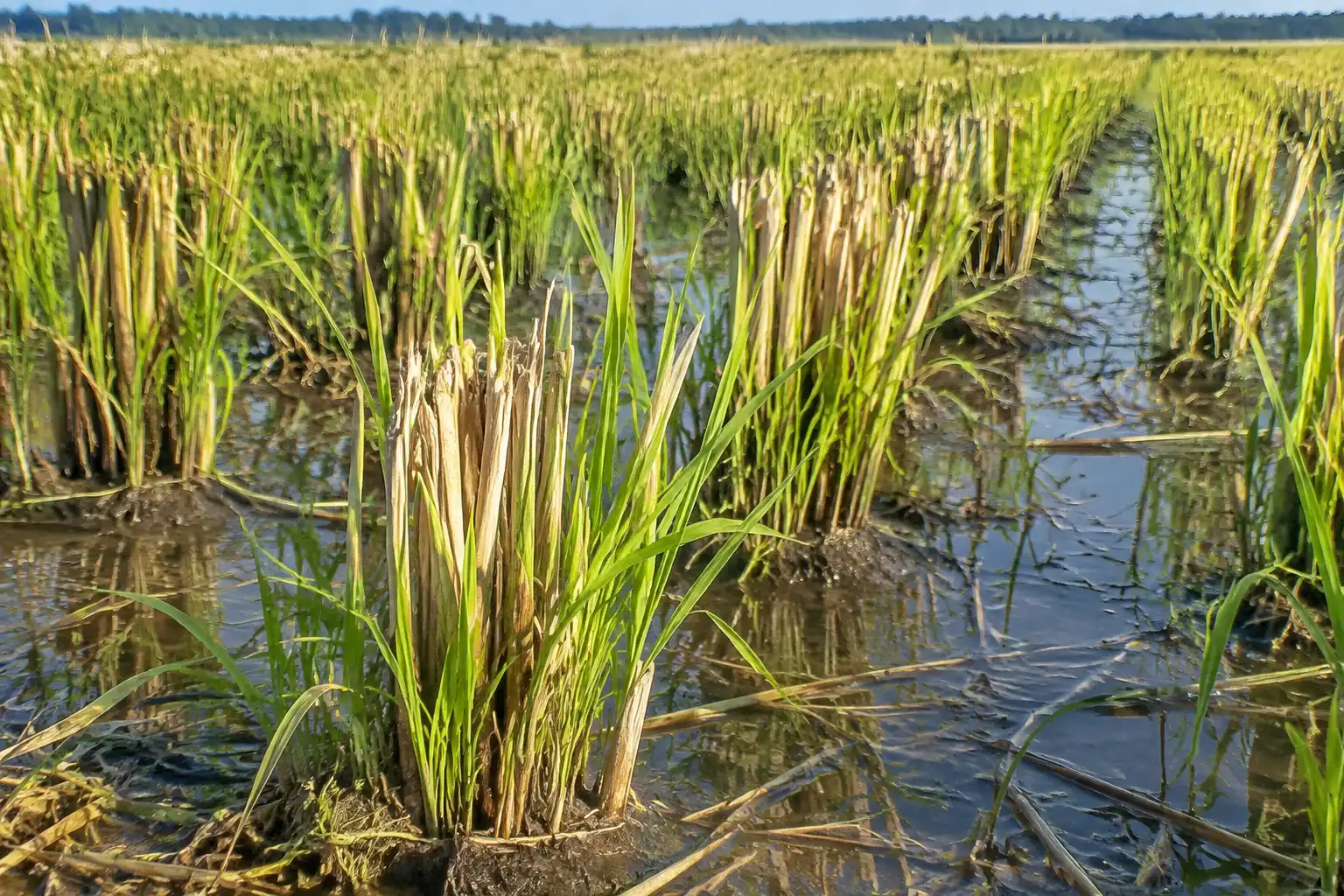
A ratoon, or second, crop needs about 90 days after the main harvest, per LSU AgCenter. That is why LSU sets roughly August 15 as the last main-crop harvest date for a field meant to ratoon. After that date, early frost becomes a serious risk.
The second crop grows from stubble, not seed. Texas A&M AgriLife Research reports that growers usually cut the main crop to 8 to 10 inch stubble. New tillers then rise from the lower nodes. The ratoon then has to mature before nights drop below about 50°F.
Run the dates for a typical Gulf Coast field:
- Plant the main crop in mid-March.
- Harvest it by August 10.
- Add 90 days for the ratoon, which lands near November 8.
That keeps one field in production for close to eight months. The return can justify it. Texas A&M AgriLife puts ratoon output at 35 to 50 percent of the main harvest. Inputs beyond nitrogen and water stay low.
Stubble handling also shifts the date. LSU AgCenter notes that clipping or rolling stubble delays regrowth by a week or more. In exchange, the second crop matures more evenly.
How Long Rice Takes in a Raised Bed or Bucket
Rice keeps the same clock at garden scale, so plan on four to five months from seeding. The plant still needs the same heat to reach heading, whatever the plot size.
Published research on small plots is thin, however. Extension rice trials measure commercial fields. None of the services cited here publish timing data for raised beds or containers. Field figures remain your best guide, since heading date tracks heat rather than area.
Three planning rules carry over directly:
- Wait until soil holds 60°F at 4 inches before sowing, per Arkansas Extension.
- Allow up to four weeks for emergence in cool soil.
- Count on at least 118 days after emergence, the fastest long-grain figure in the 2026 Arkansas guide.
Yield needs a scale translation too. Arkansas averaged 7,480 pounds of rough rice per acre in 2025, which works out to about 2.7 ounces per square foot. So a 4 by 8 raised bed tops out near 5.5 pounds of rough rice. A 5-gallon bucket tops out near 2 ounces. Treat those as ceilings, because commercial fields run on managed nitrogen and flood timing.
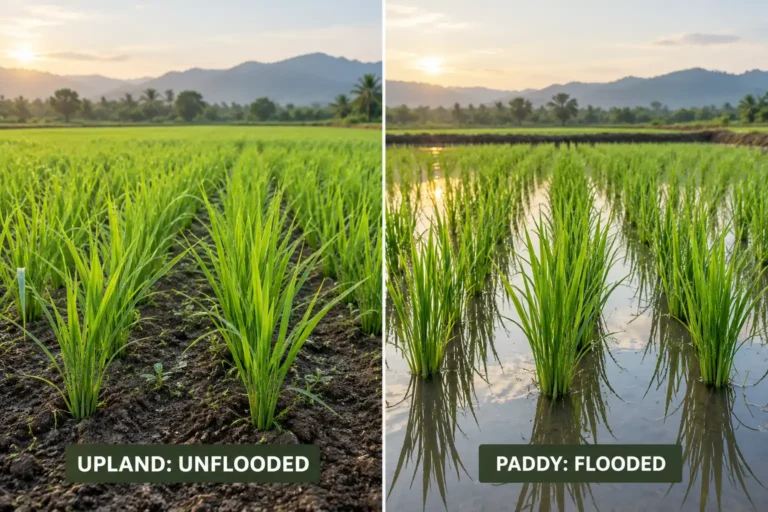
If you cannot hold standing water, compare upland and paddy rice before you buy seed.
How to Tell When Rice Is Ready to Harvest
Rice is ready when grain moisture drops to about 20 percent. That usually comes 30 to 45 days after 50% heading, but the two main Mid-South services count the stretch differently.
- LSU AgCenter: most varieties reach 20 percent moisture 30 to 40 days after heading, with medium grains five to seven days behind long grains.
- University of Arkansas DD50 program: allows 35 days for long grains, 40 for medium grains, and 50 for short grains from heading to 20 percent moisture.
Neither figure is wrong. Each comes from trials in that state’s soils and weather, so use the one closer to your field. For Gulf Coast rice, start with the LSU range. For the Delta, start with the Arkansas allowances.
Draining comes before harvest. Arkansas Extension advises draining only when a field meets both conditions:
- It is 25 days past 50% heading for long grains, or 30 days for medium grains.
- Two-thirds of the kernels are straw-colored on silt loam soils, or one-third on clay soils.
On a garden plot, the same color check works panicle by panicle. Cut when most kernels have turned straw-colored. Then dry the grain to 12 percent moisture, the level Arkansas Extension treats as dry, before you store it.

FAQs About Rice Growing Time
Can rice grow in 90 days?
Not with the cultivars Arkansas currently recommends, since the fastest need about 118 days. In the 2026 Arkansas Rice Management Guide, they head 83 days after emergence, then dry down for 35 more.
How long do rice seeds take to sprout?
Rice seed usually germinates within two days at 70 to 97°F, per the Arkansas Rice Production Handbook. Emergence through the soil then takes 5 to 28 days, depending on field conditions.
Does medium-grain rice take longer than long-grain?
Yes, mainly after heading, according to LSU AgCenter and Arkansas Extension. LSU finds medium grains need five to seven extra days, and Arkansas’s DD50 program allows them 40 days instead of 35.
Why is my rice taking longer than its maturity rating?
Heading ratings in Arkansas and LSU trials count from emergence, not planting. Cool spring weather, emergence before May 1, and heading after September 1 all add days to the Arkansas DD50 forecast.
Does rice grow back after harvest?
Yes, in warm Gulf Coast fields, where stubble cut to 8 to 10 inches regrows a ratoon crop. That crop needs about 90 days, per LSU AgCenter, so the main harvest must finish by mid-August.
How long does wild rice take to grow?
Cultivated wild rice heads from mid-July to early August, with harvest starting in late August, per University of Minnesota Extension. Growing wild rice also starts differently, with seed sown in fall or early spring.
Putting This Into Practice
Start from your emergence date, not your planting date. Add your variety’s days to 50% heading, then 35 days for long grains or 40 for medium grains. That gives a harvest target you can adjust as the season runs hot or cool.
On the Gulf Coast, work backward from August 15 if you want a ratoon crop. In a garden, confirm you have four to five warm months before you sow. If your variety has no published heading data, your county extension office can share local trial results.