Where Does Rice Come From? Origins, Top Growers, and US States
It starts as the seed of a wetland grass first tamed in China and, separately, in West Africa. Here is where rice began, who grows it today, and where the rice in US and Mexican kitchens comes from.
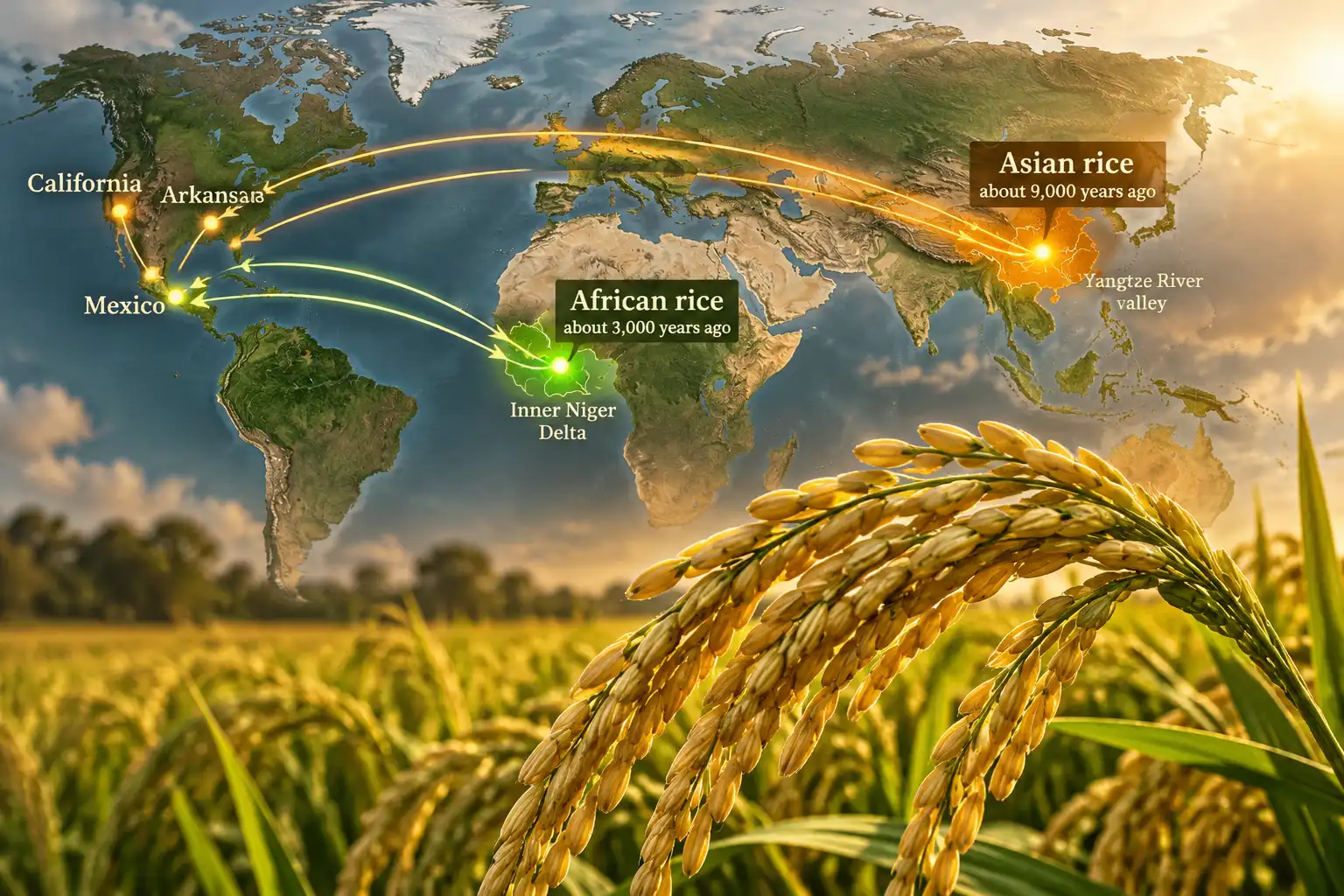
Rice comes from Oryza sativa, a grass farmers domesticated from wild rice in China’s Yangtze River valley about 9,000 years ago. West Africans tamed a second species later. Today, India and China grow over half the world’s rice.
Where Does Rice Come From Originally?
Asian rice comes from China. Farmers there domesticated it from a wild wetland grass, Oryza rufipogon, which still grows across South and Southeast Asia.
The timing is well supported. A 2011 genetic study in PNAS, led by New York University researchers, dated the origin to 8,200 to 13,500 years ago. The range depends on the molecular clock used, and it fits the archaeology. Rice farming shows up in the Yangtze River valley 8,000 to 9,000 years ago.
The exact spot is less settled. The PNAS study found one origin for both main types of Asian rice, japonica and indica. However, a 2012 study in Nature sequenced 446 wild rice samples and 1,083 cultivated varieties. It placed the first japonica rice farther south, along the middle Pearl River in Guangxi. In that account, indica came later, when japonica crossed with local wild rice in South and Southeast Asia.
So the answer depends on which evidence you weigh. Archaeology favors the Yangtze. Genetics points to southern China, with the Pearl River as one candidate. Still, both agree on the country and the wild ancestor.
India came next. The PNAS authors also note early rice farming in India’s Ganges valley about 4,000 years ago. It may have been a separate start.
African Rice: A Second, Separate Origin
Rice has a second birthplace. African rice, Oryza glaberrima, is a different species that West Africans domesticated from the wild grass Oryza barthii.
A 2018 study in Current Biology, by researchers at France’s IRD, sequenced 246 genomes. It traced the cradle of African rice to the Inner Niger Delta in northern Mali, roughly 3,000 years ago. Wild African rice began a sharp decline more than 10,000 years ago as the Sahara dried out. The study suggests that loss pushed people to start farming it.
African rice cultivation then expanded about 2,000 years ago. Over the last five centuries, however, it declined sharply as Asian rice reached Africa. Even so, some West African farmers still grow it.
That history reaches the Americas, too. Enslaved West Africans, many from rice-growing regions, supplied much of the skill behind rice farming in the Carolina colony.
How Rice Spread Around the World
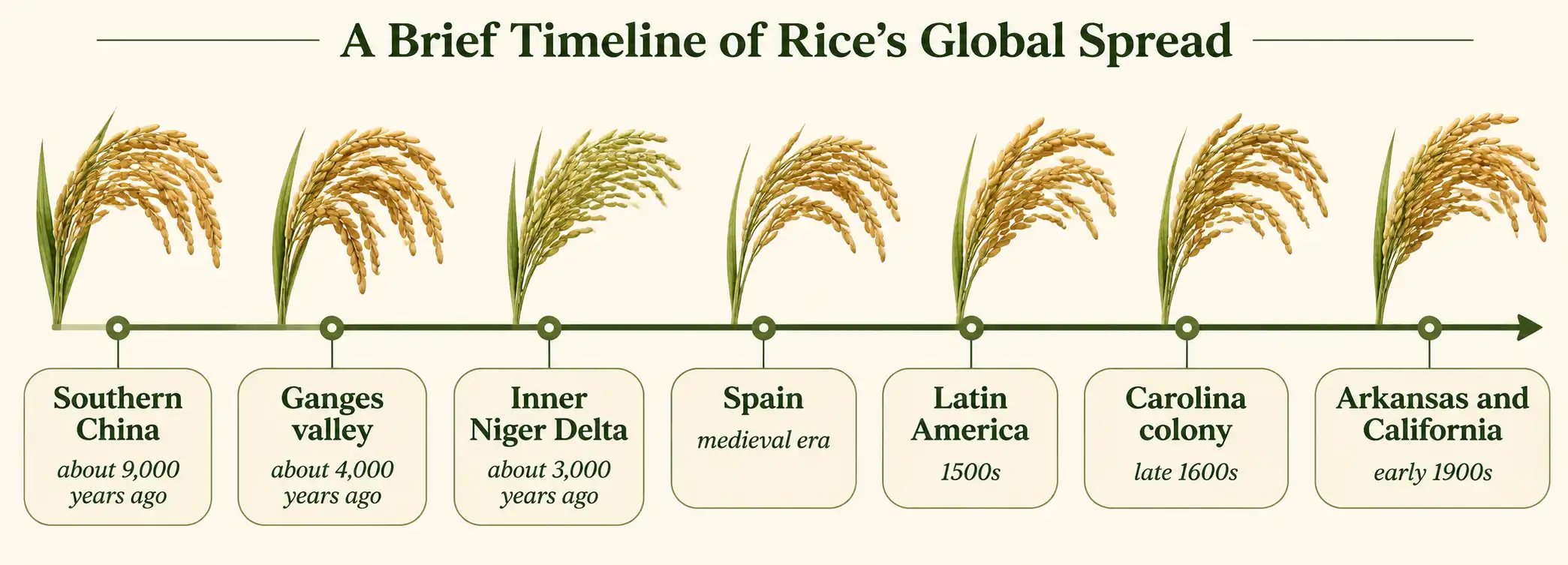
Rice left its first homes slowly, over thousands of years. The broad path runs like this:
- Southern China, about 9,000 years ago: farmers domesticate Asian rice.
- India’s Ganges valley, about 4,000 years ago: rice cultivation is underway.
- Mali’s Inner Niger Delta, about 3,000 years ago: West Africans domesticate their own rice species.
- Spain, medieval era: Arab traders and the Moors carry Asian rice into Europe.
- Latin America, 1500s: Spanish and Portuguese ships bring rice across the Atlantic.
- The Carolina colony, late 1600s: rice becomes a major export crop.
- Louisiana, Texas, Arkansas, and California, late 1800s to early 1900s: US production moves west.
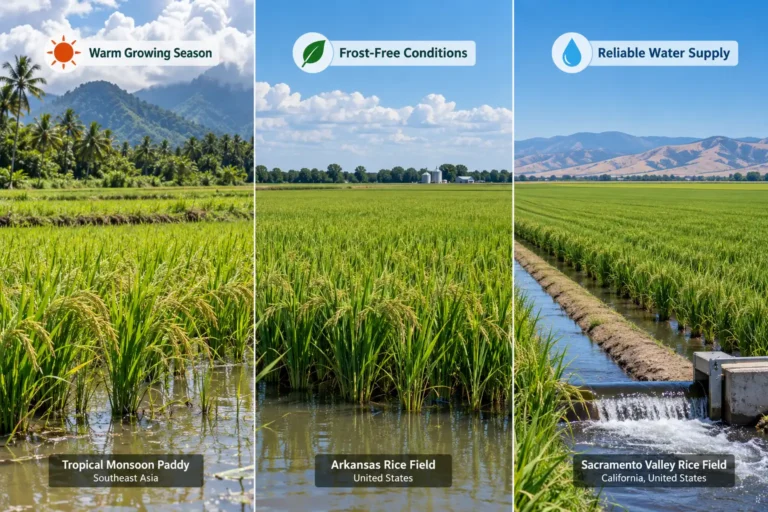
Each move followed long, warm growing seasons and plenty of water. That is why the climate rice needs still decides where it grows today.
Which Countries Grow the Most Rice?
India and China grow the most rice by far. USDA FAS data from October 2026 show the pair grew about 55 percent of the 2025/26 world crop.
| Country | 2025/26 milled rice (million metric tons) | Share of world crop |
|---|---|---|
| India | 154.0 | 28.2% |
| China | 146.3 | 26.8% |
| Bangladesh | 37.7 | 6.9% |
| Indonesia | 33.8 | 6.2% |
| Vietnam | 26.2 | 4.8% |
| Thailand | 20.7 | 3.8% |
| United States | 6.6 | 1.2% |
| World total | 545.7 | 100% |
The figures come from the FAS Grain: World Markets and Trade report, and the shares are our calculation. One metric ton equals about 2,205 pounds.
The next crop looks different. For 2026/27, FAS forecasts India and China at 147.0 million metric tons each, a tie.
The US grows a small share, but it ships a large one. USDA ERS says the US exports 40 to 45 percent of its crop each year.
How Did Rice Get to the United States?
Rice is not native to the US. Asian rice reached the Carolina colony in the late 1600s. After that, South Carolina and Georgia led US production for most of the next two centuries.
Then commercial rice moved west. Louisiana and Texas took the lead in the late 1800s, planting the flat coastal prairies. Arkansas followed after 1900. California’s Sacramento Valley started commercial production in the early 1900s, once growers found Japanese medium-grain varieties that suited it.
Where Does US Rice Come From?
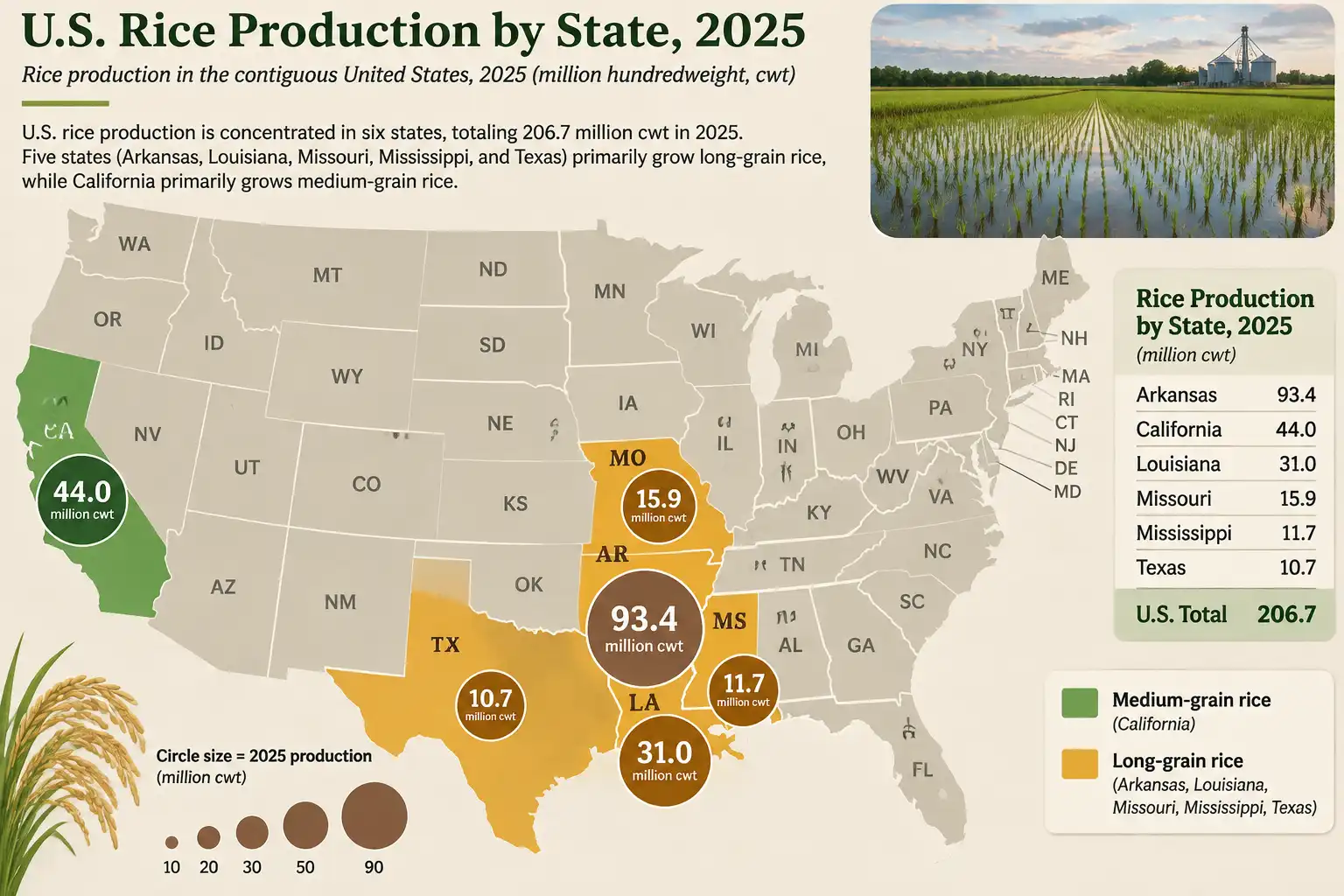
Nearly all US rice comes from six states. Arkansas alone grew 45 percent of the 2025 crop, according to the USDA NASS Crop Production 2025 Summary.
| State | 2025 production (million cwt) | Share of US crop | Main grain type | Growing region |
|---|---|---|---|---|
| Arkansas | 93.4 | 45.2% | Long grain | Grand Prairie and Delta |
| California | 44.0 | 21.3% | Medium grain | Sacramento Valley |
| Louisiana | 31.0 | 15.0% | Long grain | Gulf Coast and Delta |
| Missouri | 15.9 | 7.7% | Long grain | Delta (Bootheel) |
| Mississippi | 11.7 | 5.6% | Long grain | Delta |
| Texas | 10.7 | 5.2% | Long grain | Gulf Coast |
| United States | 206.7 | 100% | 74% long grain | Six states |
One cwt is 100 pounds of rough rice. So the 2025 US crop weighed about 20.7 billion pounds before milling.
Grain type follows geography. NASS figures show long grain made up 74 percent of the 2025 crop, and Arkansas grew 57 percent of it. In contrast, California grew 81 percent of US medium grain and 98 percent of short grain.
The 2026 crop is smaller. In its October 2026 Rice Outlook, USDA ERS forecasts 157.7 million cwt from 2.06 million harvested acres. That is the fewest acres since 1972/73.
Does Mexico Grow Rice?
Yes, Mexico grows rice, but only a small part of what it eats. The USDA FAS office in Mexico City estimates that domestic rice covers about 15 percent of national consumption. That demand runs near 1.0 million metric tons a year, or about 14 pounds per person.
Per the FAS Grain and Feed Update of June 2026, the 2025/26 crop came to 268,000 metric tons of rough rice. It grew on about 39,000 hectares. In US units, that is roughly 5.9 million cwt from 96,000 acres. USDA’s official estimate runs a bit higher, at 275,000 metric tons. For 2026/27, the FAS office forecasts 279,000.
Where Rice Grows in Mexico
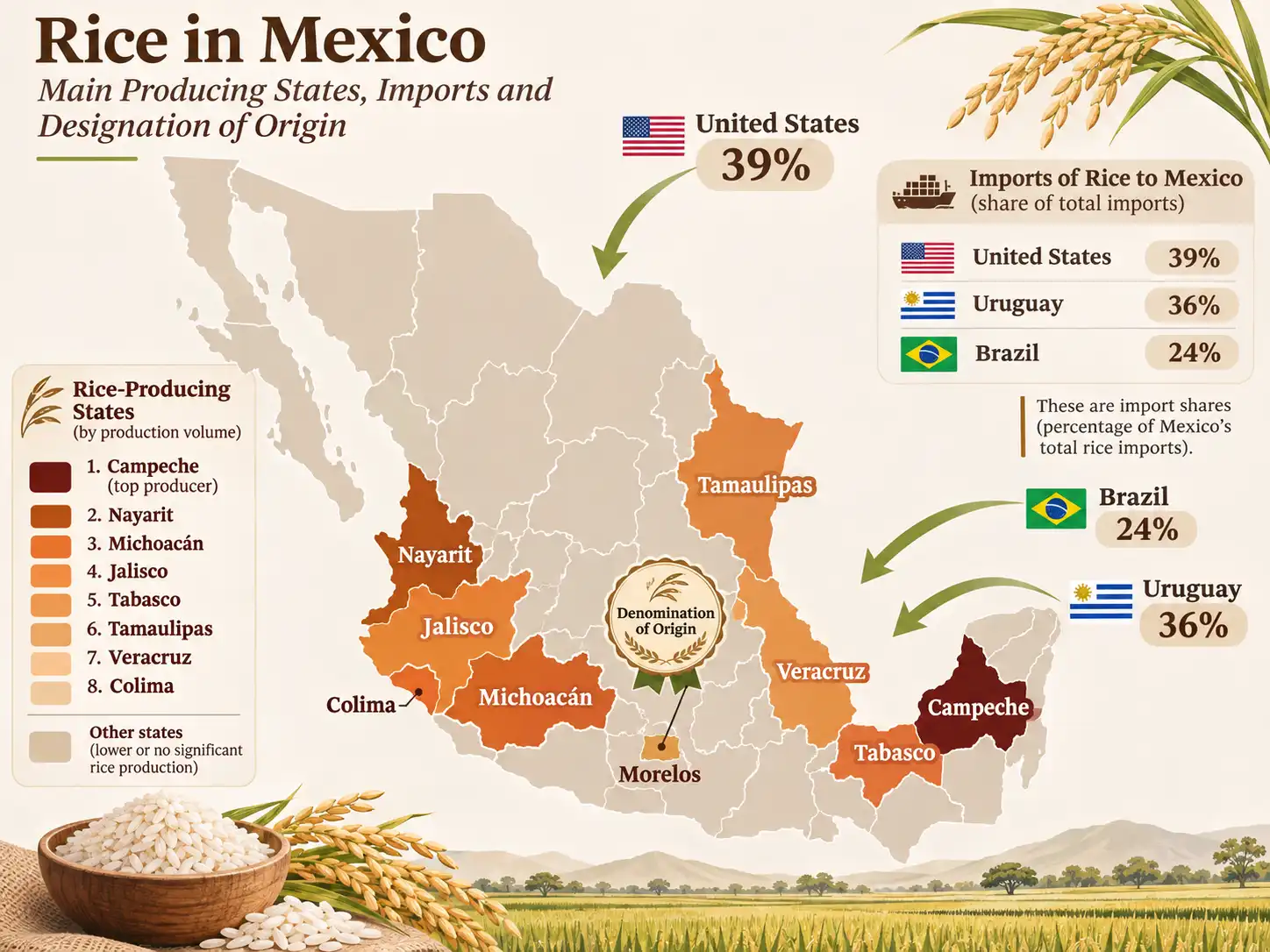
Campeche, on the Yucatán Peninsula, is the largest producing state. FAS also reports rice in Nayarit, Michoacán, Jalisco, Tabasco, Tamaulipas, Veracruz, and Colima. Morelos grows a small but well-known crop. Its “Arroz del Estado de Morelos” has held a federal denomination of origin since 2012.
Most Mexican rice is medium grain, with some long grain. For example, Nayarit growers plant the medium-grain variety Milagro Filipino. FAS describes two growing seasons:
- Spring/summer: about 70 percent of annual output, roughly 60 percent irrigated and 40 percent rainfed
- Fall/winter: almost entirely irrigated, so reservoir and aquifer levels set the planted area
Mexico Compared With US Rice States
Mexico’s whole rice crop is smaller than Texas’s. The table converts the FAS figures to US units so you can compare them with NASS state data.
| Measure | Mexico (2025/26) | Texas (2025) | Arkansas (2025) |
|---|---|---|---|
| Harvested acres | about 96,000 | 139,000 | 1,250,000 |
| Rough rice (million cwt) | 5.9 | 10.7 | 93.4 |
| Yield (pounds per acre) | about 6,130 | 7,730 | 7,480 |
By this measure, Arkansas grew about 16 times as much rice as all of Mexico. The marketing years differ slightly, so treat this as a scale comparison.
Where Mexico’s Imported Rice Comes From
Mexico imported an estimated 800,000 metric tons in 2025/26, and FAS forecasts 830,000 for 2026/27. Most arrives as paddy rice for Mexican mills. From October 2025 through April 2026, the United States supplied 39 percent of imports. Uruguay supplied 36 percent and Brazil 24 percent.
That US share used to be far higher. After Mexico opened its market in the mid-1990s, US rice filled 95 to 100 percent of its imports, per USDA ERS. Since 2010, however, South American suppliers have gained ground. Brazil, for instance, has shipped large volumes of rough rice to Mexico since 2020.
What Part of the Plant Does Rice Come From?
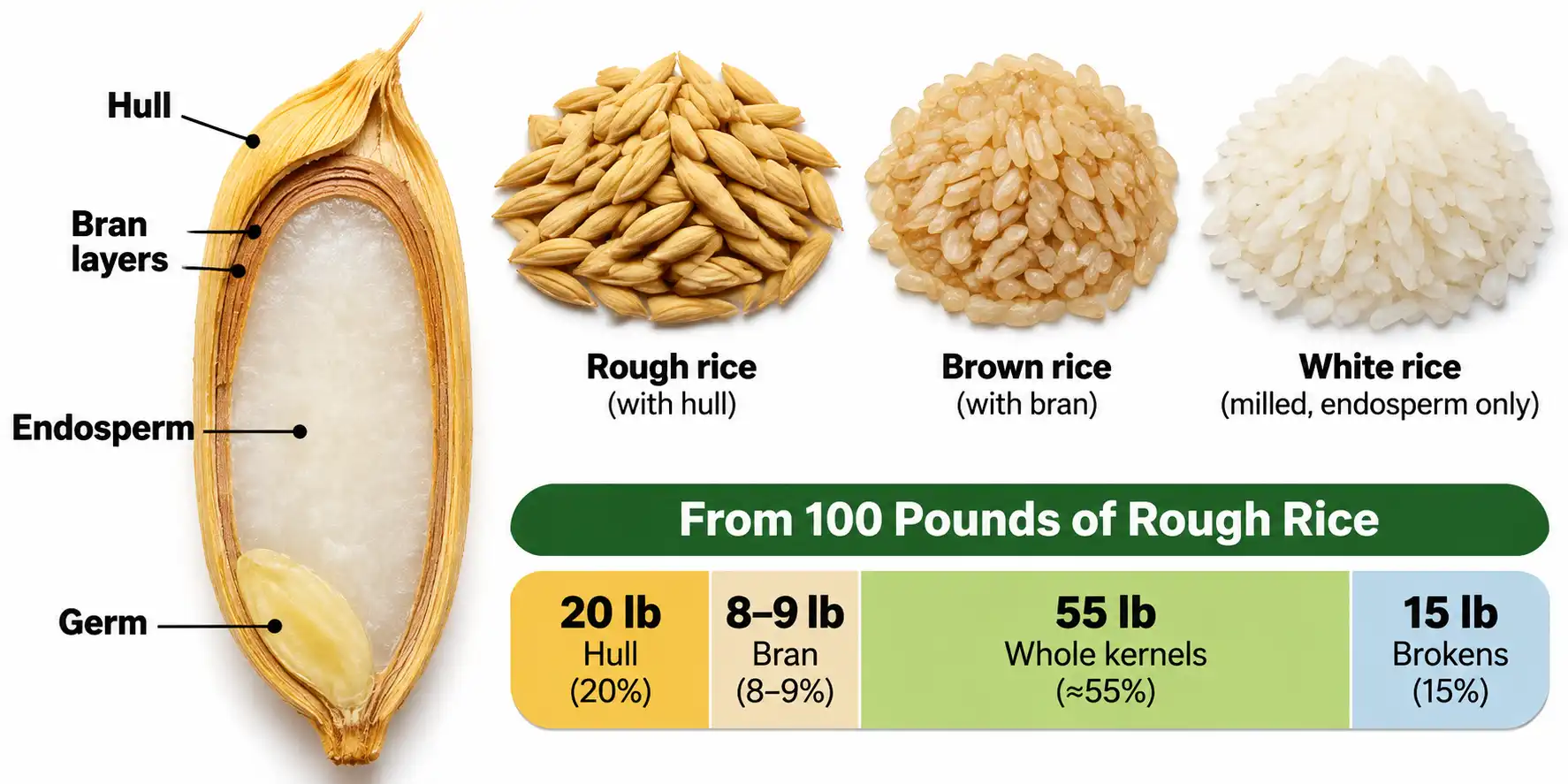
Rice is the seed of the rice plant. Each grain grows on a drooping seed head called a panicle, wrapped in a tough hull. Farmers harvest it as rough rice, also called paddy rice.
Milling then turns that seed into the rice you buy:
- Rough rice: the whole seed, hull and all, as it leaves the field.
- Brown rice: the hull comes off, but the bran layers and germ stay.
- White rice: milling rubs away the bran and germ, leaving the starchy endosperm.
Per USDA ERS, every 100 pounds of rough rice yields about 20 pounds of hull and 8 to 9 pounds of bran. The rest is about 55 pounds of whole white kernels and 15 pounds of broken kernels. So brown and white rice come from the same grain. Only the milling differs.
How Much Rice Does One Acre Produce?
An acre of Arkansas rice yielded 7,480 pounds of rough rice in 2025, per NASS. Apply the ERS milling split, and that acre gives about 4,100 pounds of whole white rice. It also gives about 1,100 pounds of brokens.
The same math works at garden scale. A 4 by 8 foot bed covers 32 square feet, about 1/1,360 of an acre. So 7,480 × 32 ÷ 43,560 comes to about 5.5 pounds of rough rice, or roughly 3.8 pounds once milled.
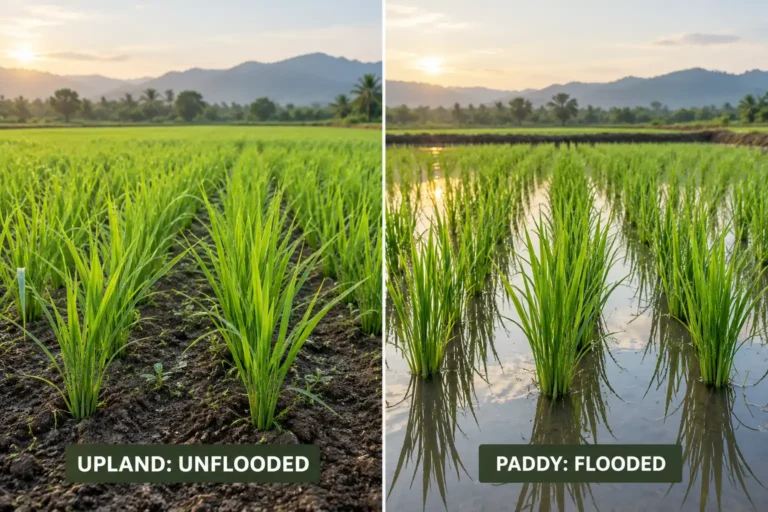
That figure assumes commercial conditions, though: flooded paddies, full fertility, and a long, hot season. If you cannot hold standing water, look at upland rice, which grows in rain-fed soil like other grains.
FAQs About Rice Come From
Is rice native to the United States?
No, Asian rice arrived in the Carolina colony in the late 1600s. North America’s native wild rice is a different grass genus, Zizania, that grows in shallow northern lakes and rivers.
Which US state grows the most rice?
Arkansas grows the most rice in the US, mostly long grain from the Grand Prairie and Delta. It produced 93.4 million cwt in 2025, about 45 percent of the national crop, per USDA NASS.
Does Mexico grow enough rice to feed itself?
No, Mexico’s own crop covers only about 15 percent of consumption, per USDA FAS. Imports from the United States, Uruguay, and Brazil fill the gap, mostly as paddy rice for Mexican mills.
Where do basmati and jasmine rice come from?
Basmati comes from the Punjab region and Himalayan foothills of India and Pakistan. Jasmine rice, or Hom Mali, comes mainly from Thailand, though farmers now grow both aromatic types elsewhere, including the US.
Is brown rice a different plant from white rice?
No, brown and white rice come from the very same grain. Brown rice keeps its bran and germ after hulling, while white rice has both milled away to expose the starchy endosperm.
Where does sushi rice come from in the US?
Mostly California, which grows the soft, sticky medium and short grains used for sushi. In 2025 it grew about 81 percent of US medium grain and 98 percent of short grain, per USDA NASS.
What the Research Supports
Rice has two origins. Asian rice began in southern China about 9,000 years ago, and African rice in Mali about 3,000 years ago. In the US, Arkansas grows most of the long grain, and California grows nearly all the medium and short grain. Mexico grows rice in Campeche, Nayarit, and other states, yet covers only about 15 percent of its own demand. For updated state figures, check the USDA NASS Crop Production Summary each January.