When to Plant Sugar Beets: Dates, Soil Temperature, and Regions

Sugar beets need an early start, suitable soil moisture, and enough growing time to develop large, sugar-rich roots. Knowing when to plant sugar beets helps you avoid poor germination, frost injury, and reduced yields.
Plant sugar beets from March through May across most northern U.S. producing regions, depending on local conditions. Aim for workable soil near 50°F. Mild desert climates can support fall planting, although commercial processing access must be confirmed.
When to Plant Sugar Beets by Region
Most U.S. sugar beet fields are planted in early spring, but the ideal month varies by region.
A longer growing season generally favors root development and sugar accumulation. However, planting into wet, compacted soil can eliminate the advantages of an early start.
The University of Wisconsin-Madison sugarbeet guide identifies April 20 to May 10 as a historical favorable planting period for Minnesota, North Dakota, and Wisconsin.
The USDA Economic Research Service’s April 2026 sugar outlook also shows how regional planting progress differs. Idaho was nearly halfway planted by April 12, while planting had barely started in Michigan and had not started in Minnesota or North Dakota.
Sugar Beet Planting Calendar
| U.S. growing region | Typical planting window | Main consideration |
|---|---|---|
| Minnesota and North Dakota | Mid-April to mid-May | Cold soil and wet spring fields |
| Michigan | April to early May | Soil moisture and spring freezes |
| Idaho | Late March to early May | Elevation, irrigation, and soil warming |
| Nebraska, Colorado, and Wyoming | April to early May | Frost risk and seedbed conditions |
| Montana | April to mid-May | Cold nights and shorter growing seasons |
| Imperial Valley, California | Historically September to October | Mild winter climate and irrigation |
These are approximate planning windows, not fixed annual deadlines.
Nebraska Extension identifies April as a common commercial planting month in western Nebraska. Its frost and replanting research also documents significant early-season freeze risk.
California requires a separate distinction. UC Agriculture and Natural Resources documents historical fall planting in the Imperial Valley, where winter conditions supported sugar beet growth.
However, California’s last beet sugar processing factory closed in 2025. The USDA Economic Research Service consequently removed California acreage from its 2025/26 commercial production projections.
Fall planting remains agronomically possible in suitable climates, but that historical commercial schedule does not establish a current processing market.
What Soil Temperature Is Best for Planting Sugar Beets?
A soil temperature around 50°F is a practical target for establishing sugar beets, although seeds can germinate at lower temperatures.
Nebraska Extension lists 50°F as its minimum soil temperature for planting sugar beets.
Cooler soil does not necessarily prevent germination. However, it slows emergence and leaves seedlings exposed to unfavorable conditions for longer.
North Dakota State University Extension provides the following estimates in its Crop and Pest Report on sugar beet emergence.
| Soil temperature | Approximate emergence time | Planting implication |
|---|---|---|
| 38°F to 45°F | 21 days or longer | Very slow emergence |
| 45°F to 52°F | 10 to 21 days | Slow establishment |
| 52°F to 60°F | 7 to 12 days | Faster establishment |
| 60°F to 70°F | 5 to 7 days | Rapid emergence with adequate moisture |
These estimates assume sufficient soil moisture. Dry conditions can delay emergence further.
The difference between germination and successful establishment matters. Commercial growers sometimes accept cooler planting conditions to extend the growing season. Smaller plantings can often wait for warmer soil and more predictable emergence.
How to Know When Your Field Is Ready for Planting
Check soil temperature, field moisture, the weather forecast, and seedbed condition before sowing.
1. Measure soil temperature
Insert a soil thermometer approximately 2 inches into the soil.
Take readings at approximately the same time for three consecutive days. Use the average rather than one unusually warm afternoon.
NDSU Extension recommends this three-day soil temperature check to guide seed planting decisions.
2. Test whether the soil is workable
Squeeze a handful of soil.
If it remains sticky or smears when pressed, postpone field operations. Soil that breaks into small, moist crumbs is generally more suitable.
Planting wet soil can create compaction that restricts root development.
3. Review the weather forecast
Check the forecast for freezing conditions, prolonged cold rain, and sharp temperature declines.
A warming trend with moderate moisture is preferable to a short warm spell followed by severe cold.
4. Check moisture at planting depth
The seed zone should be moist enough to support germination without becoming waterlogged.
Avoid placing seeds into dry, loose soil without a reliable source of moisture.
For irrigated fields, use soil conditions and crop water requirement calculations to guide subsequent watering decisions.

Can Sugar Beets Be Planted Before the Last Frost?
Yes. Sugar beets tolerate some spring frost, so planting does not always need to wait until the final expected freeze.
However, frost tolerance depends on seedling development, temperature, and exposure duration.
Nebraska Extension reports that sugar beet seedlings can suffer frost damage when temperatures fall below approximately 28°F.
Its western Nebraska research identified a substantial risk of frost injury from planting before April 25.
This does not make April 25 a universal safe date. Frost probabilities vary with location and annual weather patterns.
For practical decisions:
- Light frost expected: Early planting may remain reasonable when soil conditions are favorable.
- Severe freeze expected: Consider delaying planting, particularly if seedlings are likely to emerge during the cold period.
- Seeds already planted: Wait until emergence and injury can be evaluated before deciding to reseed.
Avoid treating the last spring frost date as the only planting requirement. Soil condition and forecast temperatures both matter.
How Deep and How Far Apart Should You Plant Sugar Beet Seeds?
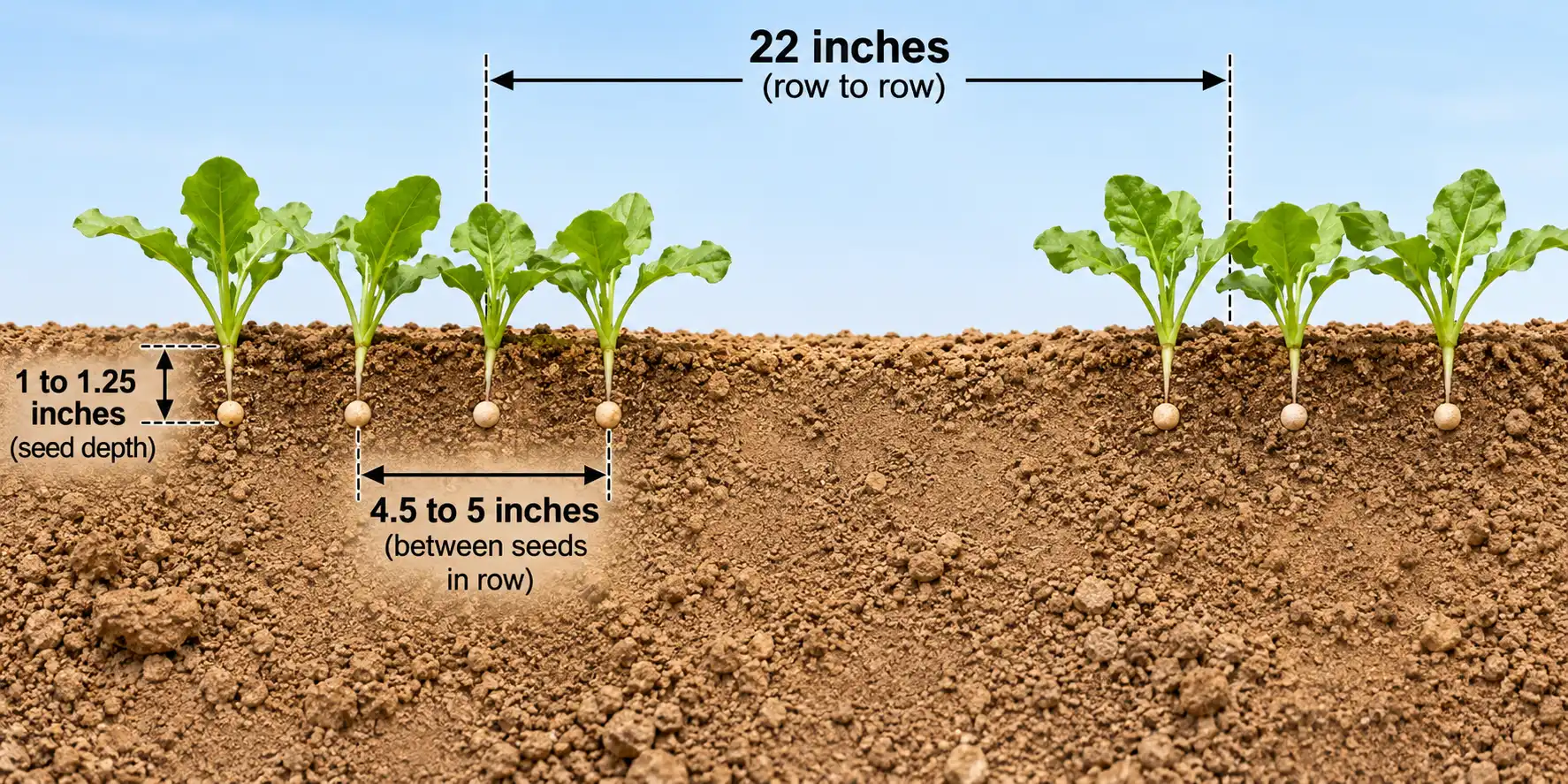
Commercial sugar beet seed is commonly placed 1 to 1.25 inches deep, with 4.5 to 5 inches between seeds in 22-inch rows.
The 2026 NDSU Sugarbeet Production Guide recommends these settings for Minnesota and North Dakota production.
| Planting specification | NDSU guidance |
|---|---|
| Planting depth | 1 to 1.25 inches |
| In-row seed spacing | 4.5 to 5 inches |
| Common row spacing | 22 inches |
| Seeds per acre | 57,024 to 63,360 |
| Desired harvest stand | 175 to 200 plants per 100 feet of row |
Use the shallower end of the recommended depth range during early planting when conditions allow.
Commercial precision planters must match seed size and pellet type. Check planter settings to reduce skips and uneven placement.
NDSU also recommends locally approved varieties through regional Coded Variety Trials. Select varieties with disease resistance suited to your growing area rather than relying only on root yield claims.
How Much Sugar Beet Seed Do You Need?
Calculate seed requirements using row spacing and distance between seeds rather than relying on pounds per acre alone.
Seed pellet size and seed count per package can vary.
Use this formula:
Seeds per acre = 6,272,640 ÷ (row spacing in inches × seed spacing in inches)
For 22-inch rows and 5-inch seed spacing:
6,272,640 ÷ (22 × 5) = 57,024 seeds per acre
For a smaller test planting, a 25-foot row contains 300 inches.
300 ÷ 5 = 60 planting positions
Therefore, eight 25-foot rows need approximately 480 seeds before accounting for extra seed or planter losses.
These figures describe seeds placed, not the final number of surviving plants.
Check emerging stands before making replant decisions.
How Late Can You Plant Sugar Beets in Spring?
Planting after the usual regional window may still produce roots, but it leaves less time for sugar accumulation.
The USDA Economic Research Service identifies mid-May as an important timing benchmark for commercial sugar beet development.
Late planting can create several disadvantages:
- Less growing time before autumn harvest.
- Reduced opportunity for canopy and root development.
- Greater exposure to warm-season weed competition.
- Higher risk of failing to meet processing expectations.
A delayed field should not automatically be abandoned. Evaluate the expected harvest period, likely stand establishment, and processing requirements.
For commercial acreage, confirm the factory or cooperative’s acceptance schedule before making a late planting decision.
When Should Sugar Beets Be Planted for Fall Growth?
Fall planting depends on whether you want sugar production, a cover crop, or wildlife forage.
Sugar production in mild climates
Historically, California’s Imperial Valley planted sugar beets during September and October.
Roots developed through the mild winter and were harvested during the following spring and summer.
Cold-tolerant varieties with low bolting risk were particularly important in these overwintering systems.
This schedule should not be copied into Minnesota, North Dakota, or other regions with severe winters.
Cover crops and deer food plots
Sugar beets grown for wildlife forage or cover-crop purposes have different planting goals.
The USDA NRCS sugar beet cover crop fact sheet for Iowa lists fall seeding from late July into early October, depending on conditions.
It also notes that 60 to 90 days of growth are needed to maximize taproot development.
For substantial fall root growth, favor the earlier part of a locally suitable planting window.
Late sowing may establish foliage without producing comparable root mass. These dates are not recommendations for commercial sugar production.
Common Problems After Early Sugar Beet Planting
Most early establishment problems involve temperature, moisture, surface crusting, or seedling injury.
| Symptom | Possible cause | What to check |
|---|---|---|
| Little emergence after 10 days | Cold soil | Review soil temperatures before reseeding |
| Uneven plant spacing | Dry seed zone or planter skips | Check planting depth and seed placement |
| Seedlings trapped below the surface | Soil crusting | Inspect the soil surface after rain |
| Collapsed or dying seedlings | Freeze injury or seedling disease | Examine roots, stems, and recent temperatures |
| Patchy stands | Variable moisture or compaction | Compare affected and healthy areas |
Do not assume that slow germination means seed failure. Sugar beets in soil below 52°F may require considerably longer to emerge.
Also, avoid immediate wholesale replanting after patchy establishment.
Nebraska Extension’s sugar beet replanting trials found that delayed replacement stands were not consistently advantageous. The results support evaluating surviving populations before destroying an established crop.
If seedlings are dying rather than simply emerging slowly, examine the affected plants and compare symptoms with common crop disease problems.
Soil testing also helps identify fertility limitations before the growing season. For fertilizer decisions, begin by interpreting your soil-test report rather than applying a uniform rate without field data.
FAQs About Plant Sugar Beets
Can you plant sugar beets in June?
Yes, June planting can establish sugar beet plants where enough growing time remains. However, commercial root and sugar yields may suffer, so check your expected harvest date and processing requirements before planting late.
Should sugar beet seeds be started indoors?
No, direct seeding is generally preferred for commercial sugar beets because it supports precision spacing and avoids transplanting the developing taproot. Starting seedlings indoors is usually unnecessary and impractical for field-scale production.
How long do sugar beets take to sprout?
Sugar beet seedlings commonly emerge in 7 to 12 days when moist soil temperatures remain around 52°F to 60°F. In colder soil, emergence may take 21 days or longer, according to NDSU Extension.
Can sugar beets grow in USDA Zones 8 and 9?
Yes, sugar beets can grow in suitable parts of Zones 8 and 9. However, winter hardiness zones alone cannot determine planting dates, so consider seasonal heat, frost patterns, soil moisture, and irrigation availability.
Are sugar beets planted at the same time as garden beets?
Their cool-season germination needs overlap, but their production schedules differ. Garden beets are usually harvested as smaller table roots, while sugar beets remain in the field much longer to develop large roots and accumulate sucrose.
Can sugar beets grow without a processing contract?
Yes, small plantings can be grown for personal projects, forage, or wildlife purposes where appropriate. Commercial sugar production requires a dependable processing outlet, so secure market access before committing substantial acreage.
Key Points for Your Sugar Beet Planting Plan
Use regional planting dates as a starting point, then check soil temperature, moisture, and the immediate weather forecast.
Aim for early establishment without damaging the seedbed. For commercial production, coordinate planting with local variety recommendations and the available processing schedule.