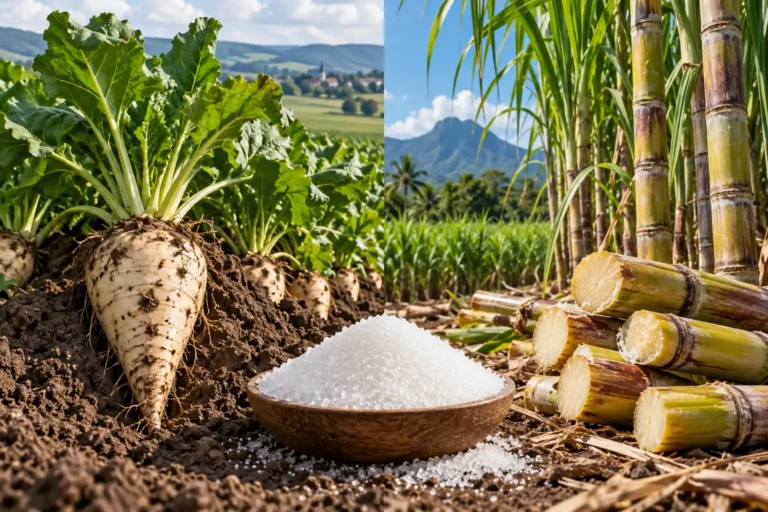
How to Grow Sugar Beets: Planting, Care, Harvest, and Sugar Production

Growing sugar beets requires a long growing season, loose soil, steady moisture, and careful nutrient management. Understanding how to grow sugar beets helps you produce healthy storage roots for sugar extraction, livestock feed, or deer food plots.
Plant sugar beets in full sun when soil temperatures reach at least 40°F. Use well-drained soil, plant seeds about 1 inch deep, maintain consistent moisture, and control weeds early. Allow several months for the roots to develop before harvesting.
What Does a Sugar Beet Plant Look Like?
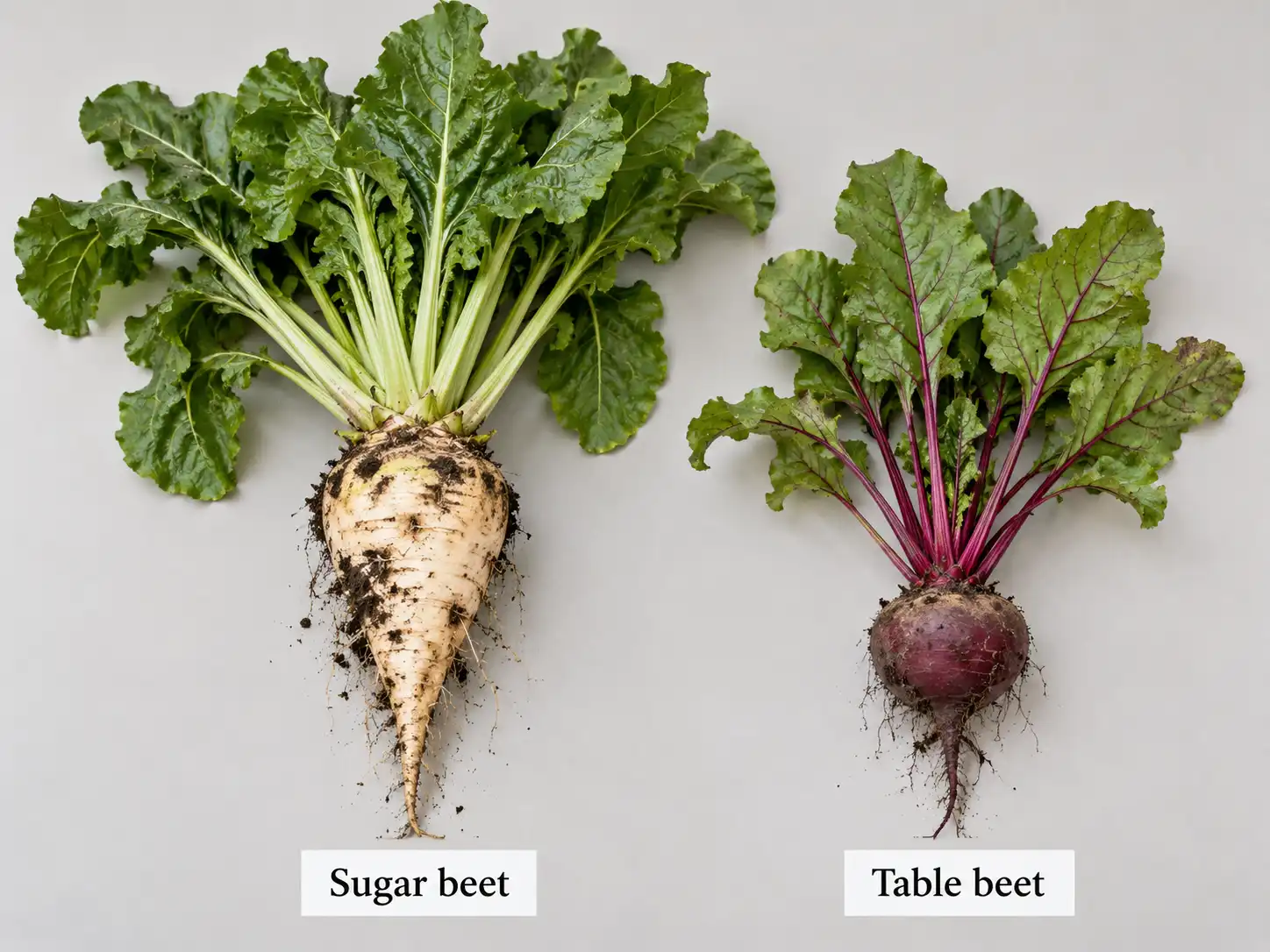
A sugar beet (Beta vulgaris) has broad green leaves growing from a central crown above a large, pale storage root.
Its foliage resembles Swiss chard or ordinary garden beets. However, the mature root usually looks more like an oversized white turnip with a tapered lower section.
The plant has several recognizable features:
- Leaves: Broad, smooth, dark green, and slightly glossy.
- Leaf stems: Thick, fleshy stalks emerging from a central crown.
- Root: Large, cream-colored or white, with a tapered taproot.
- Growth habit: A low-growing rosette during the first season.
- Flowers: A tall flowering stalk may develop during the second growing season.
Sugar beets are biennials but are normally harvested during their first year, before flowering.
The USDA Natural Resources Conservation Service describes these features in its 2026 sugar beet fact sheet.
Sugar Beets vs. Table Beets vs. Fodder Beets
These beet types belong to the same species but are selected for different uses.
| Beet type | Main characteristics | Primary use |
|---|---|---|
| Sugar beet | Large white root with high sucrose concentration | Commercial sugar extraction |
| Table beet | Usually smaller, round, and red or golden | Cooking and fresh consumption |
| Fodder beet | Large storage root selected for forage production | Livestock feeding |
Choose your seed according to its intended use. Ordinary red beet seeds are not substitutes for sugar beet varieties selected for high sugar recovery.
Where Do Sugar Beets Grow Best?
Sugar beets grow best in sunny locations with deep, well-drained soil and a sufficiently long growing season.
Cool nights and moderate daytime temperatures favor sugar accumulation. Prolonged heat, standing water, and compacted soil can reduce root development.
Sunlight, Temperature, and Soil
Aim for these conditions when selecting a field or growing bed.
| Growing factor | Recommended condition |
|---|---|
| Sunlight | Full sun, preferably 6 or more hours daily |
| Soil | Deep, fertile, well-drained loam or sandy loam |
| Soil pH | Approximately 6.0 to 7.5 |
| Minimum germination temperature | Around 40°F |
| Favorable growing temperatures | Approximately 60°F to 80°F |
| Growing season | Usually about 5 to 6 months for a mature processing crop |
Sugar beets tolerate some alkalinity but perform poorly in strongly acidic soil.
The USDA identifies 40°F as a minimum germination temperature. However, germination and emergence are often more dependable in warmer soil.
Avoid compacted ground where roots cannot expand freely. Rocky soil also complicates harvesting and can produce irregular roots.
For poor soil, improve the seedbed before planting rather than relying on fertilizer to compensate for compaction.
When to Plant Sugar Beets in Different U.S. Regions
Spring planting is standard in northern sugar-producing areas. Some warmer and low-desert locations use fall planting.
| Region | General planting window | Main consideration |
|---|---|---|
| Minnesota and North Dakota | April to May | Plant early when field conditions permit |
| Michigan and northern Great Lakes | Early to mid-spring | Finish root development before severe ground freezing |
| Nebraska, Wyoming, and irrigated western regions | Spring | Ensure water is available throughout the growing season |
| California’s Imperial Valley | September to October | Use the relatively mild winter growing season |
| Southeastern deer food plots | Late summer to early fall | Prioritize fall forage rather than maximum processing-root yield |
These are regional starting points, not universal planting dates.
The USDA’s sugar beet growing assessment documents the different northern and Imperial Valley planting cycles.
Before planting, confirm that your expected growing season is long enough for your intended harvest.
How to Plant Sugar Beet Seeds
Direct seeding into a firm, finely prepared seedbed is the usual establishment method.
Sugar beet seedlings are vulnerable to soil crusting and early weed competition. Even seed placement helps prevent uneven stands.
Step 1: Prepare the Seedbed
Remove weeds, large stones, and compacted clods.
Loosen restrictive soil where necessary, but avoid unnecessary repeated tillage that dries or erodes the surface.
Rake the top layer into a fine, level seedbed. The surface should be firm enough to provide good seed-to-soil contact.
If drainage is poor, consider a raised, open-bottom bed.
Step 2: Choose the Correct Seed
Use sugar beet seed selected for your region and intended purpose.
Commercial seed is often precision-sized, pelleted, and treated to support establishment. Some older or unprocessed beet seed types contain multiple embryos and may produce several seedlings.
Check whether your seed is monogerm or multigerm before deciding how much thinning is necessary.
Commercial producers should select varieties approved by their processor and suited to local disease risks.
Do not soak or modify treated seed unless the seed supplier’s instructions permit it.
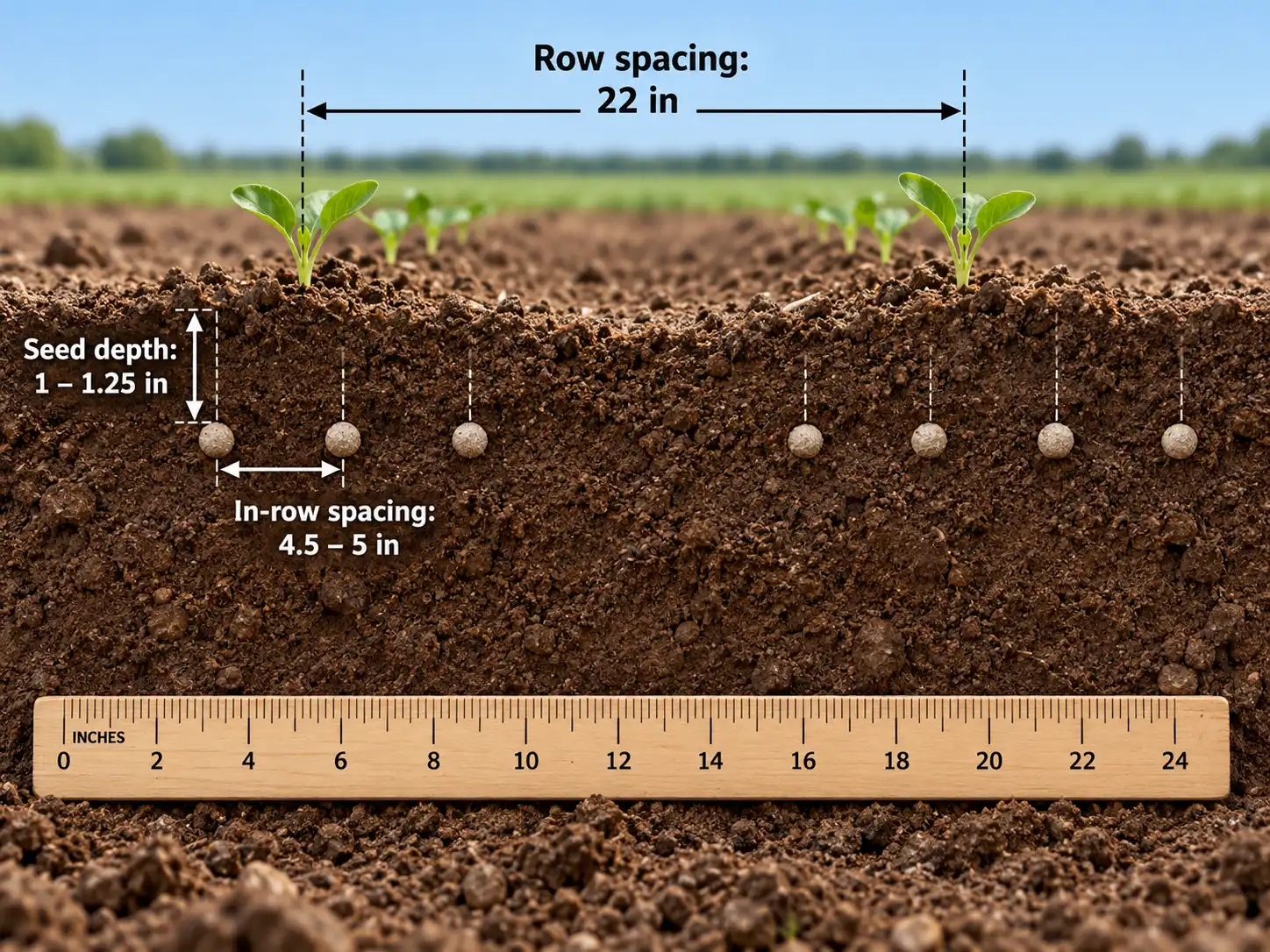
Step 3: Plant at the Correct Depth and Spacing
The 2026 North Dakota State University Sugarbeet Production Guide recommends the following for precision-planted sugar beets in Minnesota and North Dakota:
- Seed depth: 1 to 1.25 inches.
- Seed spacing: 4.5 to 5 inches along the row.
- Row spacing: 22 inches.
Use the shallower end of the depth range during early planting when moisture is adequate.
Cover seeds evenly and firm the soil gently. Water when needed to maintain moisture around the germinating seed.
For small beds, hand planting works. Larger fields benefit from a calibrated precision planter.
How Many Sugar Beet Seeds Do You Need?
Calculate commercial sugar beet planting rates from row width and seed spacing rather than using one universal seed weight.
NDSU’s 2026 guide gives these precision-planting figures for 22-inch rows.
| Spacing between seeds | Approximate seeds per acre |
|---|---|
| 4 inches | 71,280 |
| 4.5 inches | 63,360 |
| 5 inches | 57,024 |
| 6 inches | 47,520 |
These are planted seed counts, not surviving plant populations.
NDSU recommends approximately 175 to 200 surviving plants per 100 feet of row at harvest.
Example: Planting a 4-by-20-Foot Bed
An 80-square-foot bed can accommodate two 20-foot sugar beet rows spaced 22 inches apart.
At 4.5-inch seed spacing:
- Total row length: 40 feet.
- Seed positions: 40 × 12 ÷ 4.5 = approximately 107.
- Target surviving plants: approximately 70 to 80.
Actual establishment depends on germination, soil conditions, and seedling survival.
For larger fields, use:
Seeds per acre = 43,560 ÷ row spacing in feet ÷ seed spacing in feet
This gives approximately 63,360 planting positions per acre using 22-inch rows and 4.5-inch seed spacing.
Wildlife food-plot seeding rates can differ considerably. Do not substitute those bulk seed rates for commercial precision-planter settings.
How to Care for Growing Sugar Beets
Successful sugar beet care focuses on consistent water availability, balanced nitrogen, and early weed control.
The crop initially develops slowly. Later, its expanding leaf canopy captures sunlight and supplies energy for root growth.
Watering and Irrigation
Keep the seed zone moist during establishment, then manage water according to root-zone moisture and crop demand.
According to Nebraska Extension’s 2026 crop water estimates, sugar beets in the Nebraska Panhandle and eastern Wyoming require approximately 25 to 28 inches of total seasonal crop water use.
This is not 25 to 28 inches of irrigation. Rainfall and stored soil moisture supply part of that water.
- During germination, prevent the seedbed from drying or crusting.
- During canopy development, replenish moisture before prolonged stress develops.
- During root bulking, avoid repeated severe dry periods.
- Near harvest, avoid unnecessary heavy irrigation and saturated soil.
For an 80-square-foot bed, 1 inch of water equals approximately 50 gallons distributed across the surface.
Use rainfall measurements, soil moisture checks, and crop water-use calculations to determine how much supplemental irrigation is necessary.
Fertilizing Sugar Beets Without Reducing Sugar Content
Sugar beets need nitrogen for early leaf development, but too much nitrogen late in the season reduces recoverable sugar.
The University of Minnesota Extension’s sugarbeet fertilizer recommendations emphasize adjusting nitrogen applications for soil nitrate levels and growing region.
For the Minn-Dak and American Crystal northern regions, the guideline is 130 pounds of nitrogen per acre from soil nitrate plus applied fertilizer, using a 4-foot soil nitrate test.
For example:
- Regional target: 130 lb N/acre.
- Measured soil nitrate nitrogen: 40 lb N/acre.
- Calculated additional nitrogen: 90 lb N/acre, before any other applicable credits.
If all 90 pounds came from 46-0-0 urea, the calculation would require about 196 pounds of urea per acre.
That equals approximately 5.8 ounces of urea product over 80 square feet.
This is a calculation example, not a universal fertilizer recommendation.
Use your actual laboratory results and regional guidance. Avoid placing concentrated fertilizer directly against germinating seeds.
Apply phosphorus and potassium according to soil testing. Do not apply boron routinely without a confirmed need.
If your results are unfamiliar, start with reading and interpreting a soil test report.
Weed Control and Crop Rotation
Control weeds before emergence and throughout early seedling development.
Young sugar beets compete poorly with rapidly growing weeds. Once the canopy closes, shading helps reduce new weed growth.
For garden beds, use shallow hoeing or careful hand weeding. Avoid disturbing developing roots.
For field production, choose registered herbicides according to beet variety, weed species, crop stage, and label directions.
Glyphosate-tolerant sugar beet varieties do not make glyphosate safe for conventional beets.
Rotate sugar beets with other crops rather than repeatedly planting them in the same soil. Four-year rotations are common in major northern sugar beet production systems.
Include small grains where suitable, and check herbicide carryover restrictions before planting.
Practices that improve soil fertility and structure can also support the crop between rotations.
Sugar Beet Growth Stages: What to Expect
Sugar beets build a leaf canopy before directing substantial growth into their storage roots.
| Growth stage | Approximate timing | Main management priority |
|---|---|---|
| Germination and emergence | First 1 to 3 weeks | Moist seedbed and good emergence |
| Seedling establishment | First 4 to 6 weeks | Weed control and stand protection |
| Canopy expansion | Through roughly 70 to 90 days | Balanced water and nutrient supply |
| Root enlargement | Middle and later growing season | Avoid prolonged stress |
| Sugar accumulation and harvest | Late growing season | Preserve healthy foliage and root quality |
These stages overlap. Temperature, variety, planting date, and moisture affect development.
Do not judge sugar beet maturity by leaf size alone. Strong foliage supports sugar production, but commercial harvest decisions also depend on root size, sugar concentration, weather, and processor schedules.
Common Sugar Beet Growing Problems and Solutions
Uneven germination, poor root growth, and leaf diseases account for several preventable losses.
How to Identify Problems Early
| Problem | Likely cause | What to check or do |
|---|---|---|
| Poor germination | Dry seedbed, crusting, or excessive depth | Check seed depth and surface moisture |
| Yellowing seedlings | Nutrient stress, waterlogging, or disease | Inspect drainage and plant roots |
| Small roots with large tops | Excess nitrogen or overcrowding | Review spacing and fertilizer history |
| Small circular leaf spots | Possible Cercospora leaf spot | Examine symptoms and disease conditions |
| Wilting with decaying roots | Possible Rhizoctonia or Aphanomyces | Check roots, drainage, and field history |
| Missing or damaged seedlings | Cutworms, flea beetles, or other pests | Scout seedlings and identify the pest |
| Flowering during the first season | Premature bolting | Review temperature exposure and variety |
These symptoms are diagnostic clues, not proof of a particular cause.
Preventing Disease and Insect Damage
Cercospora leaf spot is a major concern in humid sugar beet production regions.
It produces small, often circular leaf lesions. Severe infections damage the canopy and reduce the plant’s ability to accumulate sugar.
The NDSU 2026 production guide emphasizes disease-resistant varieties, scouting, crop rotation, and correctly timed fungicide programs when justified.
Rhizoctonia and Aphanomyces can damage roots, particularly where disease pressure and unfavorable soil conditions coincide.
Use good drainage, suitable rotations, clean equipment, and regionally appropriate resistant varieties.
For uncertain symptoms, compare the field observations with common crop disease patterns and seek a diagnosis before applying treatment.
When and How to Harvest Sugar Beets
Harvest sugar beets after substantial root enlargement, while the roots remain sound and field conditions allow safe lifting.
Commercial northern U.S. harvests commonly occur in September and October. Root size alone does not establish maximum recoverable sugar.
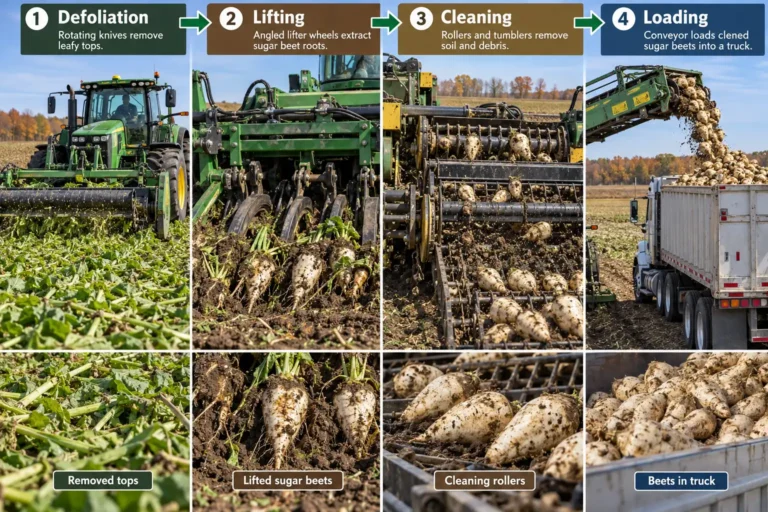
Harvesting Sugar Beets Step by Step
- Check the crop’s root development, disease condition, and intended use.
- Choose a harvest period before the ground freezes deeply.
- Remove or trim the foliage while avoiding unnecessary root damage.
- Loosen soil beside the roots with a digging fork for small plantings.
- Lift the roots carefully without cutting their storage tissues.
- Remove excess soil and separate damaged roots for prompt processing.
Commercial growers use defoliators and specialized lifters to handle larger acreages.
If selling to a sugar processor, follow its topping, cleaning, delivery, and harvest specifications.
How to Store Harvested Sugar Beets
Keep harvested roots cool, protected from excessive drying, and free of unnecessary damage.
Use sound, unbruised roots for longer storage. Damaged or diseased roots deteriorate more quickly.
Sugar beet respiration and storage microorganisms can consume sucrose after harvest.
Commercial storage often uses carefully managed piles and ventilation. A small home harvest is better handled through prompt processing or suitable cold storage rather than an unmanaged outdoor pile.
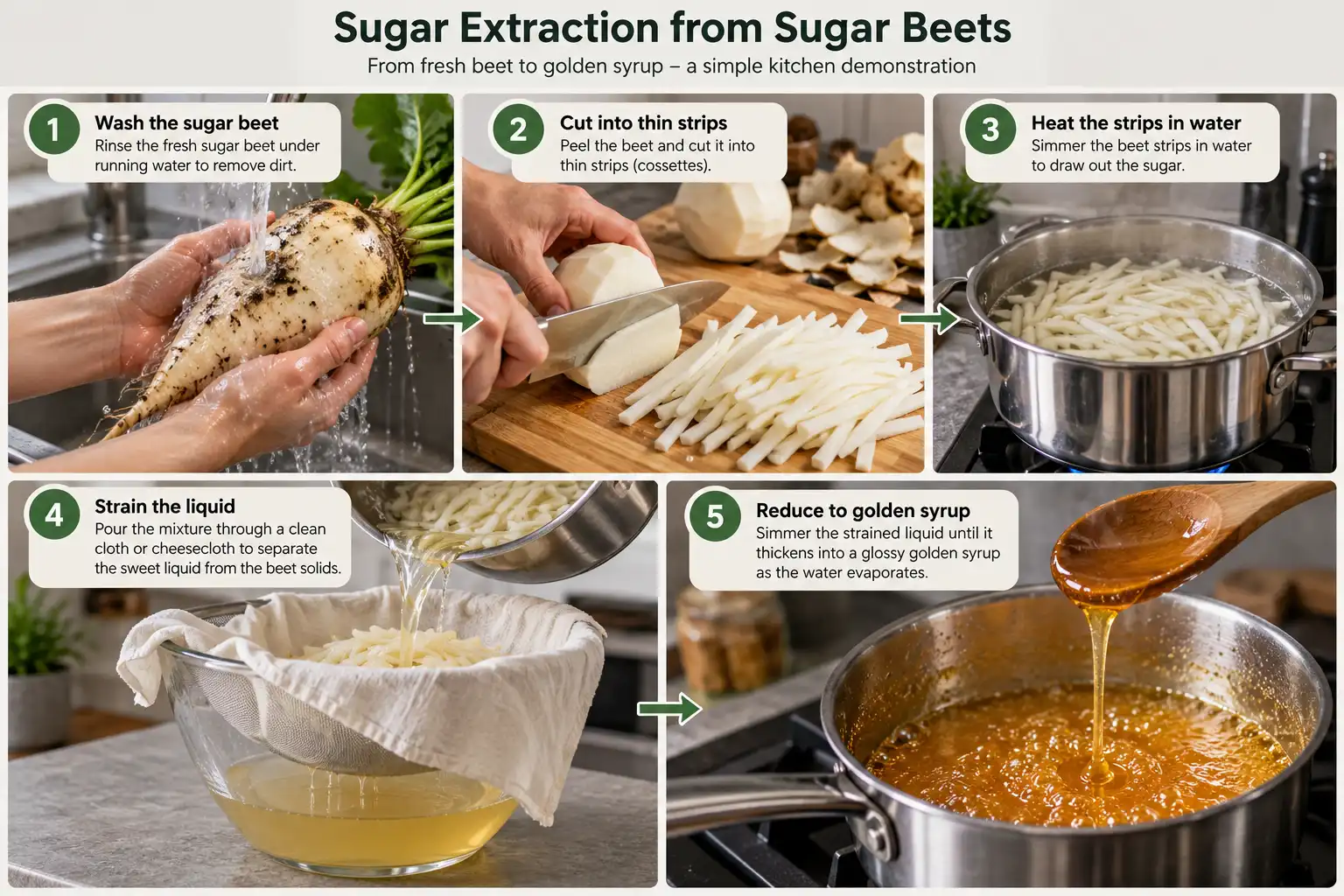
How to Make Sugar From Sugar Beets at Home
Sugar can be extracted from homegrown sugar beets, but producing refined white crystals requires more processing than making beet syrup.
Commercial factories extract sucrose with hot water, purify the juice, concentrate it, and separate crystallized sugar.
The USDA describes these processing stages in its sugar beet processing documentation.
For a home-scale project, sugar beet syrup is the more practical first product.
Step 1: Wash and Prepare the Beets
Select fresh, healthy roots grown for edible use.
Remove leaves, root tips, damaged areas, and visible dirt. Scrub the roots thoroughly.
Peel if needed, then grate or slice them into thin strips. Smaller pieces expose more surface area for sugar extraction.
Step 2: Extract the Sugar With Hot Water
Place the sliced beets in a stainless-steel pot.
Add enough clean water to cover them. Heat gently and simmer until the beet pieces soften and the liquid becomes noticeably sweet.
Strain the mixture through a clean fine sieve or food-safe cloth.
Press the softened pieces carefully to recover additional sweet liquid.
Step 3: Concentrate the Sweet Liquid
Return the strained liquid to a clean pot.
Heat gently to evaporate water. Stir regularly and reduce the heat as the liquid becomes thicker.
Stop when the mixture reaches a usable syrup consistency.
Avoid scorching, which can produce an unpleasant burnt flavor.
The resulting syrup may have a noticeable earthy beet flavor. It is not equivalent to purified granulated sugar.
Refrigerate the finished syrup promptly or freeze portions. Do not treat it as shelf-stable or use untested home-canning methods.
Can You Make White Granulated Sugar at Home?
It is technically possible, but producing clean, dry sugar crystals is much more difficult than making syrup.
Industrial processing removes impurities from beet juice before controlled crystallization. Factories also separate sugar crystals from the remaining molasses using centrifuges.
Simply boiling unpurified beet juice does not reliably produce clean, free-flowing white sugar.
For a small home harvest, syrup is usually a more realistic goal. Treat crystalline sugar production as a separate food-processing project.
How Much Sugar Can Sugar Beets Produce?
Sugar beet roots typically contain around 16% to 18% sucrose by fresh weight, according to USDA Agricultural Research Service research.
The table shows theoretical sugar content using 17% sucrose.
| Fresh beet weight | Sugar naturally present |
|---|---|
| 5 lb | 0.85 lb |
| 10 lb | 1.7 lb |
| 20 lb | 3.4 lb |
| 100 lb | 17 lb |
Actual recoverable sugar will be lower because extraction and purification are not perfectly efficient.
These figures are not expected home syrup yields.
Are Sugar Beets Good for Deer?
Yes. Sugar beets can provide leafy forage and energy-rich storage roots for deer, especially where they establish well and remain available into cooler weather.
The USDA NRCS identifies sugar beets as a forage crop preferred by wildlife in grazing mixtures. However, deer preference varies with available foods, habitat, weather, and browsing pressure.
Sugar beets should supplement, not replace, diverse natural deer habitat.
Growing Sweet Beets for Deer Food Plots
Choose an appropriate wildlife seed variety and follow its planting instructions.
For the southeastern United States, Alabama Cooperative Extension’s deer food-plot guide lists these recommendations:
- Planting period: August 15 to September 30.
- Broadcast seed rate: 8 lb/acre for a single-species planting.
- Preferred site: Fertile, well-drained loam.
These recommendations apply to regional wildlife plots, not northern commercial sugar production.
The USDA NRCS gives separate Iowa cover-crop rates of 3 to 4 lb/acre for drilling and 5 to 6 lb/acre for broadcasting.
Seed type, seed size, pure live seed percentage, planting method, and regional purpose affect these differences. Follow guidance for your actual seed and location instead of averaging rates.
Will Deer Eat Sugar Beet Roots?
Deer may feed on both leaves and accessible roots, although the amount of root consumption varies.
Do not assume every planting will attract deer equally. Nearby agricultural crops, natural forage, snow cover, and local deer numbers influence use.
Early browsing can also prevent a small plot from establishing sufficient leaf area or root mass.
For limited acreage, planting sugar beets with other suitable food-plot species may provide more varied seasonal forage. Check the seed mixture’s actual composition before planting.
Are Sugar Beets Legal for Deer Hunting?
Standing wildlife food plots are treated differently from dumped bait in many states, but hunting regulations vary.
The Minnesota Department of Natural Resources explains that normally grown agricultural crops and wildlife plantings are not considered bait. Placing harvested vegetables or other feed to attract deer can violate baiting rules.
Check your state’s current hunting and wildlife-feeding regulations.
Avoid concentrating wild deer around artificial feeding sites because doing so can increase disease transmission risks.
FAQs About Grow Sugar Beets
Can You Grow Sugar Beets in Raised Beds?
Yes. Sugar beets can grow in raised beds with adequate depth, drainage, and sunlight. Open-bottom beds are preferable when deep soil is available because mature sugar beets develop substantial roots that need room to expand.
Do Sugar Beets Need a Special Variety to Make Sugar?
Use seed identified as a sugar beet variety rather than ordinary table beet seed. Commercial hybrids are selected for sugar recovery, root quality, and disease resistance, while other beet types are bred primarily for eating or forage.
Will Sugar Beets Survive a Light Frost?
Established sugar beet plants can tolerate light frost, but prolonged severe freezing can damage roots and complicate harvest. Do not rely on frost to create sugar content; healthy growth and suitable temperatures matter throughout the season.
Can You Plant Sugar Beets After Corn?
Yes, sugar beets can follow corn when field conditions and rotation restrictions allow. Check residual herbicides, available nitrogen, soil compaction, and root-disease history before planting, because those factors can affect establishment and recoverable sugar.
Can You Harvest Sugar Beet Leaves Without Damaging the Root?
Limited removal of healthy outer leaves is possible, but substantial defoliation reduces the photosynthetic area that supports root growth. If your main goal is sugar production, preserve as much healthy foliage as possible until harvest.
How Many Pounds of Sugar Beets Make One Pound of Sugar?
At 17% sucrose, approximately 5.9 pounds of fresh roots contain one pound of sugar in theory. Actual processing requires more beets because some sucrose remains in pulp, molasses, and other material after extraction.
Key Points for a Successful Sugar Beet Crop
Start with suitable seed, a soil test, a long enough growing season, and a firm, moist seedbed. Give seedlings room to establish, protect the canopy, and avoid excessive late nitrogen. Match harvest and processing plans to your goal, whether that is refined sugar production, homemade syrup, or wildlife forage.