When to Plant Sugar Beets for Deer: Best Timing by Region
Knowing when to plant sugar beets for deer starts with deciding whether you want large storage roots or fall foliage. Northern and southern food plots follow different calendars because sugar beets need time to establish leaves before producing substantial roots.
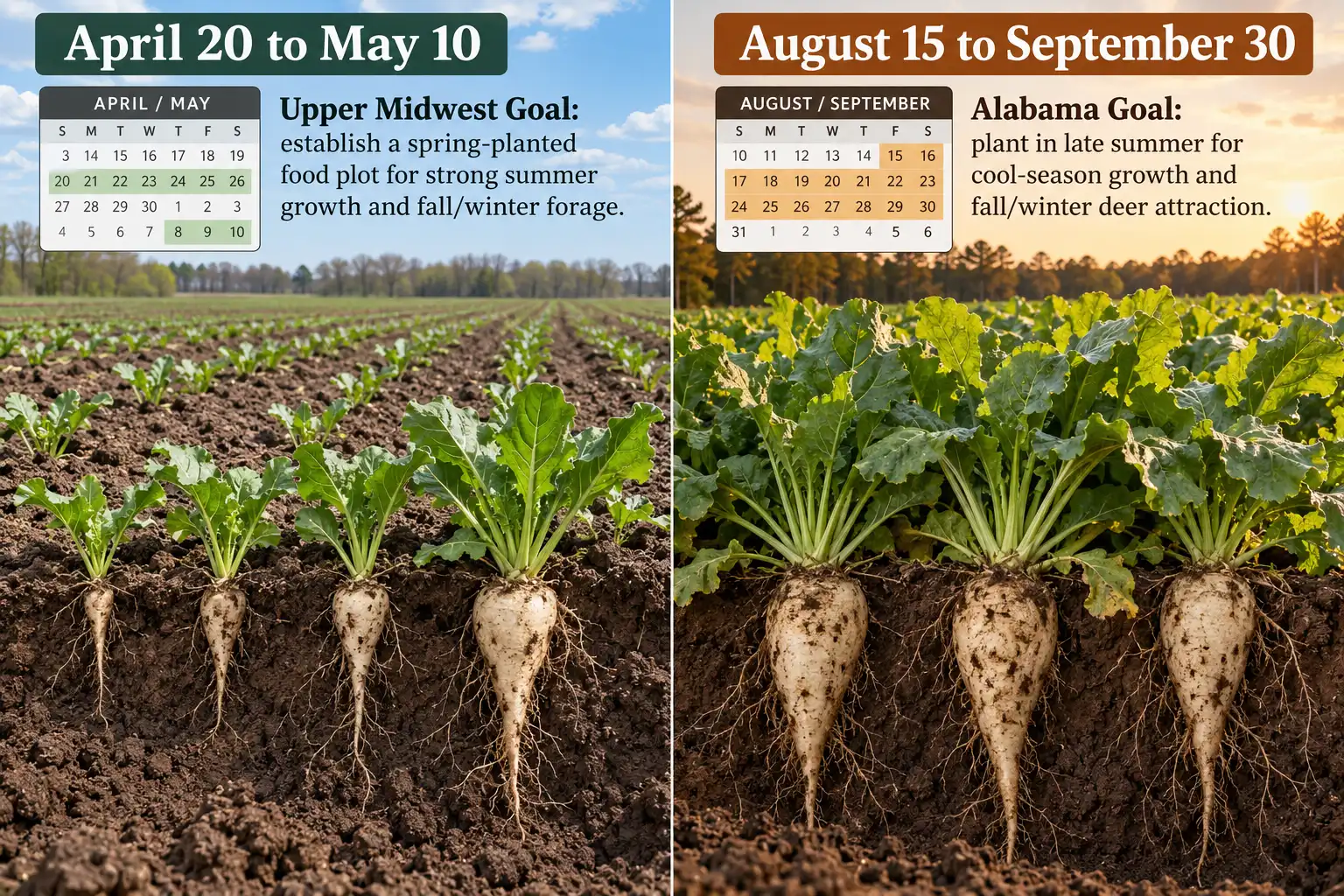
When to plant sugar beets for deer depends on your growing region and goal. Spring planting favors larger roots in northern climates, while Alabama recommends August 15 through September 30 for fall food plots, where foliage may develop before large roots.
When to Plant Sugar Beets for Deer by Region
Spring is generally the better planting season for producing large sugar beet roots in northern states. Late summer can work for fall forage in parts of the Southeast.
The University of Wisconsin-Madison’s sugar beet production guide identifies April 20 through May 10 as the preferred commercial planting period for Minnesota, North Dakota, and Wisconsin.
In contrast, Alabama Cooperative Extension recommends August 15 through September 30 for sugar beets planted as cool-season deer forage.
These recommendations address different climates and growing objectives.
| Growing region | Recommended planting period | Main consideration |
|---|---|---|
| Upper Midwest: MN, ND, WI | April 20 to May 10 | Early establishment supports larger fall roots |
| Great Lakes and Northeast | Spring, once soil is workable and warming | Exact dates depend on local conditions |
| Central Midwest and transition states | Spring for substantial roots | Late sowing reduces the root-growing season |
| Alabama and similar southeastern climates | August 15 to September 30 in Alabama | Fall establishment and leafy forage |
| Mild-winter coastal regions | Site-specific fall or cool-season window | Avoid excessive heat and check local guidance |
The dates are planning references, not guarantees. Frost timing, elevation, rainfall, and soil conditions vary substantially within each region.
For reliable scheduling, use local freeze records and planting recommendations from your county Extension service.
How Long Before Fall Should You Plant Sugar Beets?
Sugar beets need considerably longer to produce substantial storage roots than to establish their first leaves.
The University of Wisconsin’s sugar beet guide reports that canopy closure normally takes approximately 70 to 90 days after planting. Root expansion and sugar accumulation continue as the plant grows.
This creates two planting objectives:
- Large fall roots: Favor a spring planting that provides several months of growing time.
- Fall leafy forage: In suitable southern climates, a later planting can produce useful foliage without reaching full root development.
For example, consider a location with an expected hard freeze around October 15.
A June 15 planting has approximately 122 days before that date. An August 15 planting has only 61 days.
The second planting has far less time to build roots.
For southern fall plots, Alabama Extension generally advises establishing cool-season crops at least 45 days before the first frost. That is an establishment guideline, not a promise of mature sugar beet roots.
The NOAA National Weather Service frost and freeze information also distinguishes a 32°F freeze from a harder freeze near 28°F.
Use local hard-freeze dates when evaluating how long your beet crop can continue growing.
What Soil Temperature Is Best for Planting Sugar Beets?
Aim for soil near 50°F or warmer when planting sugar beets, especially when rapid, uniform emergence matters.
Sugar beets can tolerate cool conditions, but cold, saturated soil slows establishment.
NDSU Extension’s planting guidance for beets favors approximately 50°F soil. It recommends measuring temperature around 2 inches deep for three consecutive days and using the average.
Before sowing:
- Check soil temperature rather than relying solely on air temperature.
- Confirm the soil crumbles instead of forming a wet, sticky mass.
- Look for adequate moisture without standing water.
- Avoid planting immediately before prolonged cold rain.
Sugar beet seedlings can survive some light frosts. The Wisconsin production guide reports survival during temperatures in the mid-20s°F under favorable conditions.
However, frost tolerance does not eliminate the risk of stand damage.
How to Plant Sugar Beets for a Deer Food Plot
Direct seeding into a firm, relatively weed-free seedbed offers a practical way to establish sugar beets.
1. Prepare the planting area
Choose an open location receiving plenty of sunlight.
Remove competing vegetation before planting. Work the surface enough to create a level seedbed without excessive tillage.
Avoid low spots where water collects after heavy rainfall.
2. Plant at the recommended depth
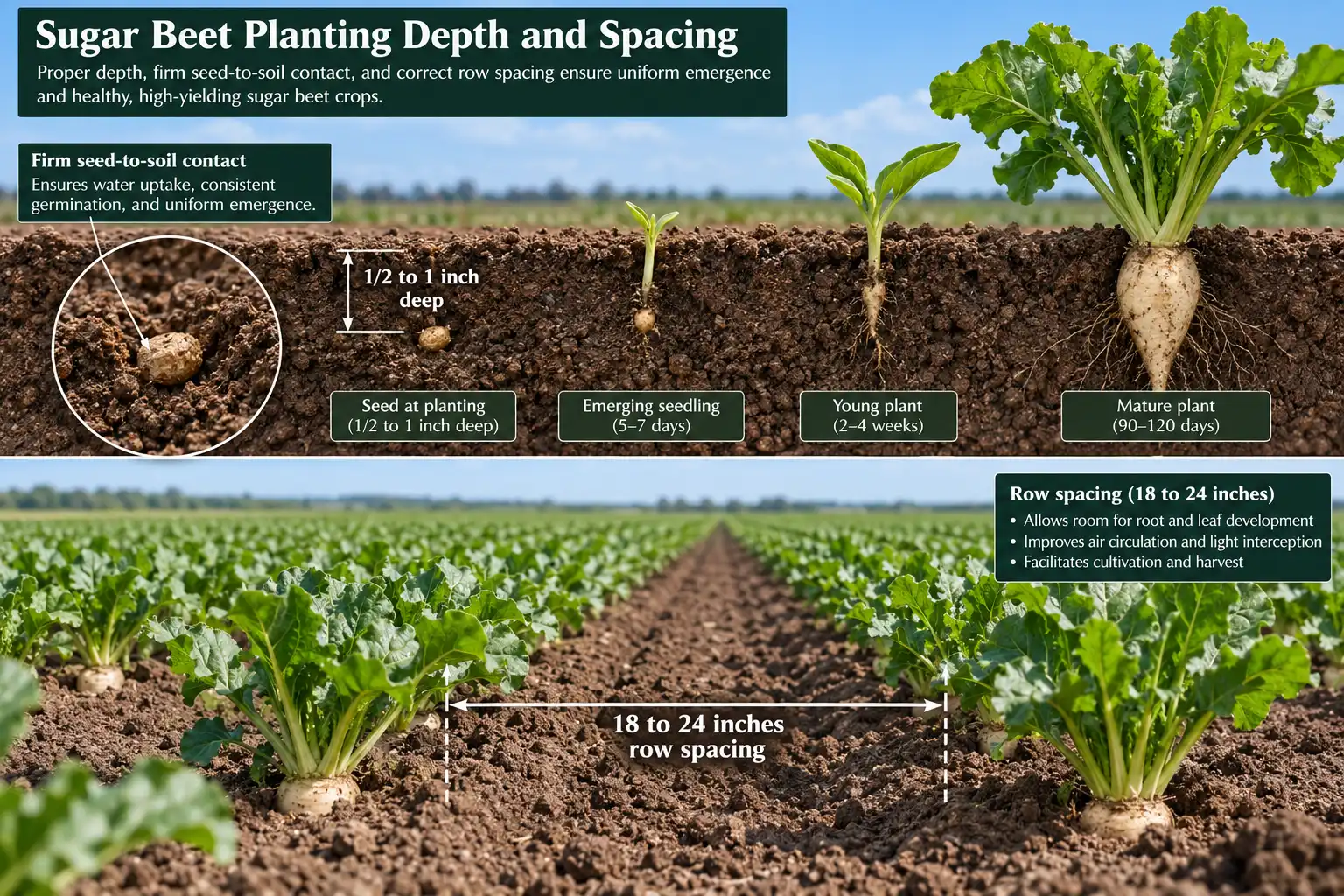
Deer Creek Seed, a DLF brand, recommends 1/2 to 1 inch deep for its sugar beet food-plot seed.
The Wisconsin commercial production guide allows approximately 3/4 to 1 1/2 inches.
Follow the depth instructions for your particular seed. Avoid unnecessarily deep planting, especially in crust-prone soils.
3. Give plants enough space
For row planting, Wisconsin’s production guidance favors rows approximately 18 to 24 inches apart.
In 22-inch rows, keeping surviving plants roughly 7 to 10 inches apart corresponds to approximately 29,000 to 41,000 plants per acre.
Thin crowded stands where necessary.
4. Maintain seed-to-soil contact
If broadcasting, distribute seed uniformly, cover it to the recommended depth, and firm the seedbed with a cultipacker or similar equipment.
Keep the seed zone moist during emergence. Check early for crusting, weeds, or uneven stands.
How Much Sugar Beet Seed Do You Need Per Acre?
Broadcast food-plot seeding rates differ from commercial precision planting rates.
Alabama Extension recommends 8 pounds of pure live sugar beet seed per acre when broadcasting a single-species cool-season plot.
Deer Creek Seed separately lists 7 to 9 pounds per acre for its standalone food-plot seed and 4 to 5 pounds per acre in mixes.
Seed size, coating, purity, and planting method affect the amount required.
Seed Requirements for Different Plot Sizes
Using Alabama Extension’s broadcast recommendation:
| Food plot area | Pure live seed required | Bagged seed at 80% PLS |
|---|---|---|
| 1/4 acre | 2 lb | 2.5 lb |
| 1/2 acre | 4 lb | 5 lb |
| 1 acre | 8 lb | 10 lb |
PLS means pure live seed. It accounts for seed purity and germination.
Seed calculation:
Required bag weight = (plot acres × recommended PLS rate) ÷ PLS fraction
For a quarter-acre plot with seed rated at 80% PLS:
0.25 × 8 ÷ 0.80 = 2.5 pounds of bagged seed
Commercial precision planters may use considerably lower seed weights. The Wisconsin guide describes 1 to 2 pounds per acre for that system.
Do not substitute that precision-planting rate for a broadcast food-plot recommendation.
Soil, Fertilizer, and Moisture Requirements
Sugar beets perform best in fertile, well-drained soil with enough moisture to support steady growth.
The University of Wisconsin identifies a suitable soil pH range of 6.0 to 8.0. A near-neutral pH of approximately 6.5 to 7.0 is a useful food-plot target.
Test the soil before applying lime or fertilizer.
A soil test report helps identify pH problems and determine the required nitrogen, phosphorus, and potassium applications.
Avoid excessive nitrogen. It can encourage leaf production while reducing sugar concentration in the roots.
If your plot has weak soil structure or low organic matter, consider methods for improving soil fertility alongside soil-test recommendations.
How Much Water Do Sugar Beets Need?
Maintain moisture around newly planted seed without saturating the seedbed.
Once established, sugar beets develop substantial root systems. However, drought can still reduce growth and root development.
Check soil moisture during extended dry periods and irrigate when necessary. Avoid applying water faster than the soil can absorb it.
For larger plots, calculating crop water needs can help you plan irrigation around rainfall, weather, and growing conditions.
When Do Deer Start Eating Sugar Beets?
Deer can browse sugar beet leaves during active growth and may begin feeding on exposed or accessible roots later in the season.
Deer Creek Seed describes sugar beets as dual-purpose forage. The foliage provides green feed, while the storage roots offer a carbohydrate-rich food source.
Cooler weather can improve their late-season appeal. However, frost is not required before deer will eat them.
Food availability also affects feeding behavior.
University of Missouri Extension’s deer habitat guidance explains that deer select different foods as seasons, nutrient requirements, and available vegetation change.
Therefore, a sugar beet plot should supplement diverse natural forage rather than replace it.
Will Deer Dig Up the Roots?
Deer may expose or pull sugar beet roots while feeding, particularly when the roots are accessible near the surface.
However, deer use varies between properties.
Frozen ground, surrounding food sources, browsing pressure, and the maturity of the crop can influence whether deer consume the roots.
A food plot full of sugar beets does not guarantee heavy deer activity.
What if You Miss the Ideal Sugar Beet Planting Window?
A late planting may still produce some green forage, but its ability to form large roots decreases as the growing season shortens.
In northern regions, an August planting is generally a poor choice if substantial roots are the goal.
For a late-summer northern food plot, consider faster-establishing alternatives such as oats, winter wheat, or turnips.
Missouri Extension lists August through September as a planting period for these cool-season forage crops.
Turnips belong to the brassica family, while true sugar beets belong to Beta vulgaris. Their root development and management requirements are not identical.
In Alabama, September remains within the recommended sugar beet planting window. However, planting near the end of September may reduce establishment time before cooler weather.
If you have missed the suitable growing window, planting a crop better matched to the remaining season is usually more productive than forcing a late sugar beet planting.
Common Sugar Beet Food Plot Problems and Fixes
Poor establishment, competition, and unsuitable soil can prevent sugar beet plots from producing the expected foliage and roots.
| Problem | Possible cause | What to check or change |
|---|---|---|
| Few seedlings emerge | Cold soil, crusting, dry seedbed, or excessive planting depth | Check soil temperature, seed placement, and moisture |
| Large leaves but small roots | Late planting, crowding, or excess nitrogen | Review sowing date, spacing, and soil-test results |
| Yellowing or dying seedlings | Saturated soil, nutrient stress, or disease | Inspect drainage and damaged roots; seek a diagnosis if needed |
| Patchy stands with many weeds | Poor seedbed preparation or early competition | Control vegetation before planting and improve seedbed uniformity |
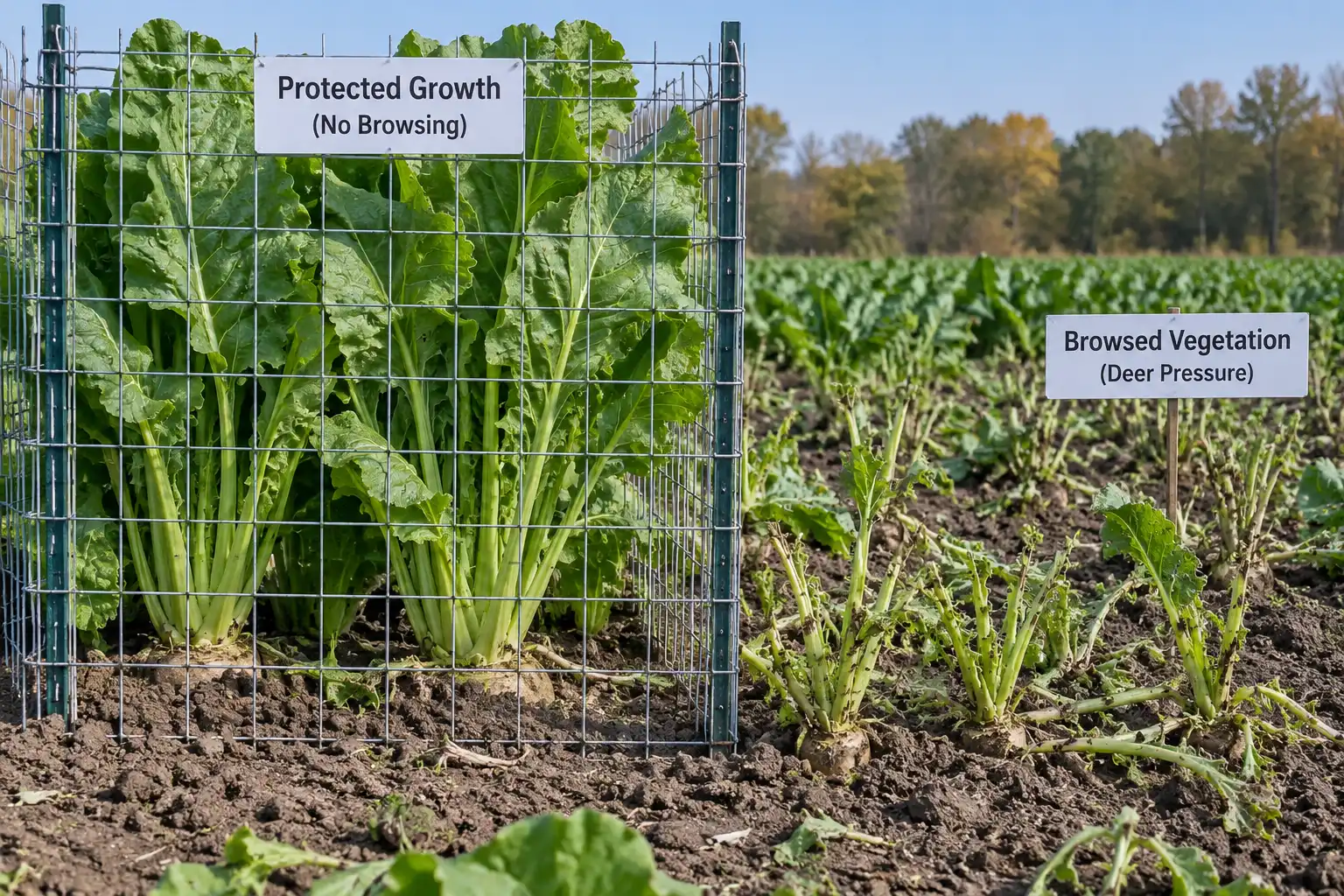
| Plants remain extremely short | Heavy deer browsing or poor growing conditions | Compare growth inside and outside an exclusion cage |
An exclusion cage is particularly useful when determining whether deer are limiting growth.
Missouri Extension recommends comparing protected vegetation with surrounding plants to assess browsing pressure.
Do not automatically assume that poor growth means the crop needs more fertilizer.
FAQs About Plant Sugar Beets for Deer
Is July too late to plant sugar beets for deer in the North?
July is generally late when your goal is substantial fall roots because canopy development alone can take 70 to 90 days. You may still establish foliage, but spring planting provides much more time for root growth.
Do sugar beets need a frost before deer eat them?
No, deer can browse sugar beet foliage before frost arrives. Cooler weather may increase the appeal of the roots later in the season, but freezing temperatures are not necessary for deer to begin feeding.
Can you plant sugar beets without a seed drill?
Yes, you can broadcast sugar beet seed into a prepared, firm seedbed and cover it according to the seed label. Use the appropriate broadcast rate, ensure soil contact, and maintain moisture during germination.
Will sugar beets return the following year?
Do not rely on sugar beets returning reliably. They are biennial plants, but northern winters may kill their roots, while surviving plants can flower during the second year instead of producing another substantial storage root.
Can you plant sugar beets and turnips together?
Yes, but verify the seed mixture and follow planting instructions for each species. Sugar beets and turnips can differ in seeding depth, rate, and development time, so separate strips may simplify establishment and weed management.
Can sugar beets grow in a shaded deer food plot?
Sugar beets may survive some partial shade, but reduced sunlight limits their potential for strong foliage and root development. Choose an open location whenever possible, or consider a more shade-tolerant forage for wooded plots.
Choose the Right Planting Time for Your Deer Plot
For large sugar beet roots, favor early spring establishment in northern climates. For fall forage in the Southeast, follow regional Extension planting windows and allow enough growing time before frost.
Check soil temperature, test fertility, and calculate seed requirements before planting. Start with a manageable plot if local deer use is uncertain.