
How Long Does Wheat Last in Storage? Bin, Pantry, and Seed Timelines
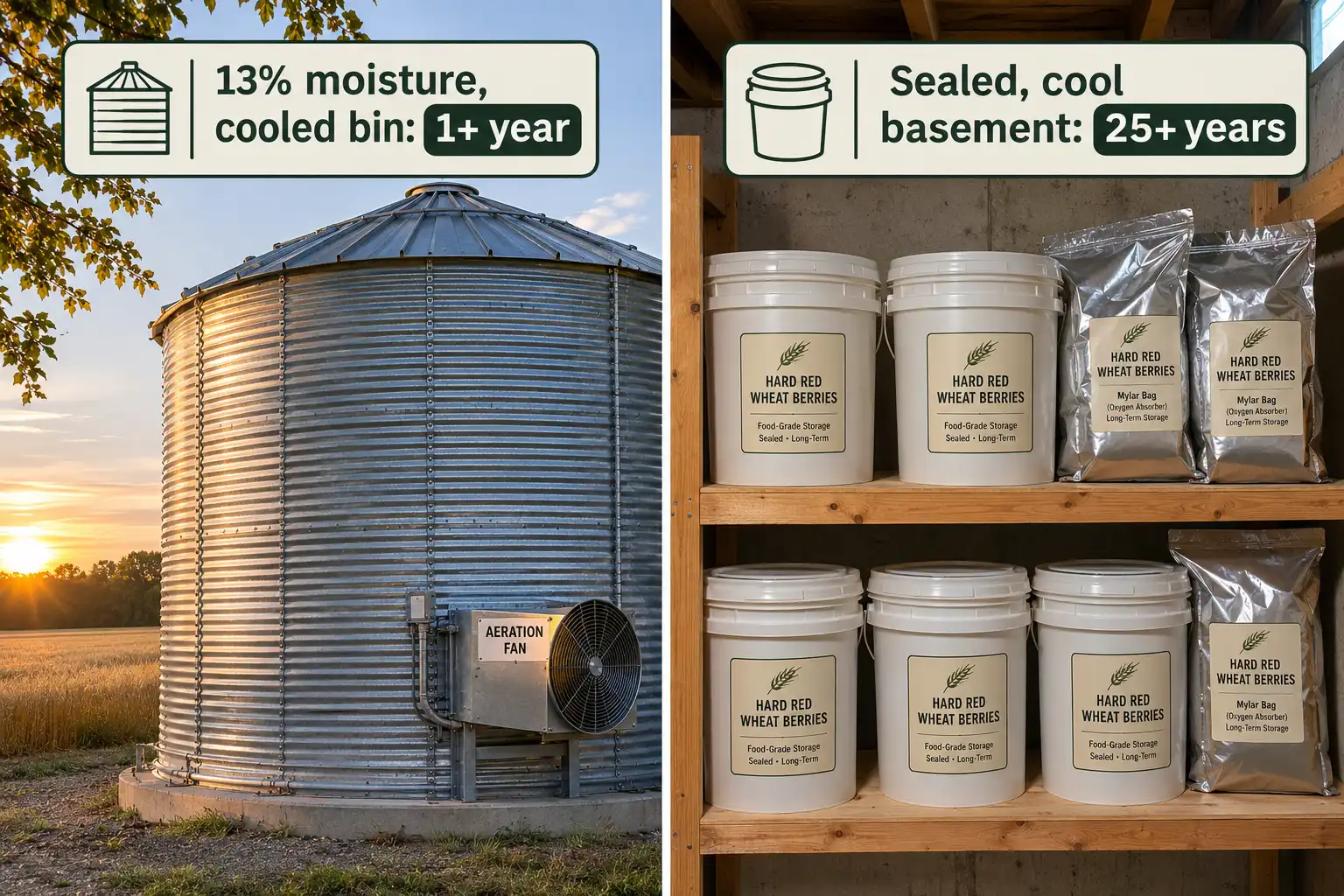
Wheat keeps longer than most stored crops, but only when it goes in dry and stays cool. This guide covers how long wheat lasts in storage for three jobs: grain in a farm bin, wheat berries in a pantry, and wheat saved for seed.
How long wheat lasts in storage comes down to moisture and heat. At 13 percent moisture in a cooled bin, it keeps a year or more. Sealed in food-grade containers below 60°F, it stays usable for decades.
How Long Wheat Lasts by Storage Setting
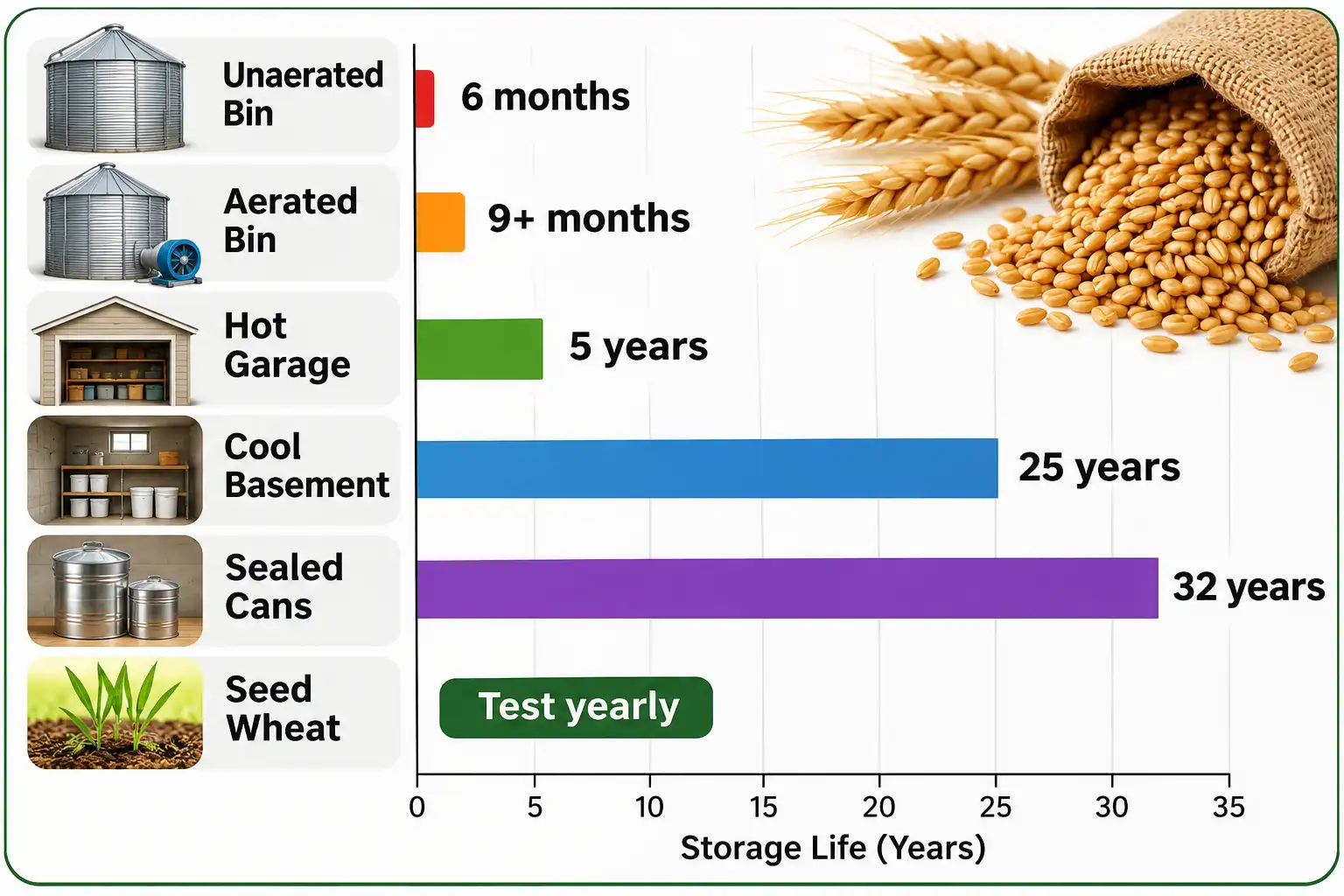
Wheat lasts anywhere from a few weeks to more than 30 years, depending on where it sits and how dry it went in. The table below pulls the published figures into one place.
| Storage setting | Moisture target | Expected storage life | Source |
|---|---|---|---|
| Aerated bin, cooled for winter | 13% or less | More than 9 months | University of Minnesota Extension |
| Bin with no aeration | 10 to 11%, plus a grain protectant | No more than 6 months | K-State Research and Extension |
| Sealed containers, cool basement | 12% or less | About 25 years | Utah State University Extension |
| Sealed containers, hot garage or attic | 12% or less | About 5 years | Utah State University Extension |
| No. 10 cans, room temperature or cooler | Dry, sealed | 32 years, still made acceptable bread | Utah State University Extension |
| Seed wheat held over a season | As dry and cool as practical | Germination declines; test before planting | Ohio State University Extension |
These figures do not conflict. Each one measures a different kind of failure.
Bin figures track when mold starts cutting grain grade. Pantry figures track when bread stops tasting acceptable. Seed figures track germination, which fades first.
Moisture and Temperature Set the Clock
Moisture and grain temperature decide almost everything about storage life. Insects and mold both need warmth and water, so taking away either one slows them down.
NDSU Extension puts the peak for insect and mold growth at about 80°F. Insect reproduction slows below about 70°F, and insects go dormant below about 50°F.
Mold follows a similar pattern. According to NDSU, every 10°F of cooling roughly doubles allowable storage time. Every 10°F of warming cuts it about in half.
K-State Research and Extension covers the moisture side. At 12 percent moisture or less, insects have a harder time developing. Mold growth slows below 14 percent.
That gives you two levers:
- Dry the grain to the target moisture before or right after binning.
- Cool the grain with aeration as soon as outdoor air allows.
Pulling both levers works far better than pulling one. For example, NDSU gives wheat at 14 percent moisture and 80°F about 140 days. Cool that same wheat to 60°F, and it gets more than 300.
What Moisture Should Wheat Be for Storage?
Store wheat at 12 to 14 percent moisture, and go drier for longer or warmer storage. Extension services land on slightly different targets because they assume different storage lengths and conditions.
- University of Minnesota Extension: 14 percent or less for under six months, and 13 percent or less beyond nine months.
- NDSU Extension: 13.5 percent for long-term storage, close to the 13.3 percent equilibrium moisture of hard red spring wheat at 70°F and 60 percent relative humidity. Its 2026 spring guidance calls for 13 percent ahead of summer.
- K-State Research and Extension: 12 percent or less to hold back insects, and 10 to 11 percent in bins without aeration.
- Utah State University Extension: 12 percent or less for home food storage.
The spread reflects risk, not disagreement. A cooled northern bin emptied by spring can carry more moisture than wheat sitting through a Kansas summer or in a pantry for years.
So use a simple rule. Choose 13 percent for bin wheat held past spring. Choose 12 percent for unaerated bins and home storage.
Accurate readings matter just as much. NDSU advises warming a sample to room temperature in a sealed bag first, since cold grain can read 1 to 1.5 points off. If you are choosing a meter, the features that matter are covered in our grain moisture tester comparison.
Allowable Storage Time Chart for Wheat
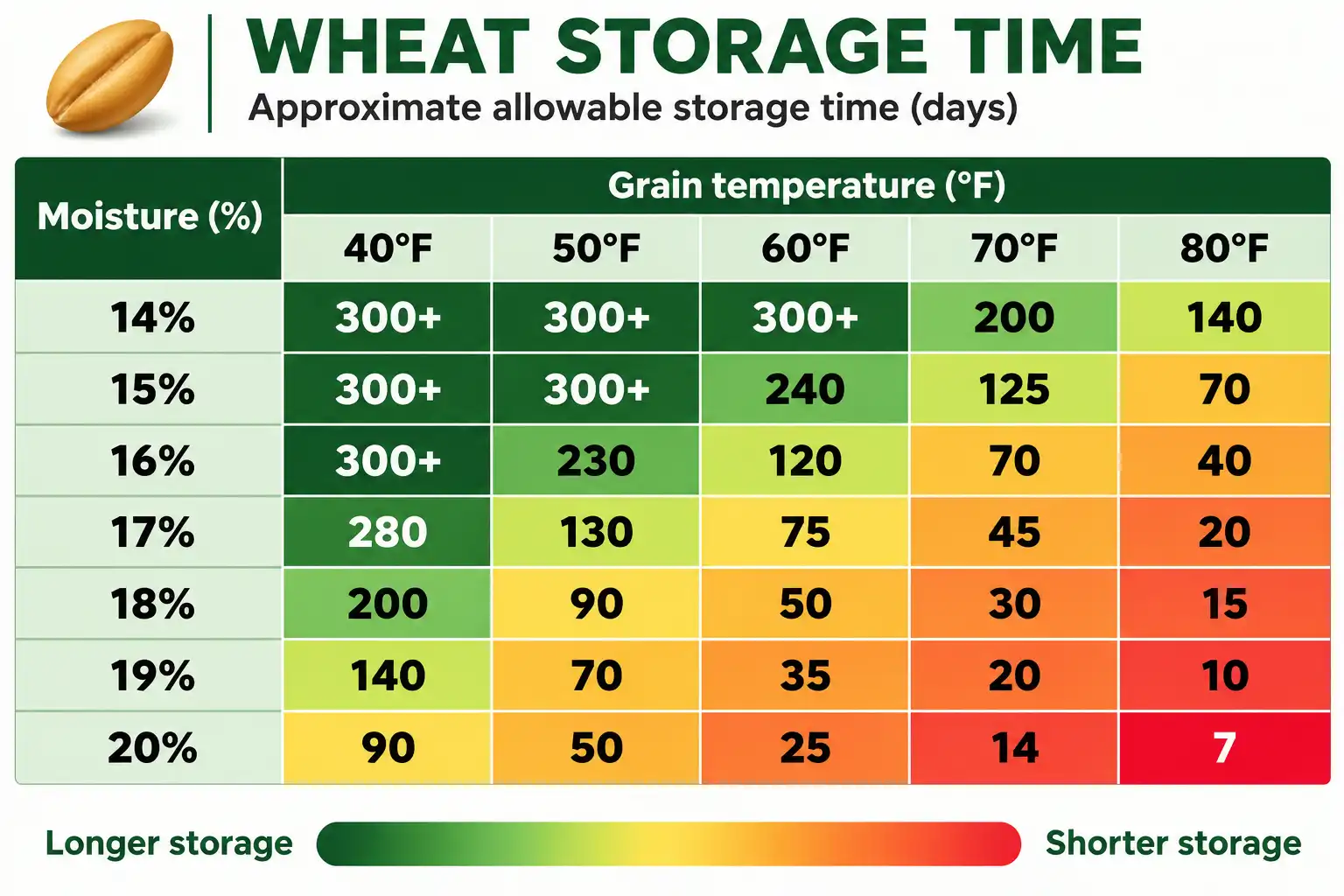
NDSU Extension publishes allowable storage time (AST) for cereal grains, including wheat. AST is the number of days before quality loss starts to affect grain grade.
| Moisture | 40°F | 50°F | 60°F | 70°F | 80°F |
|---|---|---|---|---|---|
| 14% | 300+ | 300+ | 300+ | 200 | 140 |
| 15% | 300+ | 300+ | 240 | 125 | 70 |
| 16% | 300+ | 230 | 120 | 70 | 40 |
| 17% | 280 | 130 | 75 | 45 | 20 |
| 18% | 200 | 90 | 50 | 30 | 15 |
| 20% | 90 | 50 | 25 | 14 | 7 |
Values are approximate days. Source: NDSU Extension.
Keep three NDSU caveats in mind when you read it:
- Aeration holds grain temperature, but it does not add days beyond the chart.
- The days are cumulative across the whole storage period.
- Storage time based on germination runs about half as long, which matters for seed wheat.
The chart also shows why extension targets cluster near 13 percent. Wheat drier than 14 percent sits beyond the chart entirely at 60°F and below.
Why Storage Time Adds Up: A Worked Example
Allowable storage time is cumulative, per NDSU Extension. Warm days use up storage life that later cooling cannot give back.
Here is the method. For each period, divide the days held by the AST for that moisture and temperature. Then add the results. When the total reaches 1.0, expect quality loss.
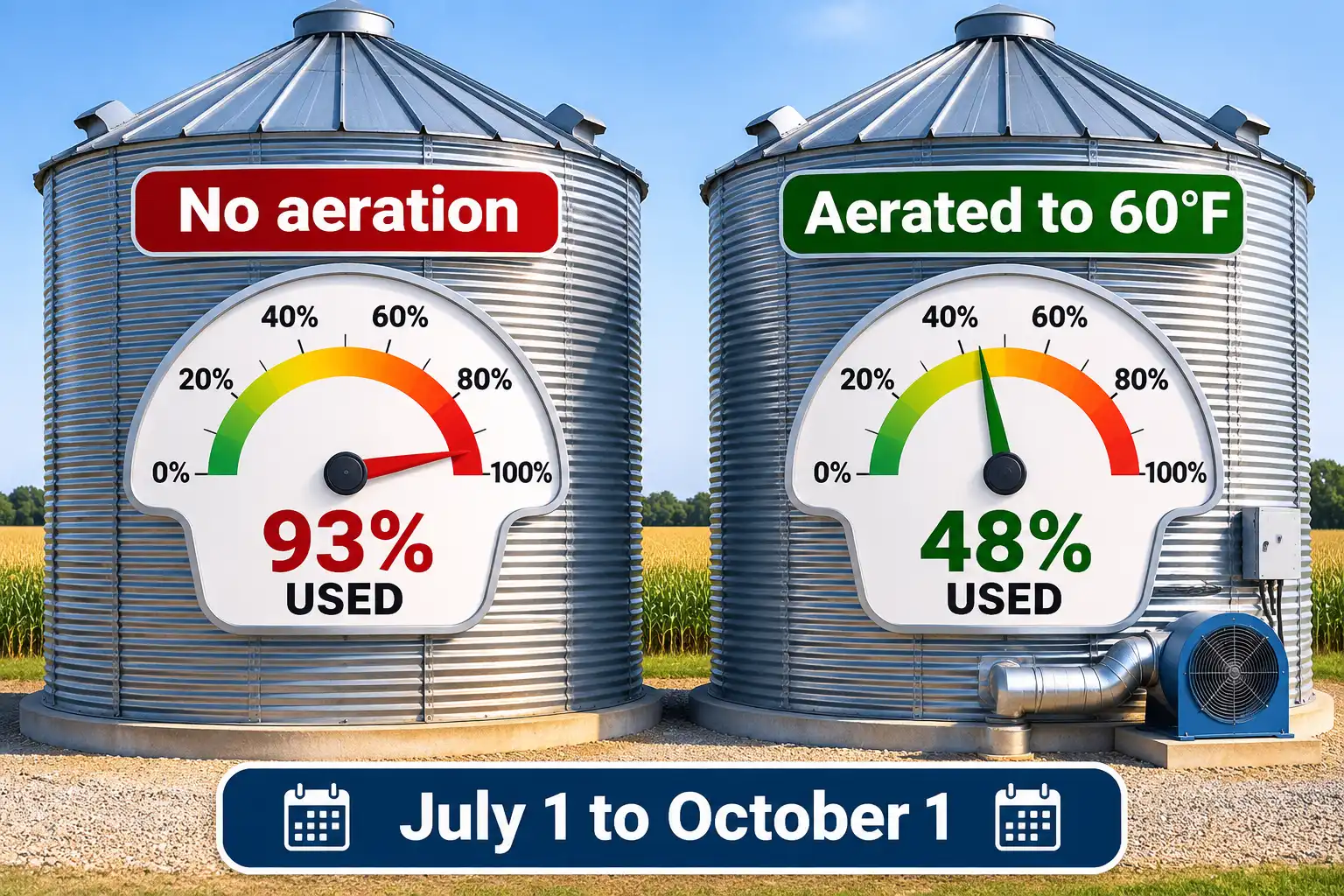
Take 15 percent wheat binned July 1 and held to October 1, about 92 days.
Bin A, no aeration. The grain stays near 80°F for 30 days, then 70°F for 62 days.
- 30 ÷ 70 = 0.43
- 62 ÷ 125 = 0.50
- Total: 0.93, so about 93 percent of storage life is gone by October.
Bin B, aerated. Fans pull the grain down to 60°F within 10 days.
- 10 ÷ 70 = 0.14
- 82 ÷ 240 = 0.34
- Total: 0.48, so more than half of its storage life remains.
Same wheat, same moisture, same dates. The only difference is how fast the grain cooled. That is why cooling belongs at the top of the list once wheat goes in the bin.
How to Keep Bin-Stored Wheat in Condition
Prepare the Bin Before Harvest
- Clean bins and equipment three to four weeks before harvest. University of Minnesota Extension sets that timeline. K-State names leftover grain in and around the bin as the main source of insects that invade new grain.
- Apply bin sprays after the cleanout. K-State times wall and floor treatments three to four weeks before binning, once all old grain and sweepings are gone.
- Never add new wheat to old grain. K-State warns that a low-level infestation in old grain is easy to miss, and it spreads into the new crop.
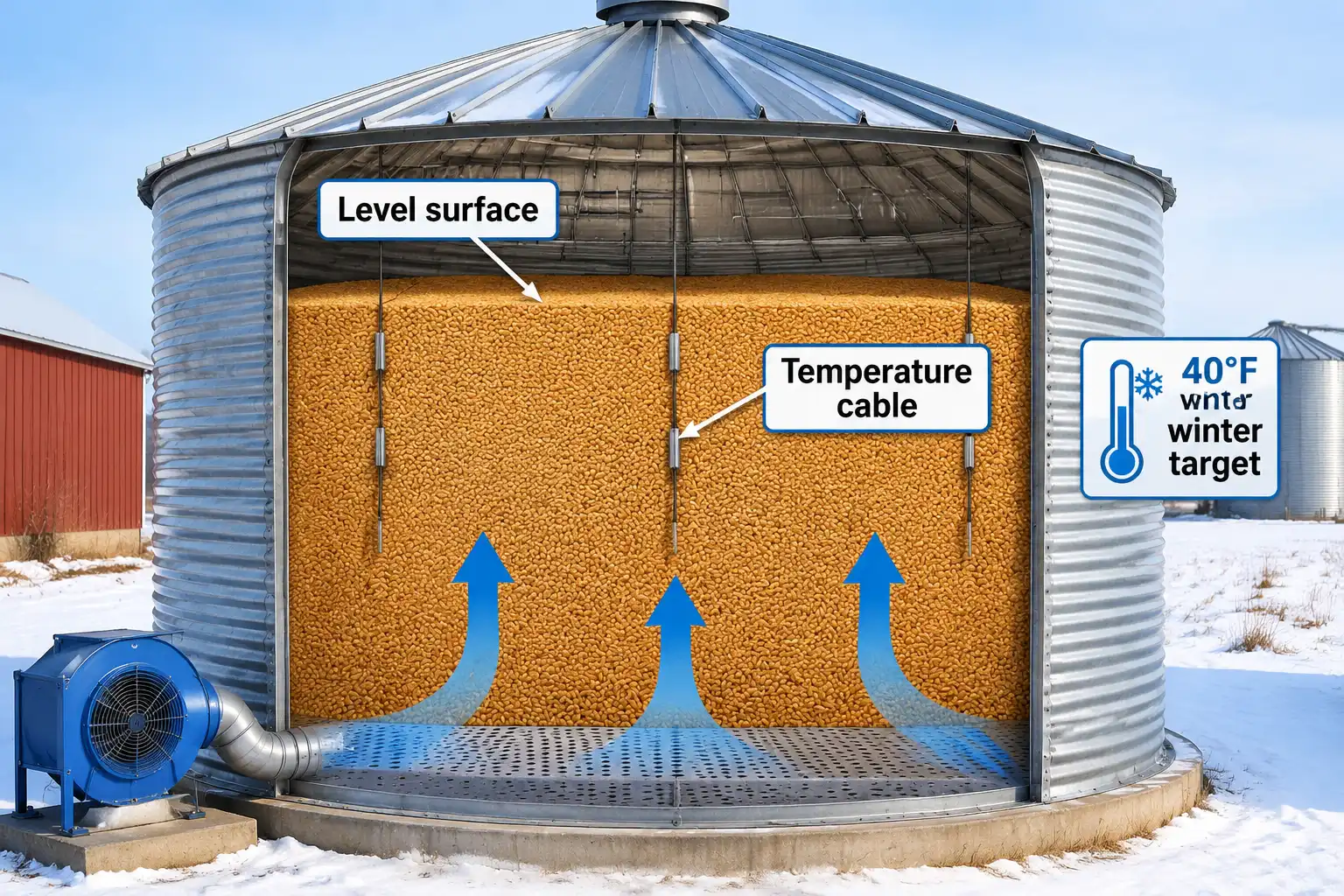
- Level the grain surface. Peaked grain cools poorly and is hard to probe. It also breeds insects and mold, per K-State.
Cool It, Then Check It
Cool wheat in steps as fall arrives. K-State recommends dropping grain temperature 10 to 15°F at a time until it reaches 40°F, then holding it there through winter. In contrast, NDSU Extension goes colder for northern bins, at 20 to 30°F, and keeps 40°F or cooler for southern states.
Plan fan time with a rule of thumb from University of Minnesota Extension: cooling hours equal 15 divided by airflow in cubic feet per minute per bushel (cfm/bu). For example, a 5,000-bushel bin with a 500 cfm fan runs 0.1 cfm/bu. One cooling cycle then takes about 150 hours.
Run fans when outside air is within 20°F of grain temperature, per K-State. Still, meaningful cooling needs air at least 10°F below the grain.
Check often. Minnesota suggests monthly checks in cold weather and every two weeks in warm weather. K-State also calls for twice-monthly checks through summer and early fall.
Moisture Migration and the Crusted Top Layer
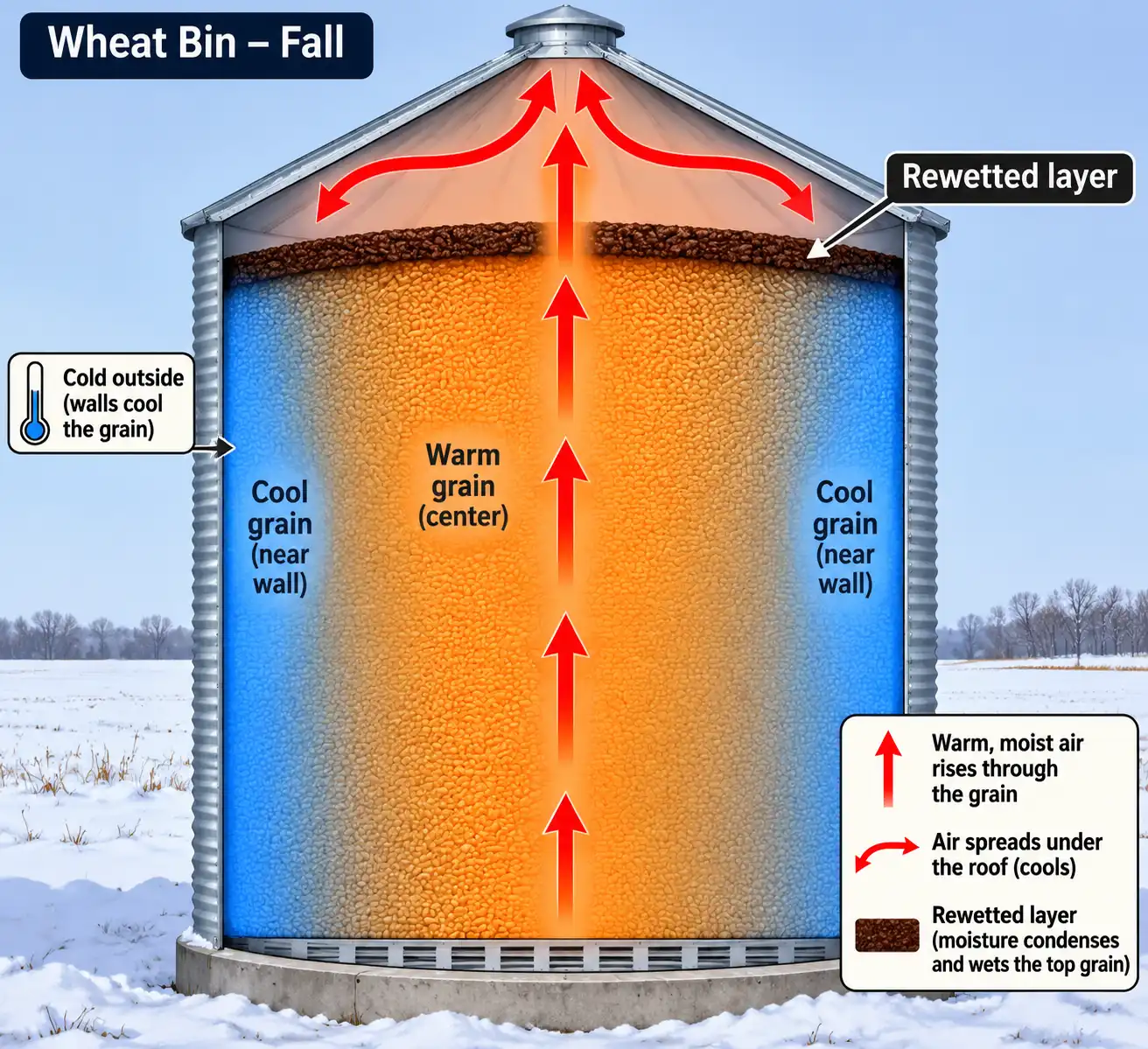
Moisture migration is one of the most common ways dry wheat spoils in a bin. NDSU Extension says it begins when grain and the average outdoor temperature differ by about 20°F.
Here is what happens. In fall, grain near the bin wall cools while the center stays warm. Warm air rises through the center, meets cold grain at the top, and leaves its moisture there. As a result, the top layer rewets, crusts, and molds, even when the wheat went in at the right moisture. University of Minnesota Extension describes the same rewetting at the top of the bin when warm grain goes into cold weather.
The fix is temperature control, not more drying. Keep the whole grain mass within about 20°F of the outdoor average by running an aeration cycle each time the season shifts. Then probe near the surface during every check, since migration damage shows up there first.
How Long Wheat Berries Last at Home
Whole wheat berries kept dry and cool stay usable for 25 years or more. Utah State University Extension reports Brigham Young University research showing wheat kept acceptable quality for about 25 years in a cold basement. The same wheat lasted only about 5 years in a hot garage or attic.
Another BYU study, cited by USU, found wheat sealed in No. 10 cans for 32 years still made bread most consumers accepted. That held regardless of how much oxygen remained in the can.
Still, edible is not the same as fresh. USU Extension notes that gluten weakens over long storage, so old wheat bakes into denser bread. Germination also drops faster above 60°F, though food value declines only slightly. For that reason, USU’s rule of thumb is to rotate wheat so no stored product is older than five years.
Hard red winter wheat and hard white wheat are both common pantry choices. Published storage research does not show a clear shelf-life difference between them, so choose by baking use.
Containers That Work
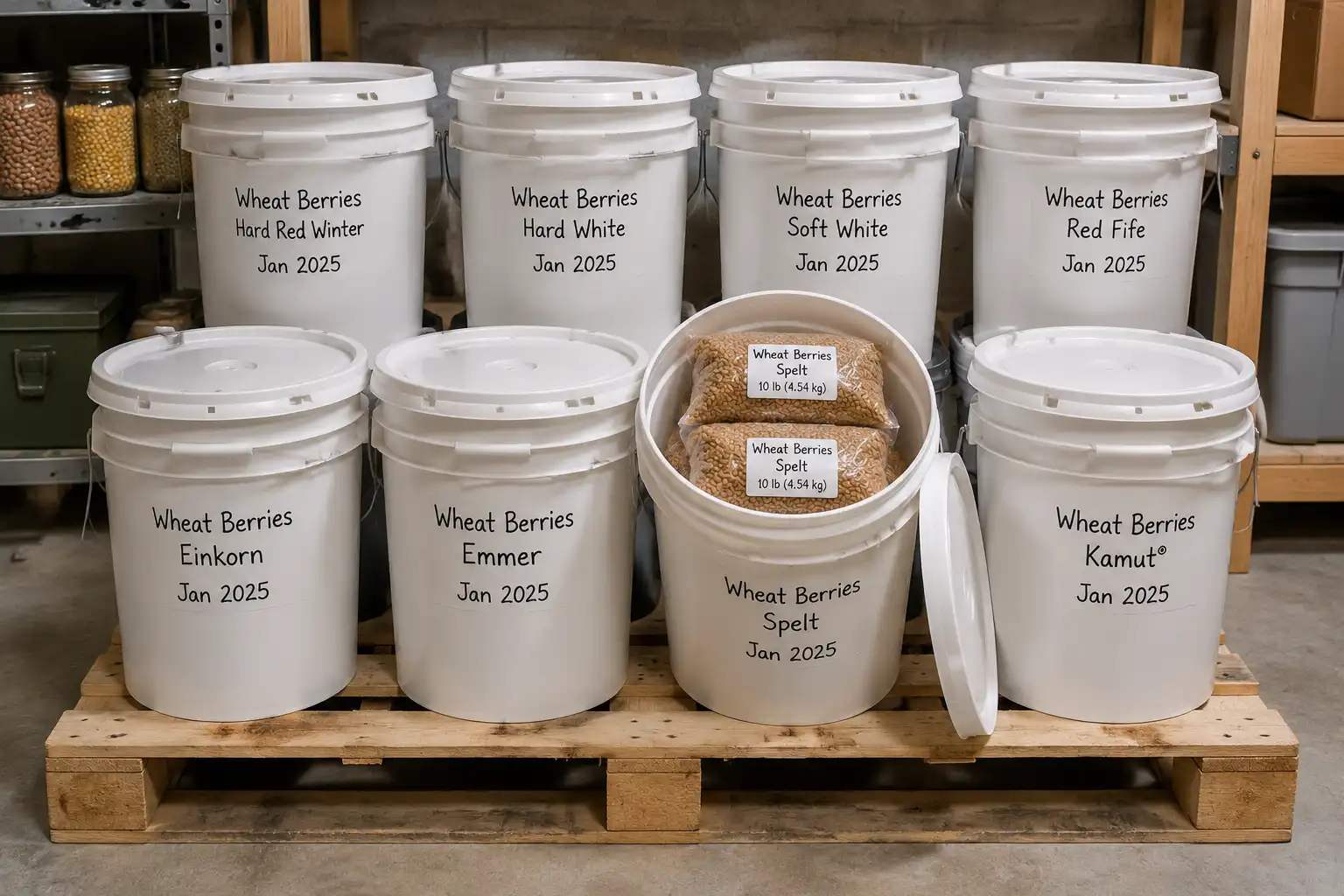
USU Extension recommends moisture-proof, food-grade containers: Mylar-type bags, polyethylene bags, plastic buckets, or No. 10 cans. Pack wheat in about 10-pound bags, which fit several to a 5-gallon bucket and make rotation easy.
Keep containers off concrete floors, which can wick moisture. Keep them out of direct sunlight, too. Plastic bags on their own will not stop rodents.
Oxygen absorbers are optional for clean wheat. USU says oxygen-free storage is unnecessary unless insects are present. If you do use absorbers, seal them in Mylar-type bags or cans, because polyethylene bags and plastic buckets do not hold an oxygen-free space over time.
How Much Wheat to Store
A 5-gallon bucket holds about 32 pounds of wheat. That figure comes from the USDA standard of 60 pounds per bushel: 5 gallons is about 0.54 bushel, and 0.54 × 60 is about 32 pounds. Actual fill shifts a little with test weight.
Now set that against the five-year rotation. A household milling 2 pounds a week uses about 104 pounds a year, or just over 3 buckets. Over five years, that adds up to roughly 16 buckets. Store more than that, and some wheat will pass five years before you reach it.
Killing Insects Before Long-Term Storage
Treat wheat for insects before you seal it, so an infestation cannot develop inside the container. Utah State University Extension gives three home methods.
- Freezing. Freeze bags of 1 to 15 pounds for 2 to 3 days, then let them warm for 24 hours. This kills live insects but not eggs, so repeat the cycle if needed.
- Dry ice. Put 3 to 4 inches of wheat in the bottom of a 5-gallon bucket. Add 2 to 3 ounces of crushed dry ice, fill the bucket, and set the lid on loosely. After 30 minutes, seal it tight. One treatment usually covers the full storage period.
- Oxygen absorbers. Sealed in Mylar-type bags or No. 10 cans, they kill adult insects and stop larvae from surviving.
USU does not recommend bay leaves, nails, salt, heating, or insecticides for home-stored wheat.
Bins are a different job. K-State notes that fumigation requires specialized training and equipment, and it can be fatal if done wrong. Many fumigants also fail below 60°F. So hire a professional applicator unless you already hold the training and gear.
How Long Seed Wheat Stays Viable
Seed wheat loses germination well before grain wheat loses food value, so test any seed held past one season. NDSU Extension notes that storage time based on germination runs about half as long as storage time based on mold.
Heat speeds the loss. Ohio State University Extension cites research where wheat stored for one year at 77°F and 45 percent relative humidity lost 15 to 20 percent of its viability and vigor, compared with wheat held at 40°F. Seed held a year or more also faces Indian meal moth and grain weevils, per Ohio State.
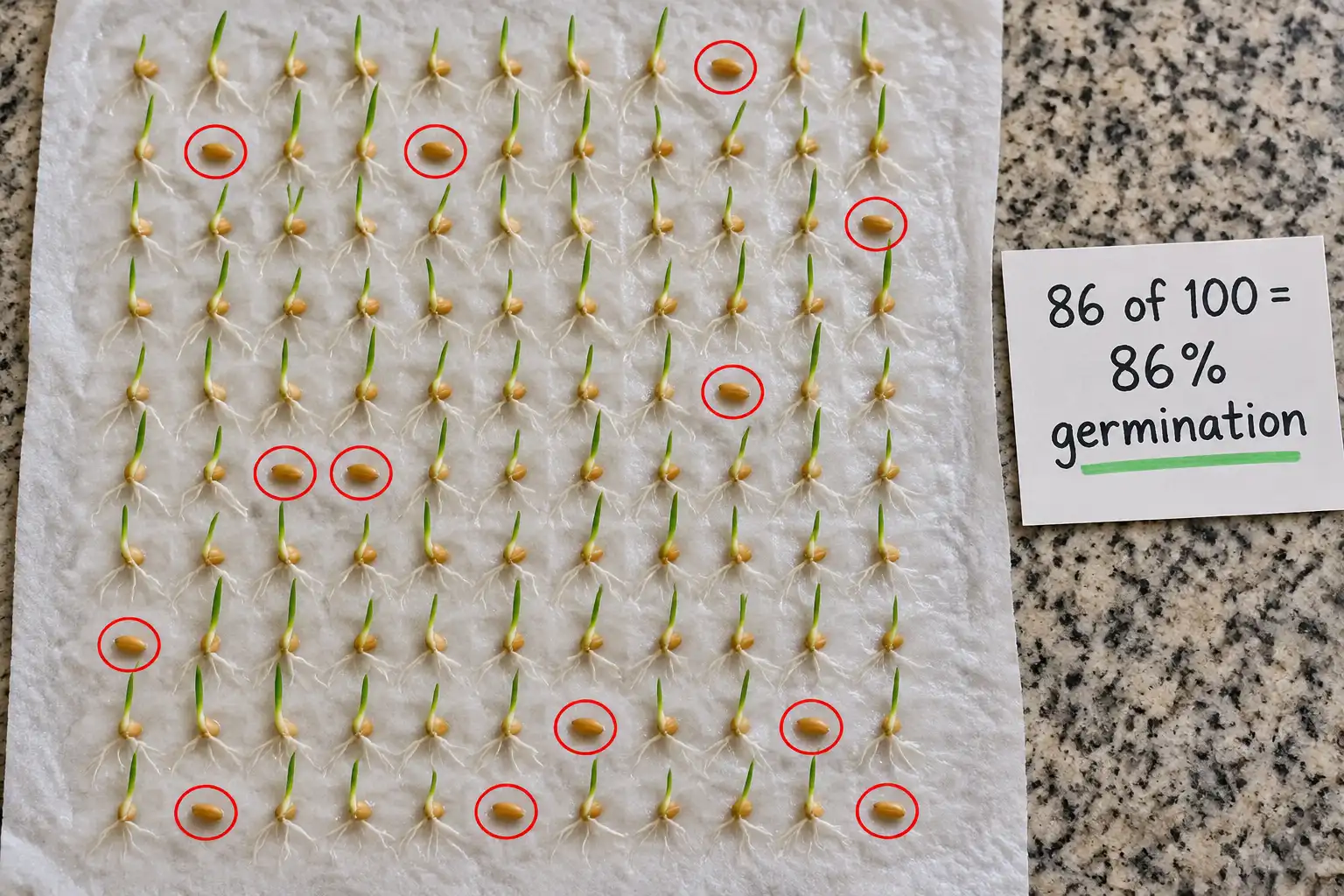
Run a germination test before planting carryover seed. K-State Research and Extension suggests sending a 2-pound sample to the Kansas Crop Improvement Association for an official test, and other states run their own seed labs. Time the test so results come back before your winter wheat planting window or your spring wheat planting date.
Then adjust the seeding rate. Multiply the planned rate by the germination it assumed, then divide by the test result. For example, a plan of 90 pounds per acre at 95 percent germination becomes 90 × 0.95 ÷ 0.80, or about 107 pounds, if the test shows 80 percent. The same logic applies to corn seed storage life and other carryover seed.
Signs Stored Wheat Has Gone Bad
Spoiling wheat usually shows itself through smell, heat, or insects before it looks bad. Check for these signs during every inspection:
- Musty or sour odor at the hatch or in a probe sample
- Crusting or clumping in the top layer, a sign of moisture migration
- Warm spots in cold weather, since K-State says to sample any area above 65°F
- Live insects or webbing, with webbing pointing to Indian meal moth larvae
- Visible mold on the surface or in probe samples, per University of Minnesota Extension
Act fast on any of these. Run aeration to cool hot spots, remove crusted grain, and move or market the bin before the problem spreads. NDSU Extension flags moldy grain as a health hazard, so wear a dust-rated respirator when you handle it.
At home, USU advises inspecting containers often and treating or discarding any lot with insect activity. Also, do not mill wheat that smells musty or rancid for food.
FAQs
Can you still use 20-year-old wheat?
Usually, if it stayed dry, cool, and insect-free. Utah State University Extension cites BYU research where 32-year-old canned wheat still made acceptable bread, though you should expect weaker gluten and denser loaves.
Does freezing damage stored wheat?
No. Utah State University Extension says freezing and sub-zero temperatures do not harm stored grain, and a 2 to 3 day freeze is one of its recommended ways to kill insects before storage.
Do you need oxygen absorbers for wheat berries?
Not for clean, insect-free wheat. Utah State University Extension says oxygen-free storage is unnecessary unless insects are present, and absorbers only hold up in Mylar-type bags or cans that keep a seal.
Does whole wheat flour last as long as wheat berries?
No, because milling breaks the bran and exposes the oily germ to air, so flour turns rancid much sooner. Store whole berries and grind only what you plan to use soon.
Can aeration dry wet wheat in the bin?
Not at typical cooling airflow. NDSU Extension says natural-air drying of wheat up to 17 percent moisture needs at least 0.75 cfm per bushel, while K-State sizes cooling airflow at 0.1 or less.
How often should you check stored wheat?
Check monthly in cold weather and every two weeks in warm weather, per University of Minnesota Extension. Look for mold, insects, odor, and warm spots, and probe below the surface instead of only looking through the hatch.
Will old wheat berries still sprout?
Often, but germination falls with age and heat. Utah State University Extension notes that viability drops faster above 60°F, so run a small sprout test before relying on stored wheat for seed or sprouting.
Putting This Into Practice
Dry wheat to 13 percent for bins held past spring, and to 12 percent for unaerated bins or home storage. Cool it as soon as the weather allows, because warm days spend storage life you cannot recover. Check monthly, and twice a month in warm weather.
At home, seal clean berries in food-grade containers in the coolest dry spot you have, and rotate stock within five years. For seed, test germination before every planting. Storage quality also starts before the bin, with the harvest timing and moisture choices made while growing wheat.