
Best Grain Moisture Tester: 8 Picks Matched to Your Elevator
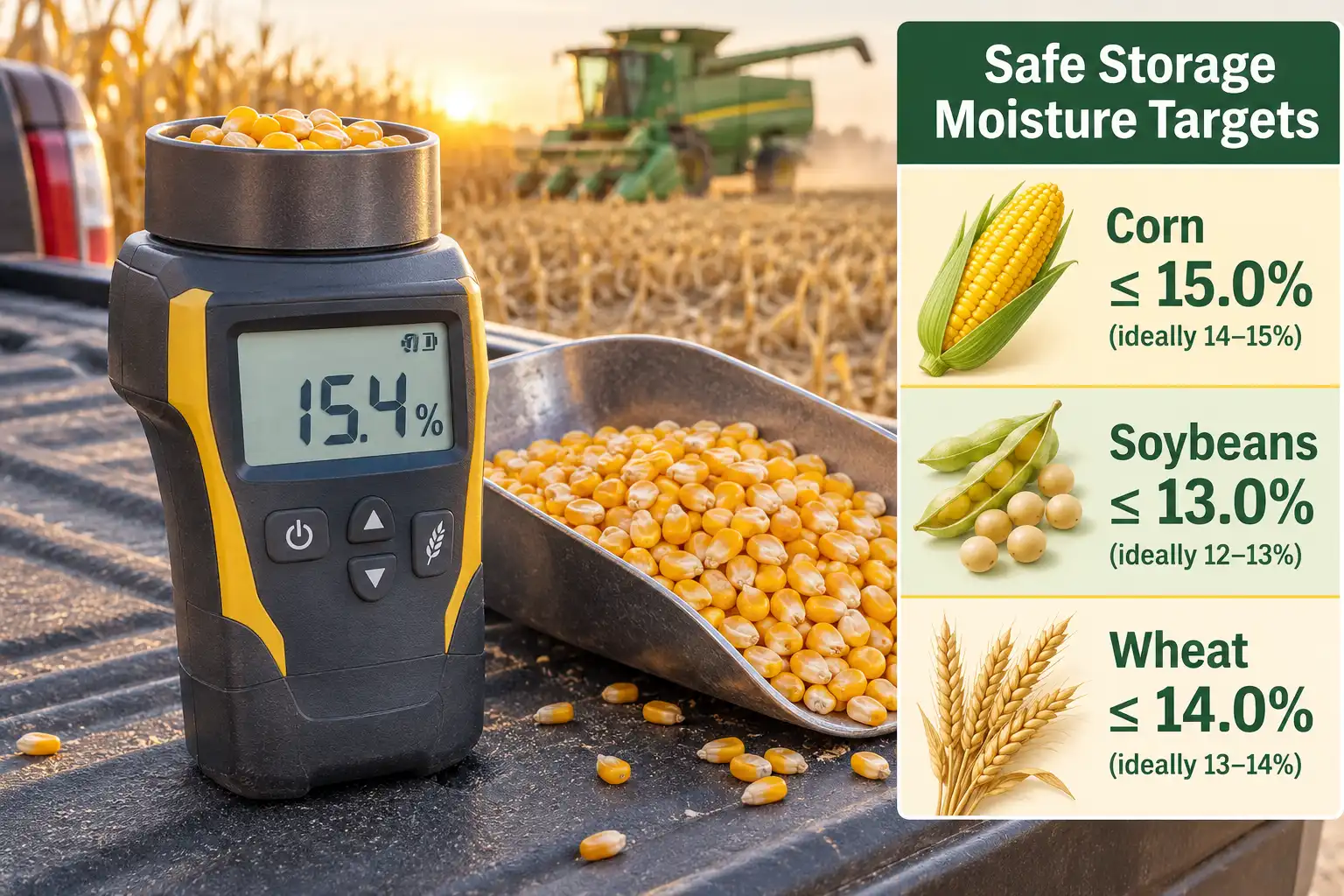
One moisture number sets when you harvest, how hard you dry, what you bin, and what the elevator docks. So the best grain moisture tester is the one that tracks your buyer’s meter in your harvest range. This guide sorts picks by crop mix and scale.
Readings that miss the elevator’s call for an adjustable tester. That makes the AgraTronix MT-16 the best grain moisture tester for corn, soybeans, and wheat. It carries 16 grain scales, averages up to 99 readings, and takes a calibration offset.
Top 8 Picks for the Best Grain Moisture Tester
The AgraTronix MT-16 leads for corn, soybeans, and wheat, while the other seven fit narrower jobs. Specs below come from manufacturer documentation. Owner feedback comes from verified-purchase reviews, because we do not test products ourselves.
| Tester | Best for | Grain scales | Rated accuracy | Power |
|---|---|---|---|---|
| AgraTronix MT-16 | Corn, soybeans, wheat | 16 | ±0.5% | One 9V |
| AgraTronix MT-PRO | Wide rotations | 40 | ±0.5% | Two 9V |
| AgraTronix MT-PRO+ | Night harvest, USB updates | 40 | ±0.5% | Two 9V |
| AgraTronix Ag-MAC Plus | Moisture plus test weight | 20 | ±0.3% | Four AA, included |
| AMTAST GM005 | Benchtop specialty crops | 24 | ±0.5% | AA or 6V DC |
| GOYERRNES GR-T8 | Complete starter kit | 20, plus 4 custom | ±0.5% | Four AA or USB, included |
| GOYOJO GS25A | Pocket-size spot checks | 25 | ±0.5%, standard grains | Four AAA plus CR2032 |
| AMTAST AMT155 | Nuts, coffee, small batches | 22 | ±0.5% | One 9V |
What a Grain Moisture Tester Has to Get Right
A grain moisture tester has one job: give you a number to act on before the buyer measures. That number times the combine and sets the dryer. It also decides what goes in the bin and what the elevator docks.
Every reading is moisture content (wet basis), meaning water as a share of total sample weight. Your buyer reports on the same basis. So the two meters should agree, and that agreement is the spec that governs everything else. Price, brand, and grain count all come after it.
The match needs to hold from about 13% to 25%. That band runs from soybeans at market moisture to wet corn headed for the dryer. A meter that nails 15% but drifts two points at 24% still costs you bushels.
Most misses trace back to four mistakes:
- Testing cold or dryer-hot grain, which pushes temperature compensation past its limits
- Selecting the wrong grain scale for the crop
- Testing a scoop off the top instead of a mixed sample
- Skipping the seasonal calibration check against a certified meter
What One Point of Moisture Error Costs
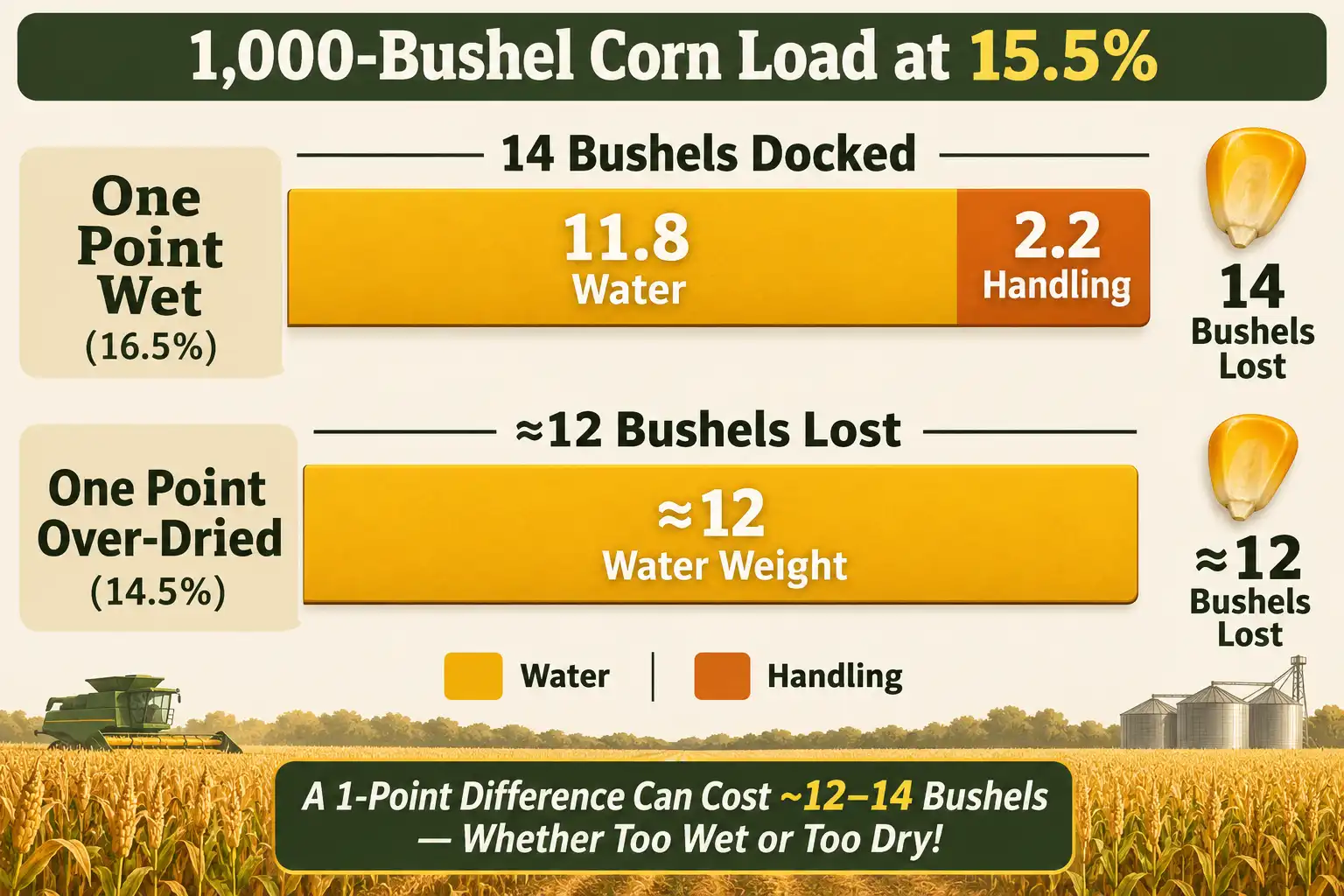
On 1,000 bushels of corn, one point of error costs about 12 to 14 bushels. Buyers charge for water plus handling. Iowa State University Extension notes that a 1.4% per point corn shrink factor includes about 0.22% for handling loss. The rest is water shrink, which Purdue Extension‘s NCH-61 puts at 1.18% per point when drying to 15.5%. Factors vary by buyer, though. University of Minnesota Extension lists typical commercial factors of 1.25% to 1.5% per point for corn. For soybeans, it lists 1.5% to 2%.
The math, for a load priced as No. 2 yellow corn at 15.5%:
- One point wet (16.5%): a 1.4% factor docks 14 bushels, and only about 11.8 are water.
- One point over-dried (14.5%): you remove about 12 bushels of saleable weight, plus the fuel.
Now scale it down. A 10-bushel batch of wheat weighs about 600 pounds, or roughly 19 five-gallon buckets. One point there is only about 7 pounds of water. Instead, the real risk is mold, since wheat held six to 12 months should sit at 13% or lower, per MWPS-13.
Do You Need Your Own Tester?
Not always. If every load goes straight from the combine to the elevator, its certified meter sets your price. Its test may be enough.
Your own tester earns its keep once you make moisture calls before the buyer does. That includes on-farm storage in a grain bin, running your own dryer, and hauling long distances. It also covers small grains kept for food and seed saving, where storage moisture affects corn seed longevity and germination. In each case, a wrong guess shows up weeks later. A corn moisture meter in the cab catches it at harvest instead.
Types of Grain Moisture Testers
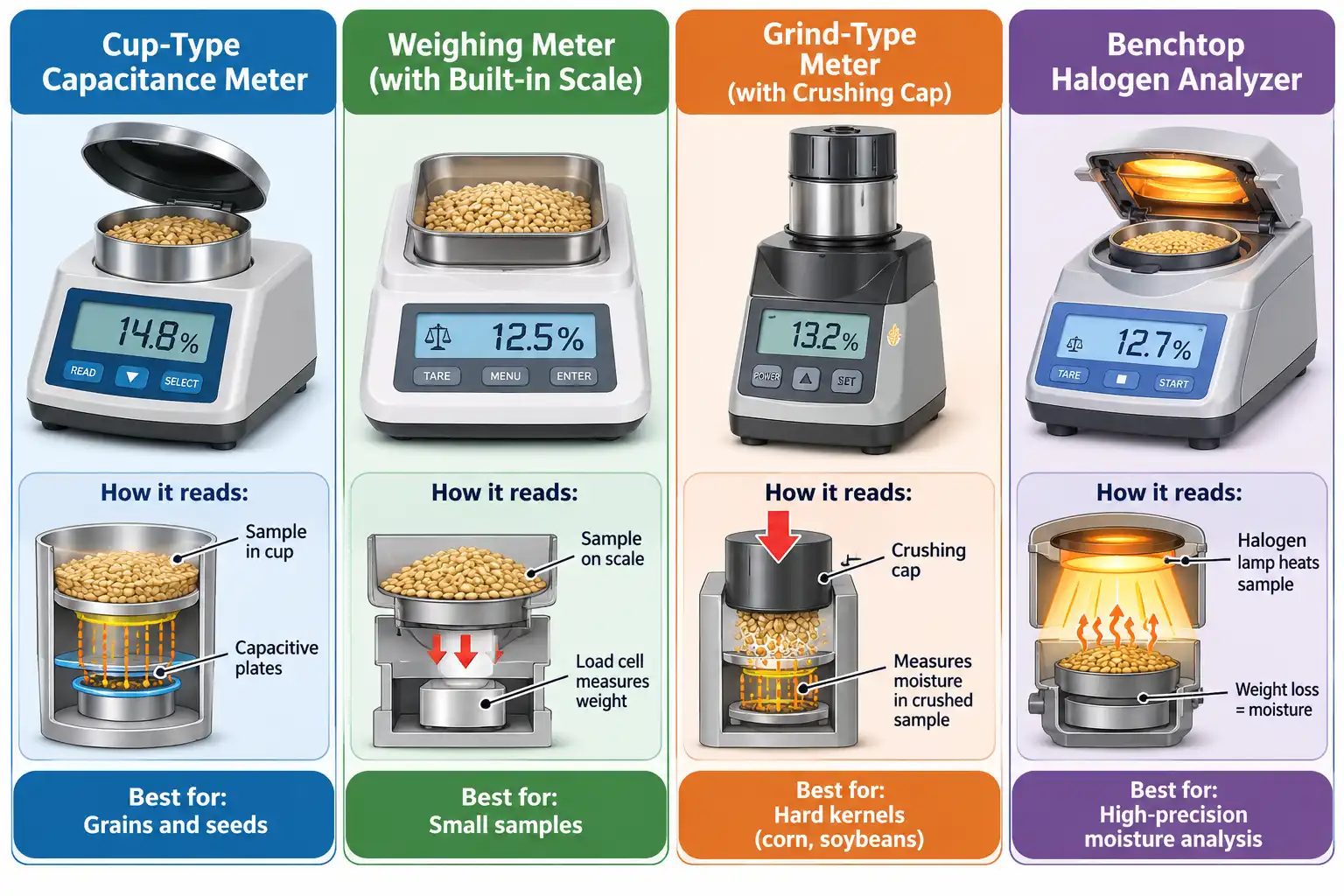
Every crop moisture tester on a farm reads moisture indirectly. Most use capacitance. Water raises grain’s dielectric constant, so a wetter sample changes the signal across the test cell. However, packing, kernel size, and temperature shift that signal too, so four designs handle it differently.
| Design | How it reads | Examples in this guide | Where it fits |
|---|---|---|---|
| Capacitance cup-type | Fills a test cup, sometimes pressed by a screw cap, then reads the electrical response and grain temperature | AgraTronix MT-16, GOYOJO GS25A, AMTAST AMT155 | Fast checks in the cab, at the bin, or at the dryer |
| Weighing, built-in scale | Weighs the sample in the cell to cancel packing error; many also report test weight | AgraTronix Ag-MAC Plus, GOYERRNES GR-T8, AMTAST GM005 | Checks before delivery, where test weight also matters |
| Grind-type | Crushes kernels in the cell before reading, so interior moisture counts | AgraTronix GMT-Grind (part 08201), listed but not reviewed here | Pre-harvest samples and freshly dried grain |
| Halogen moisture analyzer | Heats a weighed sample and measures the weight lost as water | Lab and seed-lab benchtop units | Reference checks on small batches and seed lots |
A cup-type unit depends on consistent filling, so fill and cap it the same way every time. A built-in scale removes most of that variable. Grind-type meters help when kernel surfaces dry faster than the core, as they do after a hot dryer.
Benchtop vs portable comes down to power and workflow more than accuracy. A portable grain moisture tester rides in the cab, while a bench unit stays by the scale. Most listings claim ±0.5% accuracy either way, provided you use the right grain scales. So the best grain moisture meter is the design that fits where you test.
A halogen analyzer approximates the air-oven reference method in minutes. A probe-style hay moisture tester reads bales and windrows, not loose grain.
How to Choose the Best Grain Moisture Tester
Six specs decide the pick when choosing a grain moisture meter. Check them in this order, since each one narrows the list before the next matters.
Match the Grain Scales to Your Crop Mix
Start with the scale list. When you shop for a moisture meter, grain coverage matters more than brand. About 16 grain scales cover a corn, soybean, and wheat farm. Wider rotations need a line-by-line check for grain sorghum (milo), sunflower, canola, edible beans, or rough rice. Since milo and grain sorghum are one crop, either label works. Never test on a “general” setting, because no single calibration fits every kernel.
Accuracy, Repeatability and Averaging
Read any ±0.5% accuracy claim as a best case. It usually holds only for standard grains in the normal moisture range. In fact, GOYOJO’s own spec for the GS25A widens to ±1% to ±1.5% outside that window. Repeatability is a different number. It shows whether two readings of one sample agree, and the GOYERRNES GR-T8 lists 0.2% or better. Averaging then smooths the swing from sample to sample, so log several pours rather than trusting one.
Temperature Compensation and Its Limits
Automatic temperature compensation is a must, but it has limits. A sensor in the cell, usually a thermistor, reads grain temperature and corrects the result. Even so, NDSU Extension says meters are normally inaccurate below about 40°F. Purdue Extension adds that no meter reads grain above 90°F accurately. Cold samples carried indoors also collect condensation, which pushes readings high. That matters most on late Northern Plains harvests, when corn often comes off the combine near freezing.
Calibration Offset to Match Your Elevator
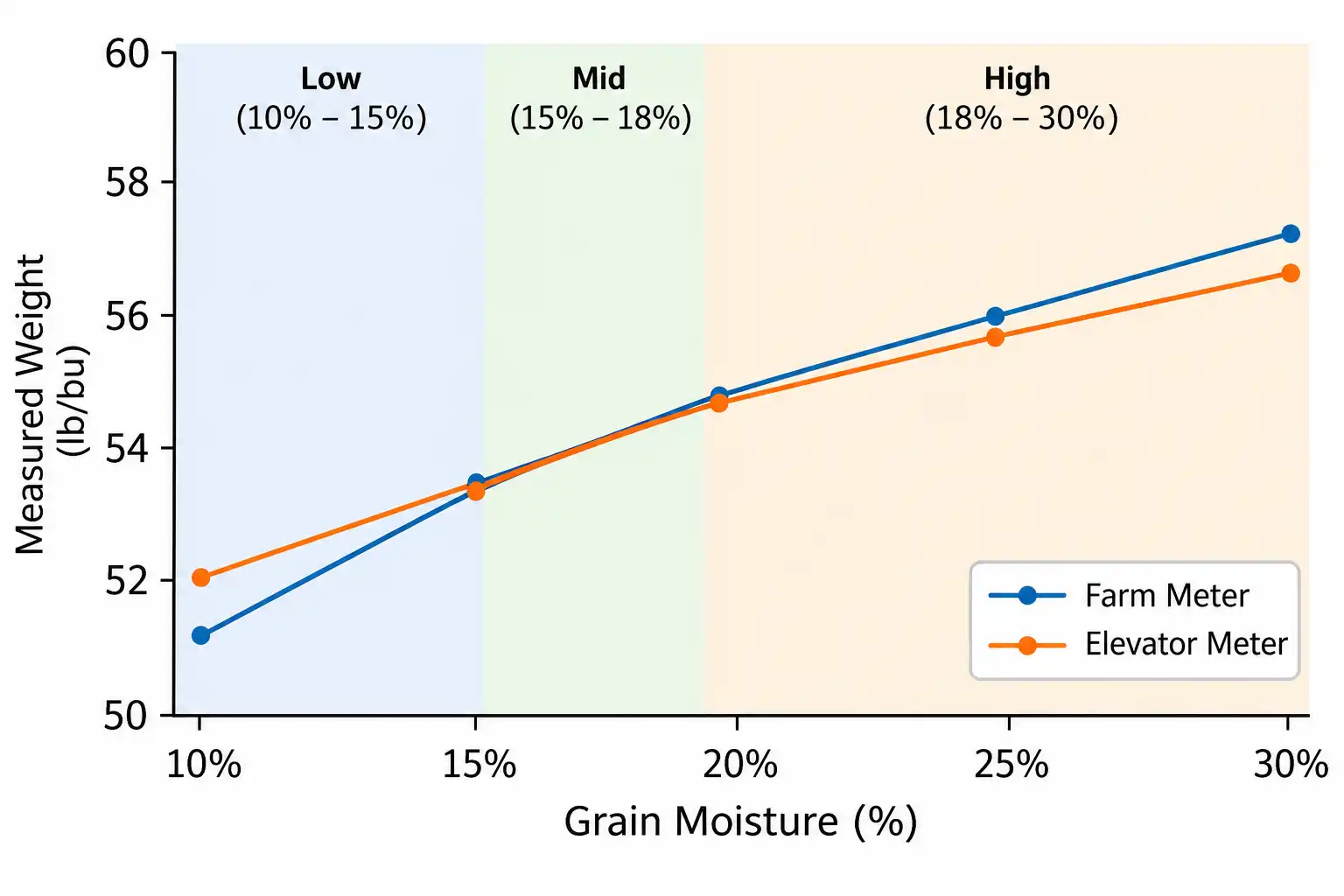
Your meter rarely matches the elevator’s at first. Official inspection meters, including the DICKEY-john GAC 2500-UGMA and Perten AM 5200-A, run USDA FGIS calibrations. Those use the Unified Grain Moisture Algorithm (UGMA), and FGIS reissued them in May 2026. Farm handhelds use their own calibrations, so the gap can flip direction. The AgraTronix MT-PRO manual shows farm readings below the elevator’s at low moisture and above it at high moisture. So look for a calibration adjustment, ideally multi-point calibration that corrects each range.
NTEP Certification: When It Matters
NTEP approval matters only when your reading sets someone else’s price. NIST Handbook 44, Section 5.56, covers the commercial grain moisture meter. Most states have written NTEP type evaluation into law, per NIST, with procedures in NCWM Publication 14. So if you buy neighbors’ grain on your reading, you need an approved meter. For your own harvest and storage calls, you do not. None of the eight handhelds in this guide lists NTEP approval in its published specifications.
Power, Display and Field Durability
Every digital grain moisture meter here runs on batteries, an adapter, or both. Many cab units take a 9V battery, while others use AA or AAA cells. The GOYOJO GS25A ships without batteries, so order them alongside it. A backlit LCD helps when you load trucks at dusk. Also look for a hard carrying case and a cleaning brush for the cell. Finally, AC/DC units such as the AMTAST GM005 and GOYERRNES GR-T8 suit a shop bench.
The 8 Best Grain Moisture Testers: Reviews
1. AgraTronix MT-16 Grain Moisture Tester: Best Overall for Corn, Soybeans and Wheat
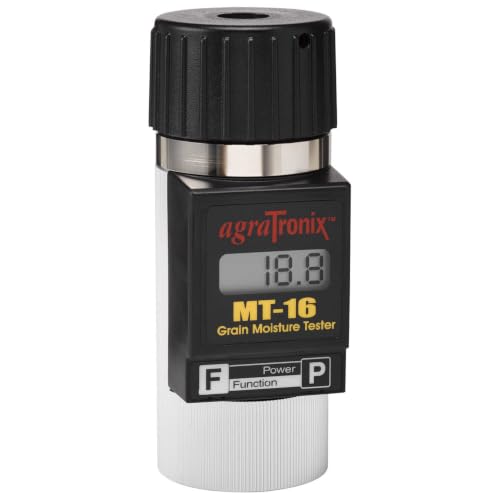
- MADE BY AGRATRONIX — MT-16 grain moisture tester from Agratronix, model 08155, with direct readout for 16 grain scales.
- 16 GRAIN SCALES — Reads corn, wheat, soybeans, sorghum, oats, canola, barley, rye, flax, safflower, sunflower and more.
- ADJUSTABLE SCALES — Each grain scale can be adjusted to match your local elevator’s readings.
AgraTronix has built moisture testers in Streetsboro, Ohio, for more than 40 years. The MT-16 (part 08155) is its entry handheld. It covers Corn Belt basics: two corn scales, hard and soft wheat, soybeans, milo, canola, and paddy rice. Each scale takes its own elevator offset. Owner reports consistently praise its fast, simple readings in the combine cab. A minority say it drifts, so recheck it every season.
Why it’s a good buy
- 16 dedicated grain scales
- Averages up to 99 readings
- Per-scale elevator offset
- Light enough for the cab
Why you might skip it
- No multi-point calibration
- Some owners report drift
Specifications
- Moisture range: 5% to 40%, by grain
- Accuracy: ±0.5%, with 0.1% resolution
- Operating range: 32°F to 113°F, automatic compensation
- Power: one 9V battery, not included
2. AgraTronix MT-PRO Grain Moisture Tester: Best for Wide Rotations

- Direct readout for 40 different grain scales
- Test high moisture grain up to 40%
- Illuminated multilingual display – English, Spanish, French, German, Italian, Portuguese, Swedish
The MT-PRO (part 08125) is AgraTronix’s step up for mixed farms. Its 40 scales split wheat into durum, hard red spring, hard red winter, soft red winter, and white. They also add field peas, lentils, popcorn, and long- and medium-grain rice. Multi-point calibration gives low and high moisture separate offsets. Owners consistently report readings that track their elevator once calibrated, with repeat tests that agree.
Why it’s a good buy
- 40 grain scales
- Multi-point elevator calibration
- Backlit seven-language display
- 99-test averaging memory
Why you might skip it
- Needs two 9V batteries
- No USB update port
Specifications
- Moisture range: 5% to 40%, by grain
- Accuracy: ±0.5%, with 0.1% resolution
- Operating range: 32°F to 113°F
- Build: 1.94 lb, high-density plastic, strap case
3. AgraTronix MT-PRO+ (05100): Best for Night Harvest and Updates

The MT-PRO+ keeps the MT-PRO’s 40 scales and adds a 2.5-inch LCD with a large-font option. Its backlit buttons help in a dark cab. A USB port loads grain-scale and firmware updates, so the meter can keep pace with new calibrations. AgraTronix says it reads best at 60°F to 90°F and suggests averaging three readings. Owners report quick, dependable readings on the combine.
Why it’s a good buy
- Large 2.5-inch screen
- Backlit buttons for night
- USB scale updates
- Spare cup cap included
Why you might skip it
- USB won’t export data
- Cap binds when overfilled
Specifications
- Grain scales: 40, in seven languages
- Accuracy: ±0.5%, with 0.1% resolution
- Moisture range: 5% to 40%, by grain
- Power: two 9V batteries, low-battery warning
4. AgraTronix Ag-MAC Plus (30100): Best for Moisture Plus Test Weight

- GRAIN TESTER: Evaluate moisture content in perishable produce like grains with this electrical meter. The Ag-Mac Plus mo…
- MULTILINGUAL DISPLAY: The non-compaction design of the agricultural equipment is combined with an LCD Display that can b…
- USB COMPATIBLE: The electrical moisture tester supports USB port connections for personalization options such as adding …
The Ag-MAC Plus reads moisture and test weight in pounds per bushel from one pour, with no pre-weighing. A non-compaction hopper loads the cell, so you never crush the sample. AgraTronix rates it at ±0.3%, the tightest spec in this group. Its 20 scales cover corn, soybeans, four wheat classes, two barleys, milo, and canola. Owners consistently say both readings land close to their elevator.
Why it’s a good buy
- Moisture and test weight
- Tightest rated accuracy
- AA batteries included
- USB updates, seven languages
Why you might skip it
- No peas, lentils, flax
- Highest cost here
Specifications
- Moisture range: 5% to 40%, by grain
- Accuracy: ±0.3%, with 0.1% resolution
- Operating range: 32°F to 113°F
- Power: four AA batteries, included
5. AMTAST GM005 Grain Moisture Tester: Best Benchtop for Specialty Crops

- 𝟐𝟒 𝐆𝐑𝐀𝐈𝐍𝐒 𝐒𝐔𝐏𝐏𝐎𝐑𝐓 – The grain moisture meter is designed to measure the moisture content of 24 different types of grains…
- 𝐏𝐎𝐖𝐄𝐑−𝐎𝐍 𝐒𝐄𝐋𝐅−𝐓𝐄𝐒𝐓 𝐅𝐔𝐍𝐂𝐓𝐈𝐎𝐍 – Our grain moisture tester comes with a power-on self-test function that automatically chec…
- 𝐀𝐂/𝐃𝐂 𝐏𝐎𝐖𝐄𝐑 𝐒𝐔𝐏𝐏𝐋𝐘 𝐂𝐎𝐌𝐏𝐀𝐓𝐈𝐁𝐈𝐋𝐈𝐓𝐘 – This seed moisture tester offers both AC and DC power supply options, providing flexi…
AMTAST builds the GM005 in China as a tabletop meter with automatic temperature and weight compensation. Its 24 presets reach past field crops to peanut kernels, sesame, hazelnuts, coffee, cocoa, and soybean meal. It runs on AA batteries or a 6V DC adapter, and neither comes in the box. Owner reports are split. Some call it accurate for the money, while others found corn readings several points off their elevator.
Why it’s a good buy
- 24 grain presets
- Weight and temperature compensation
- Multi-point calibration and correction
- Readings under 10 seconds
Why you might skip it
- Mixed corn accuracy reports
- Unclear manual, slow support
Specifications
- Moisture range: 6% to 40% for corn, wheat, soybeans
- Accuracy: ±0.5%, with 0.2% repeatability
- Operating range: 32°F to 104°F
- Build: 7.15 lb tabletop body
6. GOYERRNES GR-T8: Best Complete Starter Kit

- Professional Grain Moisture Meter: Quickly measure moisture (%), weight (g), density (g/L), and temperature (℃) of 20+ g…
- Easy Calibration for Accurate Weighing: Use the 200g weight to quickly verify before each weighing. The simple calibrati…
- Enhanced Temperature Compensation: This grain tester utilizes advanced variable frequency capacitive technology with aut…
The GR-T8 measures moisture, sample weight, density, and temperature in one test. The kit ships ready to run. It includes four AA batteries, a USB adapter, a 200-gram check weight, a sampler, and an aluminum case. Density reads in grams per liter, so multiply by 0.0777 for rough pounds per bushel. Most owners report fast, accurate results, but a few units arrived showing “Err 1.”
Why it’s a good buy
- Four readings per test
- Batteries and adapter included
- 200 g check weight
- 0.2% repeatability spec
Why you might skip it
- Some units show Err 1
- Custom grains need lab standards
Specifications
- Moisture range: 3% to 35%
- Accuracy: ±0.5%, with repeatability of 0.2% or better
- Sensor: variable-frequency capacitance, thermistor compensation
- Power: four AA or USB adapter, both included
7. GOYOJO GS25A: Best Pocket-Size Budget Pick

- High Precision & Consistency: Achieve accurate grain moisture readings with an industry-leading accuracy of ±0.5%, even …
- Supports 25 Types of Grains: GS25A is versatile and supports the measurement of 25 different grain types, including whea…
- User-Friendly & Portable Design: The lightweight, compact design and intuitive LCD display make GS25A easy to carry and …
On the market since late 2024, the GS25A weighs 15.2 ounces with batteries and fits a coat pocket. Its 25 presets include paddy rice, milo, lentils, linseed, clover seed, and green coffee. It also stores 250 readings with averages and gives voice prompts. Still, some owners report corn and soybean readings 2 to 5 points off their co-op, even after recalibrating. Check it against a certified meter before you trust it.
Why it’s a good buy
- Coat-pocket size
- 25 grain presets
- Stores 250 readings
- Backlit screen, °F option
Why you might skip it
- Some units read far off
- English and Chinese only
Specifications
- Accuracy: ±0.5% for standard grains, up to ±1.5% otherwise
- Sample: about 90 ml cup
- Compensation: automatic temperature
- Power: four AAA plus one CR2032, not included
8. AMTAST AMT155: Best for Nuts, Coffee and Small Batches

- 𝟐𝟐 𝐆𝐑𝐀𝐈𝐍𝐒 𝐒𝐔𝐏𝐏𝐎𝐑𝐓 – The grain moisture meter is specifically designed to measure the moisture content of 22 different gr…
- 𝐋𝐎𝐖 𝐏𝐎𝐖𝐄𝐑 𝐂𝐎𝐍𝐒𝐔𝐌𝐏𝐓𝐈𝐎𝐍 – Our seed moisture tester is engineered for long-lasting use, operating on a 9V battery that last…
- 𝐀𝐔𝐓𝐎𝐌𝐀𝐓𝐈𝐂 𝐓𝐄𝐌𝐏𝐄𝐑𝐀𝐓𝐔𝐑𝐄 𝐂𝐎𝐌𝐏𝐄𝐍𝐒𝐀𝐓𝐈𝐎𝐍 – This moisture meter for seeds comes equipped with automatic temperature compensatio…
The AMT155 is AMTAST’s compact cup meter, calibrated at 68°F. Fill the cup to the brim every time, or readings wander. Beyond corn, wheat, and soybeans, its 22 presets cover almonds, cashews, flaxseed, sesame, cocoa, and parchment coffee. Owner reports are split. Coffee growers praise it, while some corn growers found it far off the elevator and the manual hard to follow.
Why it’s a good buy
- 22 specialty-friendly presets
- ±9.9% reading adjustment
- Simple fill-and-read cup
- Auto-off saves battery
Why you might skip it
- Mixed corn accuracy reports
- Garbled manual, slow support
Specifications
- Corn range: 9% to 39%
- Accuracy: ±0.5%, with 0.2% repeatability
- Operating range: 32°F to 104°F
- Power: one 9V battery, up to a year per AMTAST
Safe Storage Moisture by Crop and Storage Length
The longer grain sits, the drier it must be. That rule drives every safe grain storage moisture target. Purdue Extension publishes the limits below from the MWPS-13 handbook. They assume clean grain under aeration, and Purdue notes that normal aeration airflow cools grain but cannot dry it.
Maximum moisture, % wet basis, for clean, aerated grain. Source: Purdue Extension, from MWPS-13.
| Crop | Max at harvest (%) | Up to 6 months (%) | 6 to 12 months (%) | Over 1 year (%) |
|---|---|---|---|---|
| Shelled corn, grain sorghum | 30 | 15 | 13 | 13 |
| Soybeans | 18 | 13 | 12 | 11 |
| Wheat, barley, oats | 20 | 14 | 13 | 12 |
| Sunflower | 17 | 10 | 8 | 8 |
| Canola | 14 | 9 | 8 | 8 |
| Edible beans | 16 | 16 | 13 | 13 |
Ohio State University Extension adds a seasonal view. For corn, it sets 15% for November through March and 13% for June through August. Soybeans follow the same pattern, dropping from 13% to 11%. Both sources also agree on one adjustment: hold broken, immature, or insect-damaged grain one point drier.

Your crop plan feeds straight into these limits. Shelled corn can come off at up to 30%, so anyone growing corn for storage needs a drying plan. Grain sorghum shares corn’s row, which makes sorghum harvest timing your first lever on drying cost. Small grains top out at 20% for harvest, so plan field drydown when growing wheat for the bin.
How to Get Readings That Match the Elevator
Matching the elevator takes routine, not a pricier meter. Three steps close most of the grain moisture meter vs elevator gap.
Pull a Representative Sample
A scoop off the top of a truck is not a representative sample, Purdue Extension warns. Probe the load in two or more spots, avoiding the center and corners. Better still, sample the stream as it unloads. Mix that bucket into one composite sample and test promptly, covering it if you must wait. In a bin, pull a grain probe at several depths and test each depth separately, so a wet layer shows up.
Let Cold or Dryer-Hot Grain Equalize
Put the sample in a sealed container and let it reach room temperature before the final reading. NDSU Extension warns that corn from a high-temperature dryer may read about 2 points below its true moisture. So test it, seal it for about 12 hours, and test again. The difference shows how far off the first reading was. It also tells you how well your meter’s compensation works.
Check Against a Certified Meter Every Season
Purdue Extension suggests checking your meter at the elevator or at an equipment dealer. Both usually keep a certified moisture tester that gets inspected regularly. To calibrate a grain moisture tester, run at least three samples near 15% and three near 25% on both units. Next, record each gap and set the offset for that range. Repeat this calibration check every season and whenever you switch crops.
Why Your Meter Disagrees With the Elevator
Work down this troubleshooting list, most likely cause first:
- Wrong grain scale selected.
- Sample colder than 40°F or hotter than 90°F.
- Moisture above 25%, where NDSU Extension says readings are estimates only.
- Immature or frost-damaged corn, with moisture varying kernel to kernel.
- A dirty test cell or weak battery.
- Different technology: UGMA calibrations at the elevator, a farm calibration in your hand.
FAQs about Grain Moisture Tester
What moisture level is safe for storing grain?
It depends on the crop and how long you hold it. Purdue Extension’s MWPS-13 table puts corn at 15% and soybeans at 13% for up to six months, dropping to 13% and 12% for six to 12 months.
How accurate are handheld grain moisture meters compared to the elevator?
Once offset to your elevator, a good handheld typically reads within about half a point of it, matching most makers’ ±0.5% rating. Without that offset, readings can run a point or more off, especially at low or high moisture.
How often should I calibrate a grain moisture tester?
Check it against a certified elevator or dealer meter every season before harvest, and again when you switch crops. Purdue Extension suggests three samples near 15% and three near 25% so both ends get an offset.
Does grain temperature affect moisture readings?
Yes, enough to swing a storage decision. Meters misread grain below about 40°F, per NDSU Extension, or above 90°F, per Purdue Extension, so let sealed samples reach room temperature first.
Is a portable or benchtop grain moisture tester better?
Portable is better for in-field calls like harvest timing and dryer checks, since it rides in the cab. A benchtop or weighing unit suits the scale house, where steady power and test weight readings matter more than mobility.
What is the most accurate grain moisture meter?
For official grading, USDA FGIS uses benchtop meters like the DICKEY-john GAC 2500-UGMA and Perten AM 5200-A. Among handhelds in this guide, the AgraTronix Ag-MAC Plus rates tightest at ±0.3%, but your calibration matters more than the spec.
What moisture should wheat be stored at?
Keep clean, aerated wheat at 14% or less for up to six months and 13% for six to 12 months, per Purdue Extension. Past a year, drop it to 12%, and hold damaged wheat one point drier.
Do I need an NTEP-certified grain moisture meter?
Only if your reading sets the price when grain changes hands, such as buying from neighbors. For your own harvest, drying, and storage calls, a calibrated farm handheld is fine, because NIST Handbook 44 targets meters used in trade.
Bottom Line for Your Field
Pick by crop mix first, then by budget:
- Corn, soybeans, and wheat: the AgraTronix MT-16
- Wide rotations with specialty crops: the AgraTronix MT-PRO
- Tight budget: the GOYOJO GS25A
Whichever grain moisture meter you choose, one habit matters more than the model. Each season, run three samples near 15% and three near 25% beside a certified meter, then set your offset. Write the gaps down, too, so next harvest starts from a known offset. That check turns the best grain moisture tester on paper into one that matches your elevator at the scale.