How to Grow Onions From Seed: Timing, Trimming, and Transplanting

Onion seed costs little and opens up far more varieties than sets or bundled plants. It also needs a long head start and the right day-length type. Get those two choices right, and you can grow onions from seed in one season, from flat to cured bulb.
To grow onions from seed, pick a day-length type for your latitude and sow indoors 8 to 12 weeks before transplanting. Southern growers direct-seed in fall. Trim seedlings to 4 inches and set them 3 to 5 inches apart.
Choose a Day-Length Type Before You Grow Onions From Seed
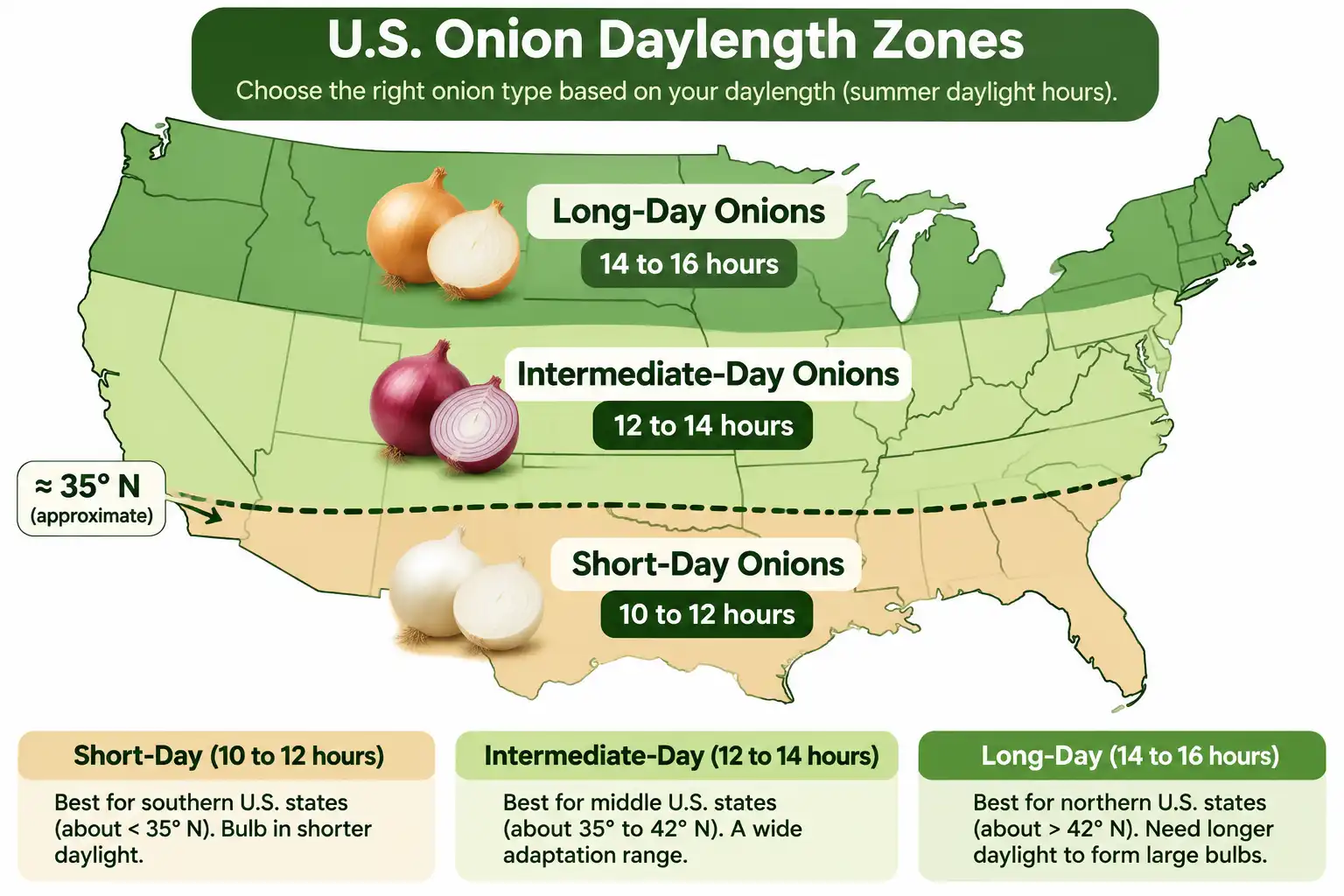
Day length decides whether an onion forms a bulb at all, so choose the type before you buy seed. An onion keeps making leaves until days reach a set length. Then it stops and swells a bulb instead.
Texas A&M AgriLife Extension and University of Georgia Extension draw those lines a little differently:
| Type | Texas A&M AgriLife | UGA Extension | Examples from the Texas A&M list |
|---|---|---|---|
| Short day | 10 to 12 hours | 11 to 12 hours | Granex, Early Grano 502, Yellow TX Supersweet 1015 |
| Intermediate day | 12 to 14 hours | 13 to 14 hours | Cimarron, Yula, Alabaster |
| Long day | 14 to 16 hours | 15 hours or more | Armado, Carmen |
That one-hour gap on long-day types matters most in the middle of the country. Near 35° N, the longest summer days run just over 14 hours. So a variety that needs 15 may bulb poorly there, and an intermediate type is the safer buy.
Seed catalogs put the short-day and long-day dividing line near 35° N, roughly Tennessee’s southern border west through Albuquerque. Treat it as a guide rather than a hard rule. In Minnesota, University of Minnesota Extension notes that short-day sweet onions usually form small bulbs. Going the other way, UGA suggests harvesting a mistaken long-day planting in Georgia as green onions over winter.
When to Start Onion Seeds
Your start date depends on which way your season runs. Northern growers sow indoors in late winter and transplant in spring. In the South, growers sow in fall and harvest the next spring.
Early starts pay off in bulb size. Texas A&M AgriLife ties bulb size to the number and size of leaves a plant carries. So every leaf grown before bulbing counts.
For a spring transplant, count back from the day you plan to set plants out. Iowa State University Extension sows 8 to 10 weeks ahead, while UMN Extension allows 10 to 12.
| Location | Method | Sow | Set out or thin |
|---|---|---|---|
| Kansas (K-State) | Indoors | Mid to late January | Transplant in March |
| Iowa (Iowa State) | Indoors | Late January to mid February | Transplant early to mid April |
| Minnesota (UMN) | Indoors | February | Transplant in May |
| South Georgia (UGA) | Direct, at final spacing | Mid October | Thin in place |
| Texas (Texas A&M AgriLife) | Direct | October through December | Thin at about 6 inches tall |
The Iowa sowing dates count back 8 to 10 weeks from its April planting window.
In the South, the risk runs the other way. Plants that grow large before winter tend to bolt. For that reason, UGA advises waiting until mid October to direct-seed at final spacing rather than sowing in September.
How Much Onion Seed You Need
A little seed goes a long way. Texas A&M AgriLife counts about 8,500 onion seeds per ounce, or roughly 300 per gram.
Run it for a 4 by 8 raised bed:
- Plant four rows 12 inches apart down the 8-foot length.
- At 4 inches between plants, each row holds 24 onions, or 96 for the bed.
- Sow about 150 seeds to cover gaps and weak seedlings. That comes to about half a gram.
At field scale, Texas A&M AgriLife direct-seeds 2 to 4 pounds of raw seed per acre. Coated seed runs 10 to 20 pounds per acre because the coating adds weight to each seed.
How to Start Onion Seeds Indoors
Indoor sowing gives northern growers transplants that are ready when the ground is. Work through these steps in order.
- Start with fresh seed. A UC Agriculture and Natural Resources (UC ANR) seed viability chart lists onion seed at about one year. So buy new seed each season.
- Fill a flat with a well-drained mix. Iowa State University Extension uses a well-drained medium in flats or plug trays. Soggy mix invites damping off.
- Sow thick but even. K-State Research and Extension spaces seeds ½ to ¾ inch apart. Then cover them ¼ to ¾ inch deep, the depth range Texas A&M AgriLife lists.
- Keep the flat warm until sprouts appear. K-State holds flats at 75 to 80°F, while UC ANR puts the optimum at 68 to 77°F. A heat mat set near 75°F meets both.
- Cool the seedlings once they are up. K-State moves them to 60 to 65°F at 1 to 2 inches tall. Iowa State gives 55 to 65°F and warns that warmth above 65°F plus weak light makes spindly plants.
- Keep the mix evenly moist. UMN Extension stresses even moisture, since a dried-out flat stalls germination.
- Thin crowded flats early. If plants come up crowded, Iowa State thins them within 2 to 3 weeks of germination.
Light, Feeding, and Trimming Seedlings
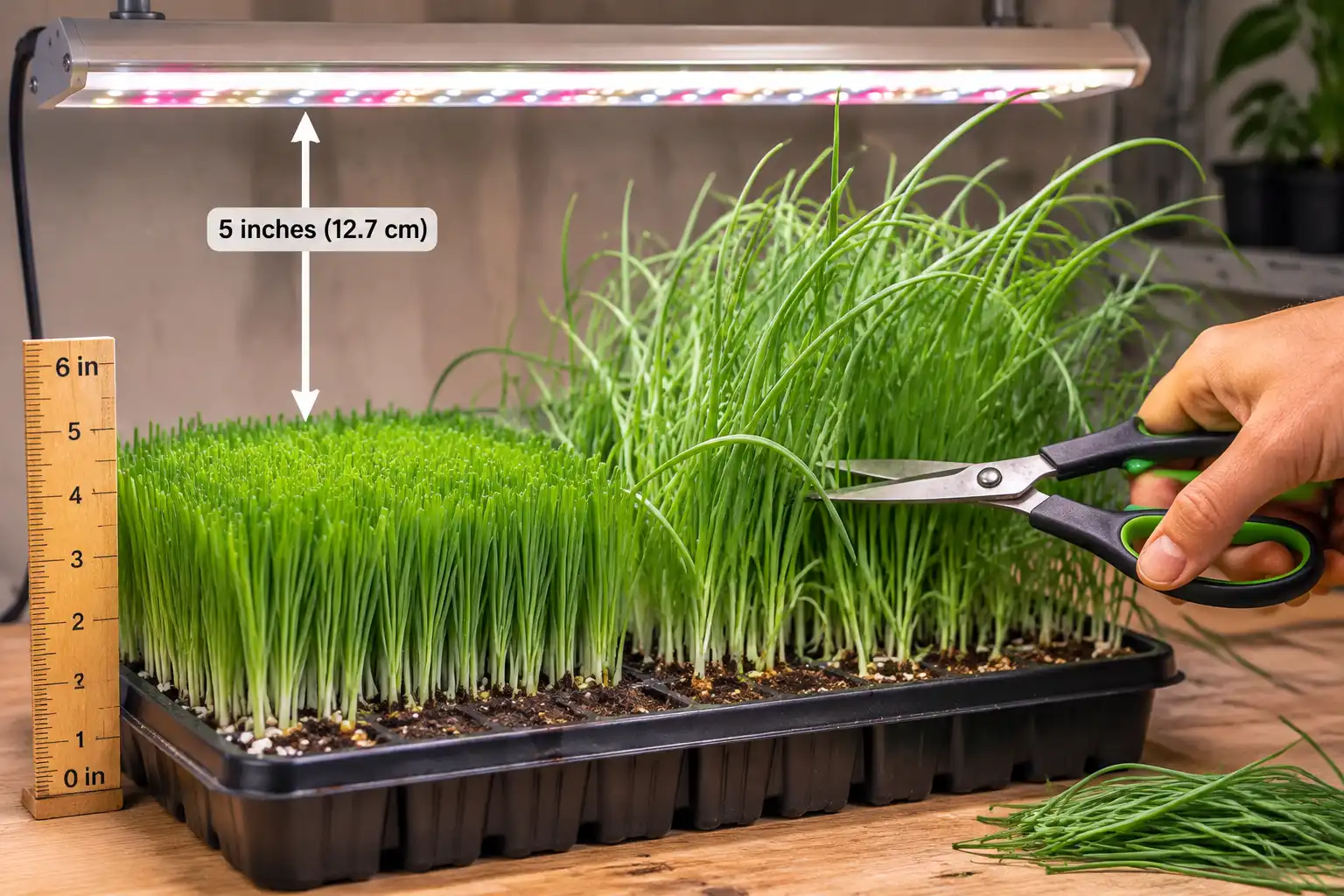
Light matters most once seedlings emerge. Iowa State University Extension moves them under lights right after germination. Keep the fixture no more than 4 to 6 inches above the leaves. A basic shop light does the job.
Next comes feeding. K-State Research and Extension starts a soluble fertilizer once plants reach 2 to 3 inches tall. Apply it with every watering or every other one.
Then trim. Onion seedlings grow thin, and the old seed coat often clings to a leaf tip for weeks. K-State recommends clipping the leaf ends when plants reach 4 to 5 inches tall, which makes them stockier. After that, snip again whenever the tops flop over the edge of the flat. The clippings taste like chives, so toss them in a salad.
Hardening Off and Transplanting
Harden seedlings for 7 to 10 days before planting, per Iowa State University Extension. Start them in a shady, sheltered spot, then give them more sun each day. Also, bring the flat indoors if the forecast calls for 32°F or colder.
Plant once temperatures reach about 50°F. UMN Extension notes that onion transplants handle a light frost. In Iowa, that point usually arrives in early to mid April.
Prepare each plant before it goes in:
- Tease the plants apart and trim the roots to ½ inch.
- Cut the tops back to 4 inches.
- Set plants 3 to 4 inches apart in rows 12 to 16 inches apart.
Those figures come from UMN Extension. UGA spaces short-day transplants a little wider, at about 5 inches apart in rows 12 inches apart. So use the wider spacing for the largest bulbs. Use the tighter one if you plan to pull every other plant as a green onion.
Depth is where the sources split. UMN Extension sets transplants 2 inches deep, but Texas A&M AgriLife plants them ¾ inch deep and no deeper than 1 inch. Where your state’s extension service publishes a depth, follow it.

Direct Seeding Onions in the Garden
Direct seeding skips the flat, but it asks more of your weeding. Onion seedlings start slow and grassy, so fast weeds shade them out early.
In northern gardens, UMN Extension sows as soon as you can work the soil in spring. Spread seed in a 2-inch-wide band, ¼ to ½ inch deep, in rows 12 to 18 inches apart. Then thin to 3 to 4 inches once the seedlings are up. Expect slow emergence in cold ground, because UC ANR ties good emergence to soil of at least 55°F.
In the South, direct seeding happens in fall instead. Texas A&M AgriLife sows ¼ inch deep and 1 inch apart from October through December. When plants stand about 6 inches tall, thin to one every 2 to 3 inches and eat the pulls as green onions.
Hoe shallowly in either region. UMN Extension warns that deep hoeing injures bulbs and leaves them prone to disease.
Soil and Fertilizer for Seed-Grown Onions
Onions want loose, well-drained soil with a pH of 6.0 to 7.0, per UMN Extension. Work in well-rotted manure or compost ahead of planting, but never fresh manure. If the ground is thin, spend a season improving soil fertility with compost or a cover crop first.
Let a soil test set phosphorus and potassium. UMN notes that many Minnesota soils already hold enough phosphorus. Learning to interpret soil test results tells you whether to add any.
For a garden bed, Texas A&M AgriLife mixes 2 to 3 pounds of 10-10-10 per 100 square feet. Work it into the top 3 to 4 inches. On a 4 by 8 bed, that works out to about 10 to 15 ounces.
Once roots are established, side-dress with nitrogen. UMN Extension applies urea (45-0-0) at 0.25 to 0.5 pound per 25 feet of row, once or twice a season. That equals 1.6 to 3.2 ounces per 10 feet of row. Scratch it in about 6 inches from the plants.
At field scale, Texas A&M AgriLife’s commercial guide totals 70 to 150 pounds of nitrogen per acre. It applies 20 pounds before planting, then 25 to 40 pounds every three weeks. Side-dressing stops 40 days before maturity. That cutoff matters, since UMN Extension links excess nitrogen to thick necks, soft bulbs, and poor storage.
Watering From Transplant to Harvest
Onions need steady moisture from planting to bulb swell. UMN Extension calls for at least one thorough soaking a week whenever rain falls short of 1 inch.
Soil type changes how far that inch goes. One inch wets sandy soil about 10 inches deep, but clay only about 6 inches. So sandy beds need water more than once a week. To check, dig with a trowel. If the soil is wet only 1 or 2 inches down, keep watering.
For field planning, Texas A&M AgriLife puts seasonal demand at 25 to 30 inches, or 1 to 3 inches a week. Stand establishment and bulb development are the two periods to protect. To size a system for your acreage, estimate crop water use against expected rainfall.
Finally, stop watering when bulbs reach full size and the tops begin to fall. Both UMN and Texas A&M AgriLife end irrigation at that point, which lets the necks dry down before curing.
Troubleshooting Onions Grown From Seed
Most failures trace back to timing, temperature, or nitrogen.
Plants Sent Up Flower Stalks
Cold triggers onion bolting, not day length, per Texas A&M AgriLife. Pencil-size plants that sit in the low to mid 40s for a long stretch bolt most often. That makes it the reverse of lettuce bolting, which heat and long days drive. So in the South, avoid early fall sowing. Pull any bolted plants for fresh use, because UGA notes a seed head ruins the bulb.
Bulbs Stayed Small
Check the day-length type first, since a short-day variety in the North bulbs before it has grown enough leaves. Next, look at the weather. Texas A&M AgriLife reports no bulbing below 50 to 60°F, whatever the day length. Crowded rows also cap bulb size, so thin to full spacing.
Necks Stayed Thick and Will Not Dry
Too much nitrogen is the usual cause, per UMN Extension. So stop side-dressing about 40 days before maturity, as the Texas A&M AgriLife commercial schedule does.
Seedlings Are Thin and Floppy
Weak light and room temperatures above 65°F cause spindly growth, according to Iowa State University Extension. Lower the light to 4 to 6 inches above the leaves, cool the room, and trim the tops.
Bulbs Rot After Harvest
UMN Extension names Fusarium basal rot, Botrytis neck rot, and bacterial soft rot as the main onion rots. All three belong to a wider group of field crop diseases. Harvest on a dry, cool day and cure fully. Also, choose varieties resistant to Fusarium basal rot where it has caused trouble before.
When to Harvest and How to Cure
Harvest when about half the tops have fallen over and dried, per UMN Extension. The Texas A&M AgriLife commercial guide starts harvest anywhere from 50 to 80 percent of tops down. Either way, pick a dry, cool day, since that limits rot after harvest.
Loosen before you lift. UMN Extension undercuts bulbs with a spading fork. Texas A&M AgriLife loosens the soil several inches below the bulbs, then pulls. In dry, warm weather, the bulbs can stay on the ground for several days.
Next, cure storage onions in a warm, airy spot. UMN Extension cures at 75 to 90°F for two to four weeks. Curing ends when the outer scales are dry and the neck is tight. After that, braid the tops or cut them off.
Store cured long-day bulbs cool, dry, and above freezing. UMN notes that onions sprout when held above 40°F. Short-day sweet onions behave differently. UGA groups them with catalog terms like non-storing, so plan to use them fresh.

FAQs About Grow Onions From Seed
How long does it take to grow onions from seed?
Texas A&M AgriLife puts harvest at 120 to 210 days after direct seeding, or 85 to 95 days after transplanting. Add 8 to 12 weeks in the flat when you start transplants indoors.
How long do onion seeds take to sprout?
Onion seed sprouts fastest in soil at 68 to 77°F, the optimum range UC ANR gives. Below 55°F, fewer than 70 percent of seeds emerge within two weeks, so cold flats and early spring beds lag behind.
How deep should you plant onion seeds?
Plant onion seed ¼ to ½ inch deep outdoors, the depth UMN Extension uses for direct seeding. Texas A&M AgriLife lists a wider range of ¼ to ¾ inch for field seeding.
Is it better to grow onions from seed or sets?
Seed costs less and offers far more varieties than sets. Sets are easier to plant and quicker to mature, so they suit growers who care more about convenience than variety choice.
Can you grow green onions from bulb onion seed?
Yes, any bulb onion works as a green onion. Texas A&M AgriLife picks them from pencil size until bulbs start to form, so your thinnings become a useful early harvest.
Can you save seed from your own onions?
Yes, but onions are biennials, so they flower only after a winter of cold in their second year. Hybrids such as Granex types also will not come true from saved seed.
What to Check Before You Plant
Check three things before any seed goes in. First, confirm the variety’s day-length type fits your latitude, since no amount of care fixes the wrong type. Next, count back 8 to 12 weeks from your transplant date, or plan a mid fall sowing in the South. Finally, let a soil test set phosphorus and potassium, and plan to stop nitrogen 40 days before maturity.