Are Onions Tubers? No, They Are Bulbs Built From Leaves
Onions grow underground beside potatoes in most gardens, so the two often get filed together. Are onions tubers, though? Botanically, no. And the difference is more than a label. It changes how you plant the crop, what makes it size up, and how you store the harvest.
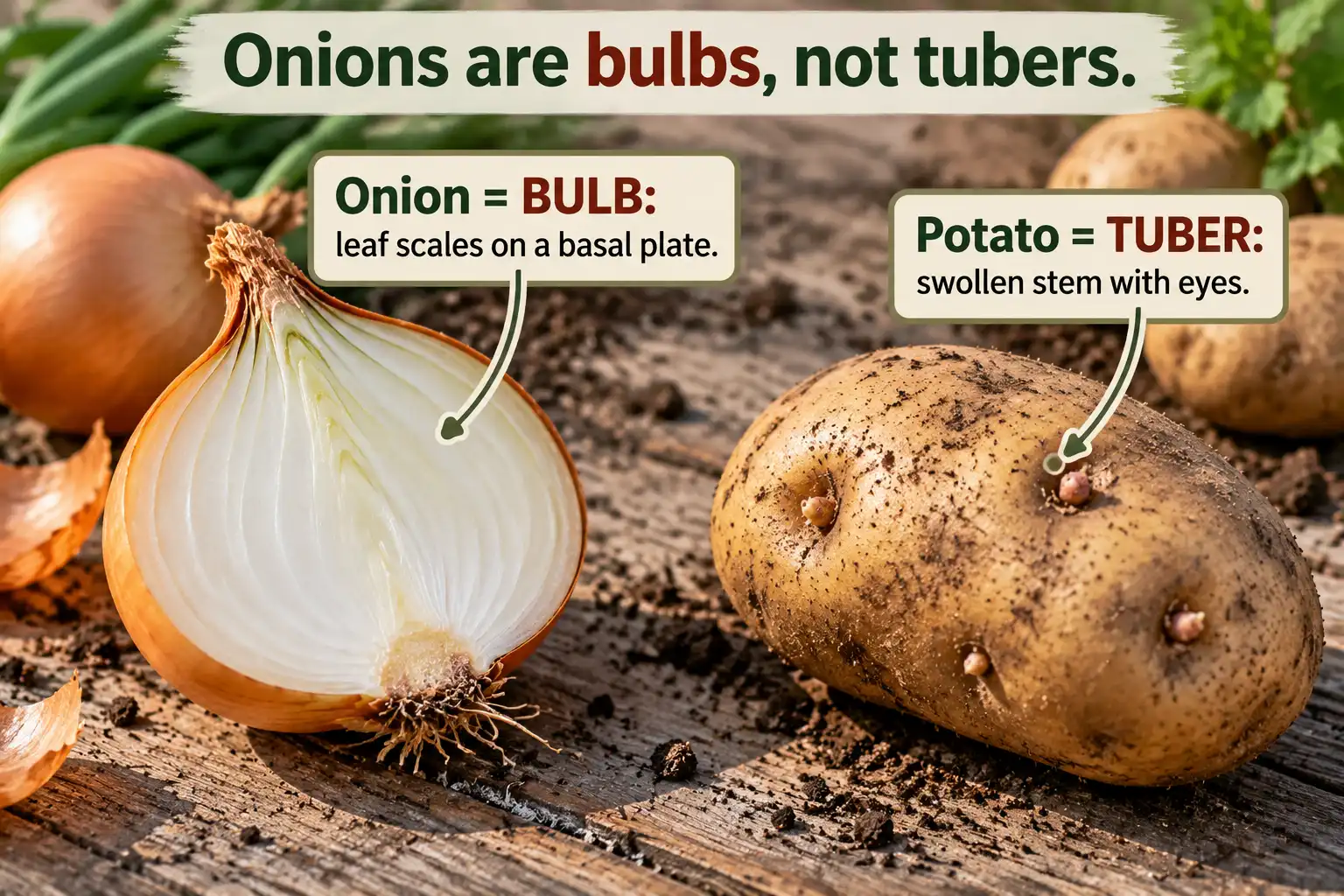
Onions are not tubers. Each onion is a true bulb: a short, flat stem called the basal plate wrapped in fleshy leaf scales. A tuber, like a potato, stores food in swollen stem tissue and has no basal plate.
Are Onions Tubers or Bulbs?
Onions are bulbs, not tubers. Penn State Extension counts both bulbs and true tubers as modified stems, which explains the mix-up. The real split is where each one stores its food.
A potato packs its reserves into swollen stem tissue. An onion does the opposite. Its stem shrinks to a thin disk, and its leaves do the storing.
UF/IFAS Extension defines a true bulb as a compressed underground stem, the basal plate. A growing point sits on it, wrapped in fleshy modified leaves called scales. The onion is its first example. A tuber is also an underground stem. However, it stores food in the stem itself and has no basal plate.
So when you cut a potato, you are looking at stem. Cut an onion, and you are mostly looking at leaves.
What an Onion Bulb Is Made Of
An onion bulb has five parts, and only one of them is stem.
- Basal plate: the flat, hard disk at the root end. It is the onion’s true stem.
- Roots: thin, fibrous roots that grow from the underside of the basal plate.
- Fleshy scales: the rings you slice and cook. Each one is the thickened base of a leaf.
- Tunic: the papery outer skin. UF/IFAS notes it keeps the bulb from drying out, which makes onions and garlic “tunicate” bulbs.
- Growing point: the bud at the center, which sends up new leaves or a flower stalk.
Texas A&M AgriLife Extension makes the leaf connection practical. Its onion growing guide notes that each leaf forms one ring in the bulb. More leaves mean more rings and bigger onions. In practice, every leaf the plant grows before bulbing starts adds size at harvest.

Bulb vs Tuber vs Root: How Underground Crops Compare
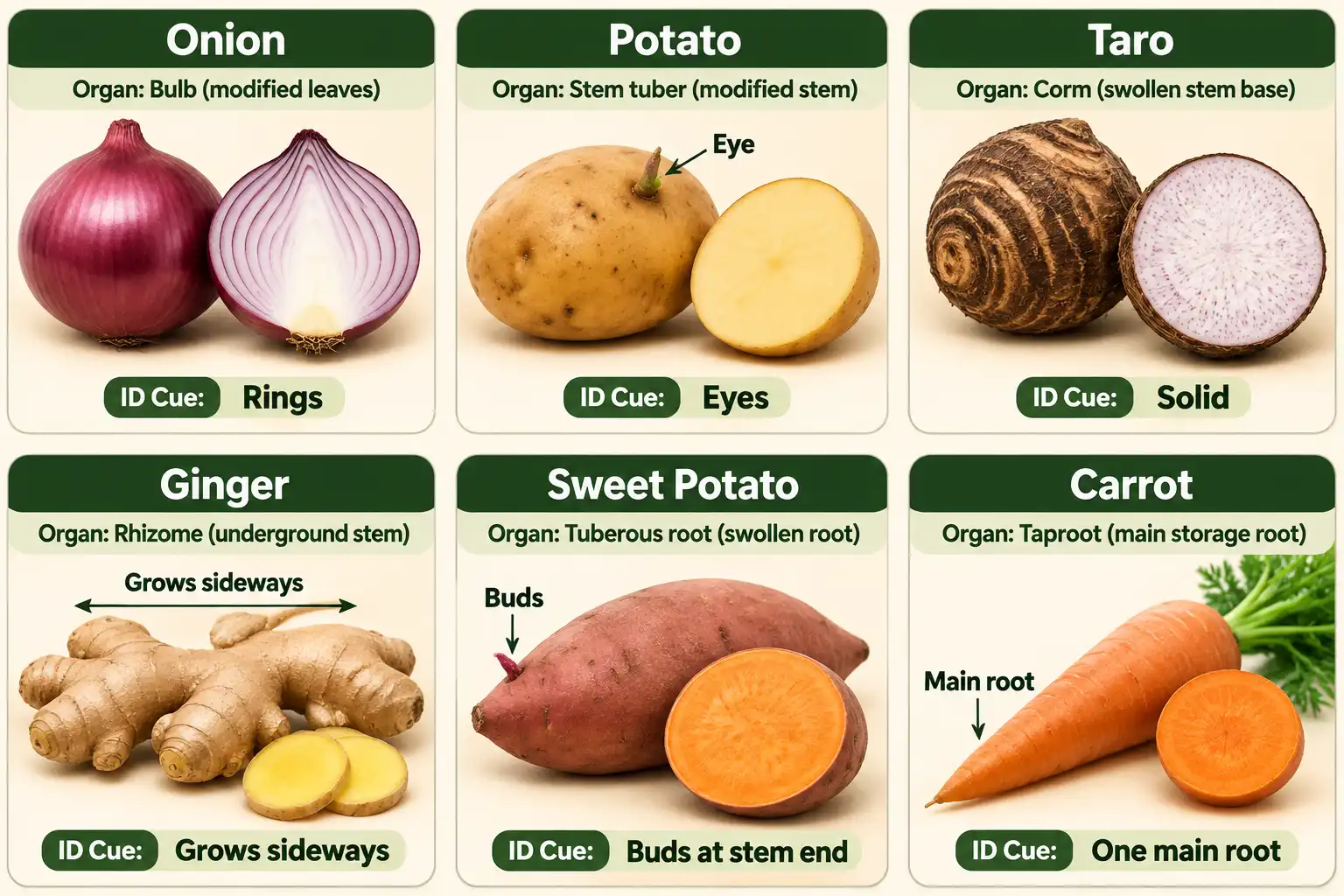
Six kinds of underground storage organs show up in vegetable gardens, and only two are true roots. The table follows the definitions used by Penn State Extension and UF/IFAS Extension.
| Organ | Built from | Food stored in | How to spot it | Crop examples |
|---|---|---|---|---|
| True bulb | Short stem plus leaf bases | Leaf scales | Rings, papery skin | Onion, garlic, shallot |
| Stem tuber | Swollen stem | Stem tissue | Eyes, no basal plate | Potato, sunchoke |
| Corm | Swollen stem base | Stem tissue | Solid, no rings | Taro, water chestnut |
| Rhizome | Sideways stem | Stem tissue | Grows sideways, has nodes | Ginger, turmeric |
| Tuberous root | Swollen side root | Root tissue | Buds only at stem end | Sweet potato, cassava |
| Taproot | Main root | Root tissue | One thick root, no eyes | Carrot, beet, turnip |
For a quick check, cut the vegetable in half. Rings point to a bulb. Solid flesh with eyes on the skin points to a tuber.
Sweet potato is the one that trips people up. It often gets called a tuber. Penn State Extension, however, classifies it as a tuberous root: a side root thickened to store food. Potatoes really are stem. Their eyes are buds, which is why seed potatoes can grow a whole new plant from one piece.
Is an Onion a Root Vegetable?
In the kitchen, yes. In botany, no. Penn State Extension points out that “root vegetable” is a cooking category, not a botanical one. As a result, it sweeps in bulbs, tubers, and true roots alike.
The only real roots on an onion are the fibrous strands you trim off the basal plate. What you eat is almost entirely leaf.
Nutrition guidance splits onions from potatoes, too. USDA MyPlate places potatoes in the starchy vegetable subgroup. Onions, however, sit in the “other vegetables” subgroup alongside cabbage and green peppers. So an onion does not count as a starchy side the way a potato does.
Why the Difference Matters When You Grow Onions
Because an onion builds its bulb from leaves, it follows a different calendar than a potato. Three practical differences come out of that anatomy: what triggers bulbing, how you plant, and how you store.
Onions Bulb on Day Length
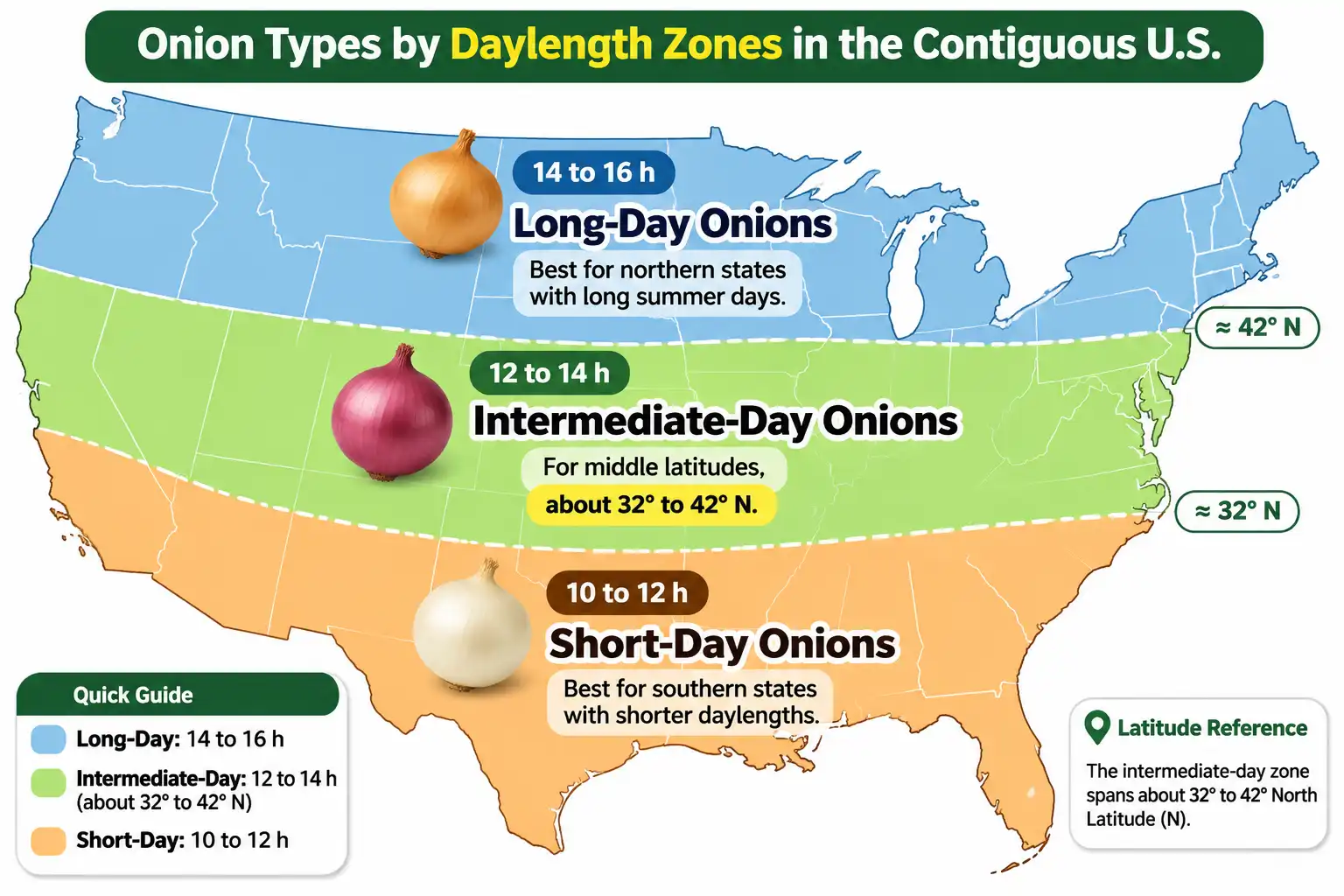
An onion grows leaves until the days reach a set length. Then it switches to swelling the bulb. That trigger is bred into each variety, so the day-length class on the label matters more than the variety name.
| Day-length class | Daylight to start bulbing | Where it fits | Example varieties |
|---|---|---|---|
| Short-day | 10 to 12 hours (UF/IFAS); 11 to 12 hours (Texas A&M) | Southern states; the only type UF/IFAS advises for the Florida Panhandle | TX 1015Y, Granex |
| Intermediate | 12 to 14 hours (UF/IFAS); 12 to 13 hours (Texas A&M) | Roughly 32° to 42° N, zones 5 and 6, per UF/IFAS | Cimarron, Sierra Blanca |
| Long-day | 14 to 16 hours (both) | Northern states | Yellow Sweet Spanish |
The two services agree on long-day onions. However, they set the short-day and intermediate thresholds about an hour apart, so treat those lines as approximate.
Texas A&M AgriLife Extension adds a temperature rule: no bulbing occurs below 50 to 60°F, whatever the day length. UF/IFAS also notes that short-day onions carry more water and sugar and thinner skins. For that reason, they store for less time than long-day types.
Onions Go in Whole, Potatoes Go in Pieces
A potato tuber has eyes all over its skin, and Penn State Extension notes each eye is a bud. That is why growers cut seed potatoes into chunks with an eye on each. An onion set, by contrast, has one growing point at the center of its basal plate. So it goes in whole, root end down.
Depth works the other way, too. Potato tubers form along buried stems and turn green in light, which is why growers hill potato rows. Onion bulbs swell near the surface instead.
Planting guidance differs slightly by service:
- Iowa State University Extension: sets 1 to 1.5 inches deep, 2 to 3 inches apart, rows 12 to 15 inches apart.
- Texas A&M AgriLife Extension: sets or transplants 3/4 inch deep, 3 inches apart, never deeper than 1 inch.
On a 4 by 8 raised bed, rows 12 inches apart fit four rows along the 8-foot length. At 2 to 3 inches apart, each row holds 32 to 48 sets, or 128 to 192 for the bed.
Set size matters as well. Iowa State University Extension advises sorting sets first, because those larger than a nickel often bolt and make poor bulbs. Plant the big ones close together for green onions instead.
Onions Store Dry, Potatoes Store Humid
The two crops want nearly opposite storage air. NDSU Extension files onions under “cold and dry” and advises keeping them away from potatoes.
| Crop | Curing | Storage temperature | Relative humidity |
|---|---|---|---|
| Onions | Single layer in a warm, airy spot until necks wither, 2 to 4 weeks | 32 to 40°F | About 65% |
| Potatoes | About 2 weeks in the dark at 50s °F and 80 to 90% humidity | 42 to 55°F | About 90% |
That fits the anatomy. UF/IFAS notes the onion’s papery tunic keeps the bulb from drying out. So, unlike a potato, it does not need humid air. For potatoes, NDSU adds that colder storage makes them sweeter, while warmer storage may make them sprout.
Why Onions Fail to Bulb or Bolt
Most onion problems trace back to two traits: a bulb built from leaves, and a two-year life cycle. A bulb is the resting stage before a flower stalk, so a long chill can push the plant to flower early.
| What you see | Likely cause | What to do |
|---|---|---|
| Large green tops, small or no bulb | Long-day variety in the South, or temperatures below 50 to 60°F | Buy the day-length class for your latitude |
| Bulbs form early and stay small | Short-day variety in the North, or late planting with few leaves | Plant earlier and choose intermediate or long-day types |
| Flower stalk (bolting) | Pencil-size plants chilled in the low to mid 40s °F for a long stretch, or oversized sets | Plant sets smaller than a nickel |
| Soft or sprouting bulbs in storage | Skipped curing, or warm, damp storage | Cure until necks wither, then store at 32 to 40°F |
Texas A&M AgriLife Extension ties bolting to temperature rather than day length. In fact, the risk peaks when fast early growth meets a cool spell. Carrots share the same two-year habit, and a similar cold trigger explains carrots that flower early.
FAQs About Onions Tubers
Is garlic a tuber?
No, garlic is a bulb with papery skin, just like the onion. UF/IFAS Extension lists both as tunicate bulbs, but garlic splits into cloves that each grow a new plant.
Is a sweet potato a tuber?
No, a sweet potato is a tuberous root, a side root swollen with stored food, per Penn State Extension. The white potato is the true tuber, formed from stem tissue.
Is a potato a root?
No, a potato is a stem tuber, not a root. Penn State Extension explains that its eyes are buds, and each eye can sprout into a whole new potato plant.
Is an onion a stem or a leaf?
An onion is both stem and leaf, per UF/IFAS Extension. The flat basal plate at the root end is the true stem, and the rings you eat are thickened leaf bases.
Are green onions bulbs?
No, green onions are young plants pulled before a bulb forms, or bunching types that never form one. Texas A&M AgriLife Extension says you can pick bulb onions green from pencil size until bulbing begins.
Can you store onions and potatoes together?
No, keep onions and potatoes in separate storage spots, as NDSU Extension advises. Onions keep best in dry air near 65% relative humidity, while potatoes need damp air near 90%.
What to Check Before You Plant Onions
Treat the onion as a leaf crop on a short stem, not a buried tuber. First, match the day-length class to your latitude, since no amount of care fixes the wrong class. Next, plant small sets whole and shallow, and give the plants time to build leaves before bulbing starts. Then cure the harvest until the necks wither, and store it cold and dry, away from your potatoes.