Do Carrots Flower in the First Year? Causes and Prevention
They sometimes do, although most cultivated carrots follow a two-year life cycle. If your carrots develop tall stalks and white flowers sooner than expected, understanding the cause can help you protect your harvest.
Yes, carrots can flower in their first year, but this is uncommon for most garden varieties. Carrots normally bloom during their second growing season. Premature flowering, called bolting, usually results from prolonged cold exposure or genetic differences.
When Do Carrots Normally Flower?
Carrots normally flower in their second growing season because they are biennial plants.
During the first season, a carrot (Daucus carota subsp. sativus) produces leaves and stores carbohydrates in its thickening taproot. This is the part harvested for food.
When a mature carrot survives winter, cold exposure can trigger the reproductive stage. As growth resumes, the plant produces a tall flowering stalk and eventually develops seeds.
The normal life cycle follows this pattern:
| Growth stage | What happens |
|---|---|
| First growing season | Leaves develop, and the edible storage root enlarges. |
| Winter or prolonged cold period | Cold exposure can initiate the transition toward flowering. |
| Second growing season | A tall flower stalk develops, followed by white flower clusters and seeds. |
| After seed production | The biennial plant completes its life cycle and dies. |
Most carrots never reach the flowering stage because growers harvest their roots much earlier.
According to the University of Maryland Extension, many garden carrot varieties reach harvest maturity approximately 65-75 days after planting.
Why Do Carrots Flower in the First Year?
First-year flowering usually occurs when cold temperatures trigger a carrot to begin reproductive development earlier than expected.
1. Prolonged cold exposure
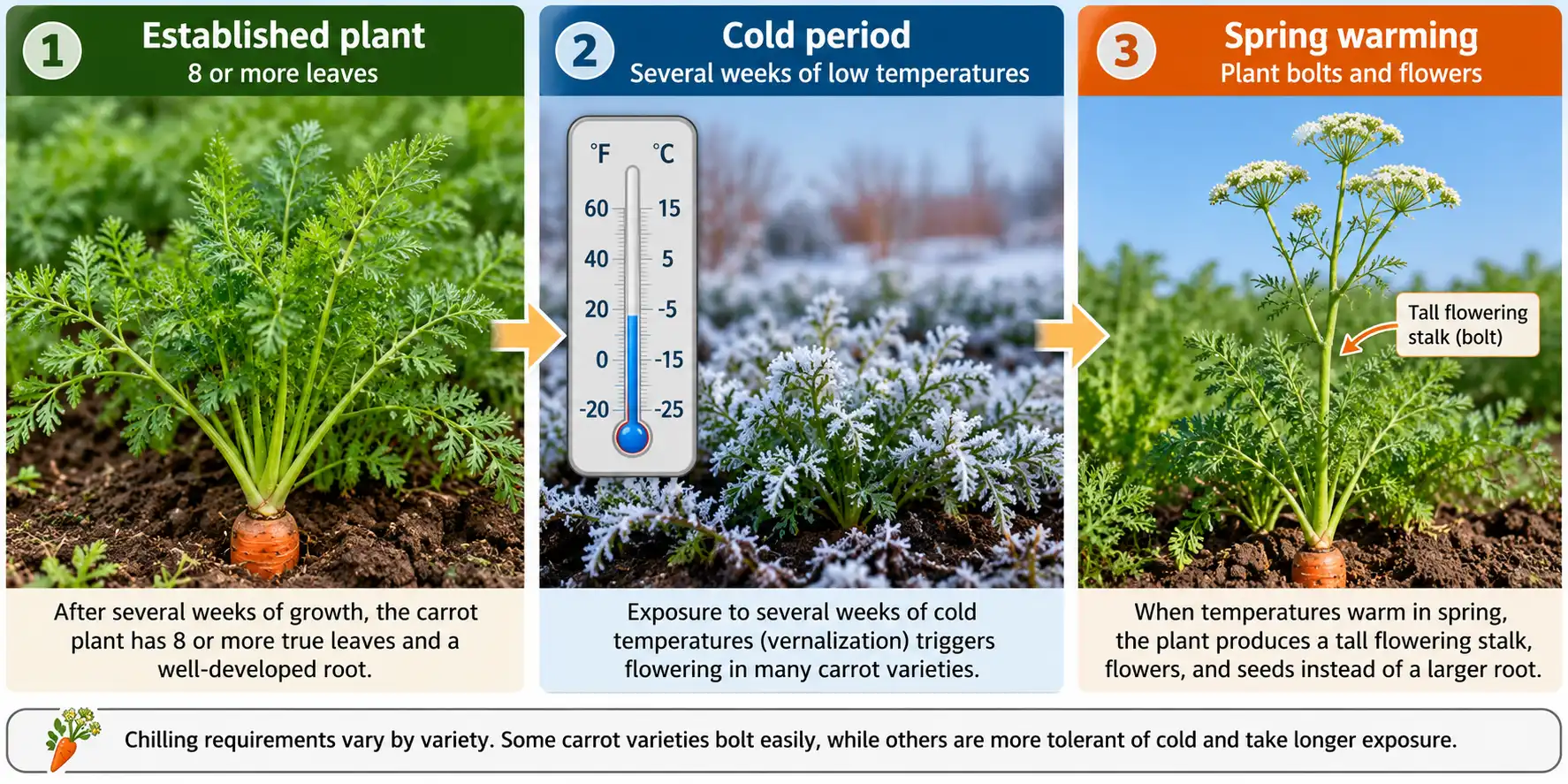
The main trigger is vernalization, a biological response to extended exposure to low temperatures.
Michigan State University Extension identifies the following general conditions for carrot vernalization:
- Plants generally become responsive after developing more than eight leaves.
- Temperatures around 35-43°F are particularly effective.
- Depending on the variety, approximately 5-12 weeks of cold exposure may initiate flowering.
University of Georgia Extension describes a somewhat different production range, with approximately 6-8 weeks below 50°F associated with carrot flower induction.
These differences reflect cultivar and growing-condition effects. Neither temperature range guarantees that every carrot will bolt.
A single frosty night generally does not provide the sustained chilling required.
2. Warmer weather following a cold period
After sufficient chilling, rising spring temperatures can accelerate flower-stalk growth.
A carrot may appear healthy during cold weather, then develop a tall stalk as temperatures increase.
This differs from the heat-driven flowering common in lettuce. The temperature-management approach for preventing lettuce from bolting does not directly apply to carrots.
3. Genetic differences between carrot varieties
Not every carrot requires the same amount of chilling.
A 2024 study published in Frontiers in Plant Science describes differences between annual-flowering and biennial carrot types.
Most temperate commercial root varieties have biennial flowering habits. However, some carrot populations adapted to warmer regions can flower during their first growing season with little or no chilling requirement.
What Does a Flowering Carrot Look Like?
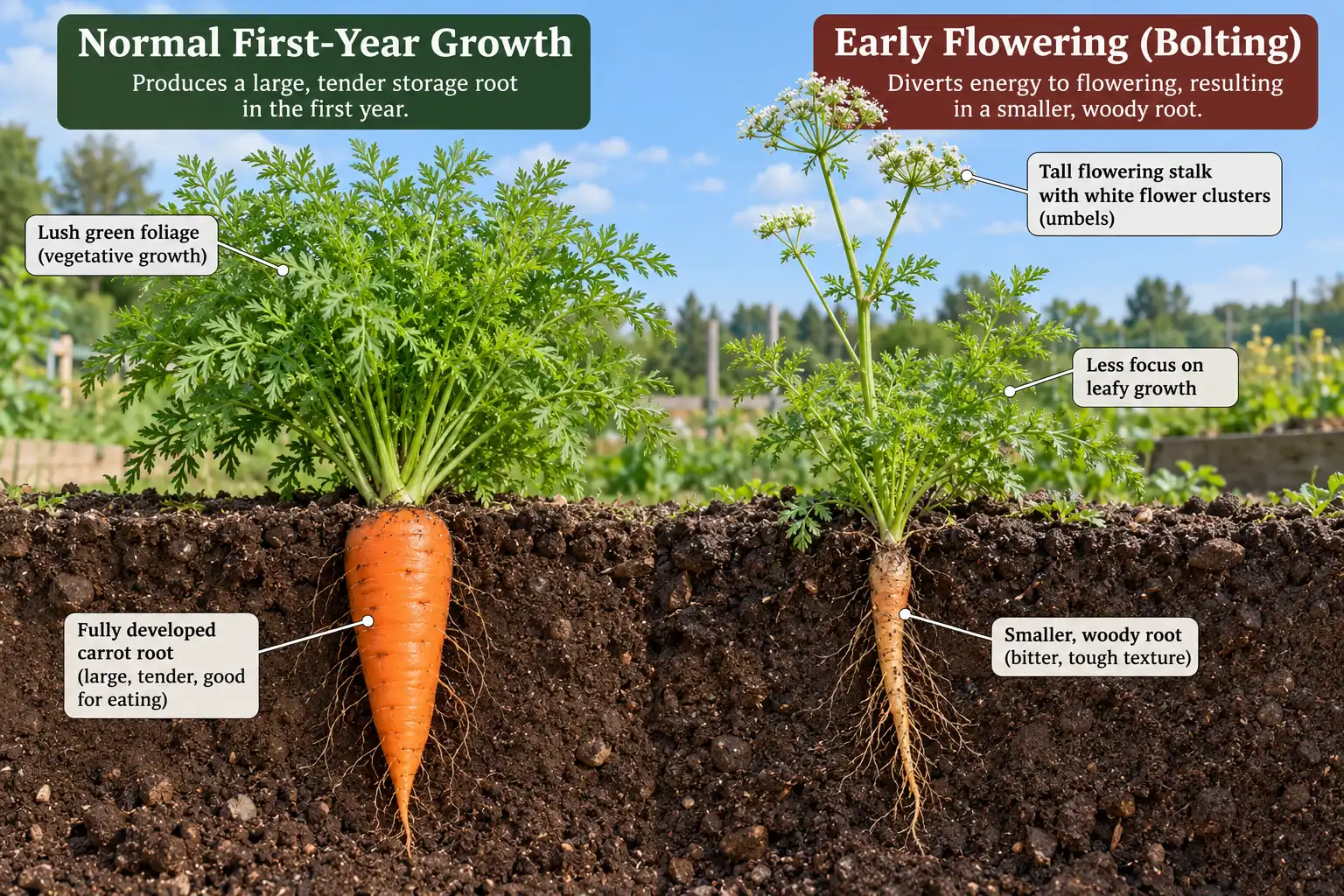
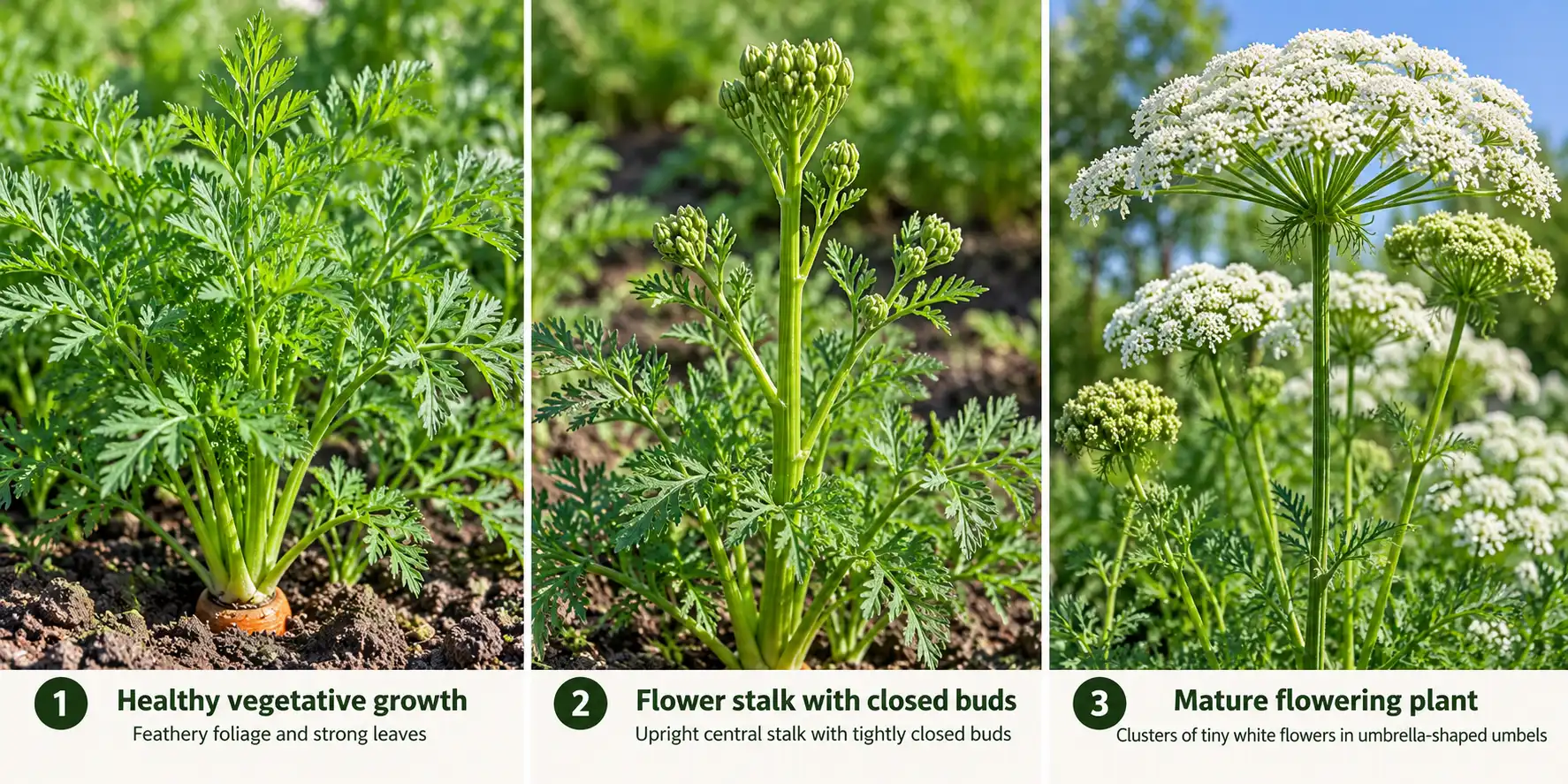
A flowering carrot develops a noticeably tall central stalk above its normal feathery foliage.
The earliest visible sign is often a firm, upright stem emerging from the center of the leafy crown.
As the plant enters its reproductive stage, it typically develops these features:
- Tall central stalk: An upright stem extends above the surrounding leaves.
- Flower buds: Small clusters begin forming near the top of the stem.
- White flowers: Numerous tiny flowers open in umbrella-shaped clusters called umbels.
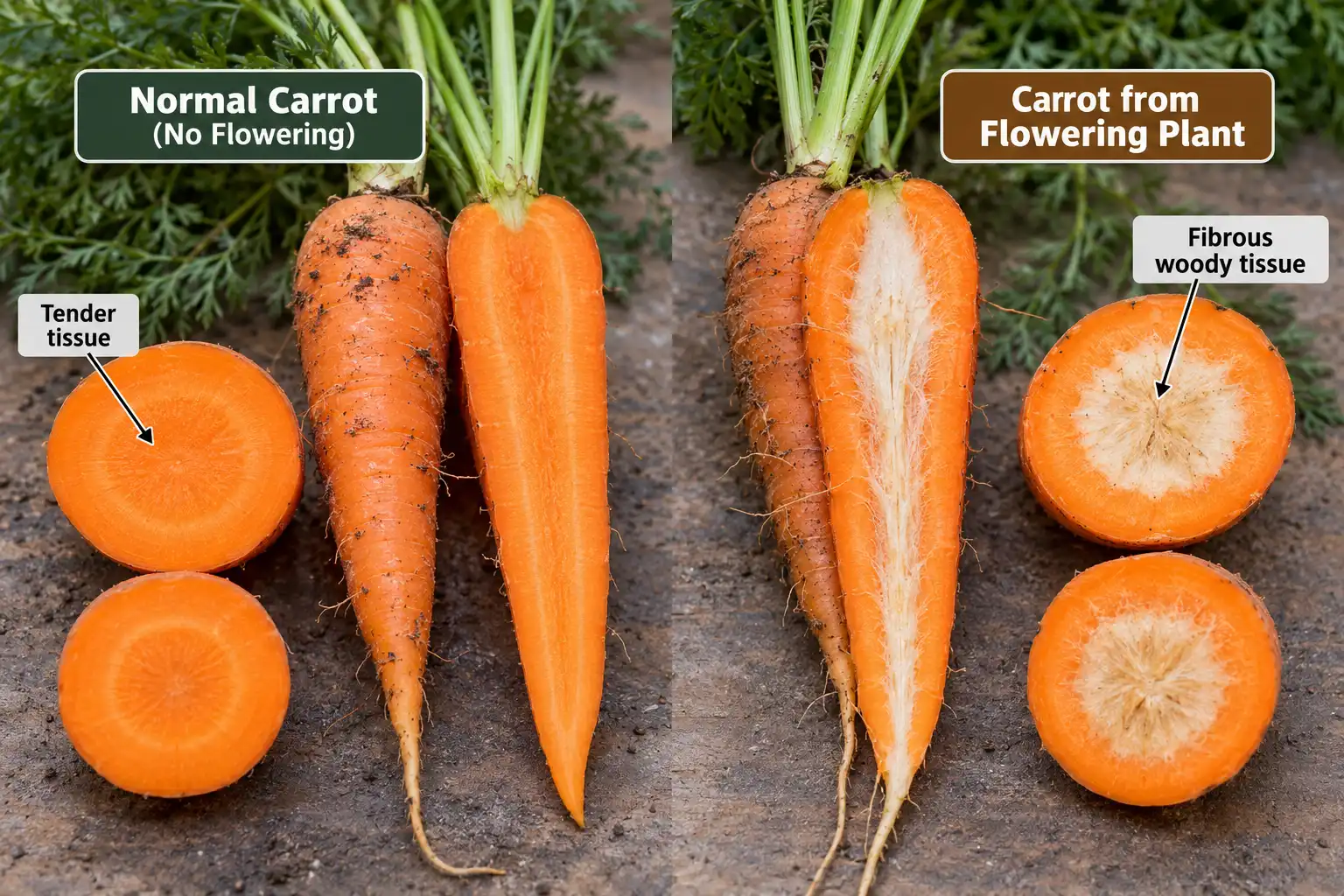
- Changing roots: The storage root may become harder, more fibrous, and less desirable for eating.
A carrot can already be bolting before the white flowers appear.
The comparison below helps distinguish normal growth from premature flowering.
| Observation | Likely meaning |
|---|---|
| Short, leafy crown with no central stalk | Normal vegetative growth |
| Upright central stalk becoming taller | Early bolting |
| White, umbrella-shaped flower clusters | Active flowering |
| Hard, stringy root beneath a flower stalk | Root quality has declined |
White flowers alone do not confirm that a plant is a cultivated carrot. Wild carrot and some poisonous plants have similar-looking flowers, so never eat an unidentified plant.
Can You Eat a Carrot After It Flowers?
Flowering does not automatically make a correctly identified carrot root poisonous. However, its eating quality usually deteriorates significantly.
Once reproductive development begins, the plant redirects stored energy toward flowering and seed production.
The storage root undergoes structural changes. Its central tissues become increasingly woody and fibrous.
The 2024 carrot-flowering research in Frontiers in Plant Science describes rapid lignification of root tissues during this transition, sometimes before the flowering stalk becomes visible.
If you notice a new flower stalk, dig up one affected carrot and examine it.
A root that is still firm, crisp, and tender may remain usable if harvested promptly. However, a root with a hard, stringy center is unlikely to provide acceptable eating quality.
Once a carrot has developed mature flowers, do not expect a tender storage root.
What Should You Do When Carrots Start Flowering?
Once a carrot begins producing a flower stalk, removing that stalk will not reliably restore normal root development.
Your next step depends on whether you want edible roots or seeds.
| Your goal | Recommended action |
|---|---|
| Harvest edible carrots | Dig affected plants promptly and inspect their roots. |
| Protect the remaining crop | Check nearby plants for developing central stalks. |
| Maintain marketable root quality | Separate bolted carrots from roots intended for sale or storage. |
| Grow flowers for pollinators | Leave selected plants to bloom where unwanted reseeding is manageable. |
| Save carrot seeds | Use appropriately selected plants and manage cross-pollination. |
For a larger planting, measure how widespread the problem is.
For example, if 10 out of 100 inspected plants have flower stalks, the visible bolting rate is 10%.
A 100-foot bed containing four seeded rows, with six plants per row-foot, holds approximately 2,400 carrots. A 5% visible bolting rate represents about 120 affected plants.
At 4-foot bed centers, one acre contains approximately 109 equivalent 100-foot bed units. The same planting density and 5% rate would represent roughly 13,100 visibly bolted plants per acre.
These are illustrative calculations, not expected loss rates. Field estimates should use actual stand counts and representative sampling.
How Can You Prevent Carrots From Flowering Early?
The most effective approach is to match planting dates and carrot varieties to the expected temperature pattern.
You cannot control every cold spell. However, several planting decisions can reduce avoidable exposure and protect root quality.
1. Choose a suitable planting window. Avoid schedules that expose established carrots to many weeks of flowering-inducing cold before harvest.
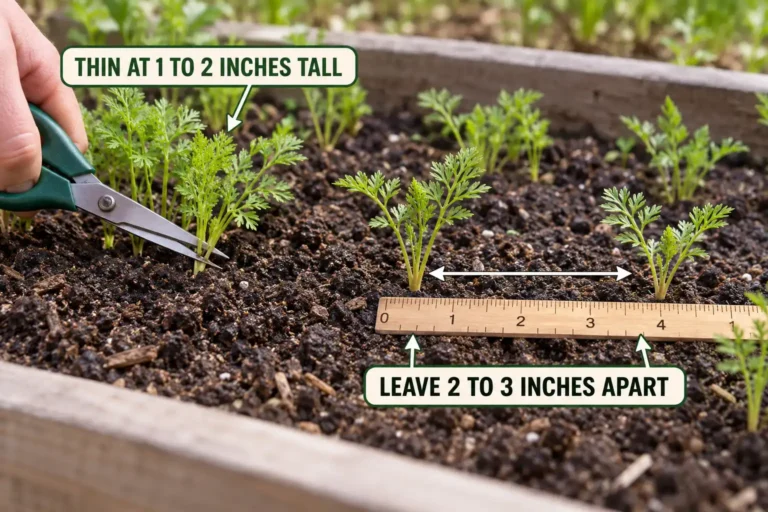
2. Monitor soil temperature. Maryland Extension recommends planting when soil reaches at least 45°F. Sow seeds approximately 1/4-1/2 inch deep and thin garden carrots to roughly 1-2 inches apart, adjusting for the variety.
3. Harvest roots on schedule. Check the cultivar’s maturity period and root size. Do not leave mature carrots indefinitely into spring if prolonged winter chilling has occurred.
4. Choose varieties for the season. Look for documented low-bolting performance under similar growing conditions. Early maturity, winter hardiness, and bolting resistance are different characteristics.
5. Maintain consistent moisture. Adequate water improves root growth, although watering cannot reverse cold-induced flowering.
For field or bed irrigation planning, use crop water requirement calculations alongside rainfall and soil moisture observations.
Soil fertility also affects root development. Understanding your soil test results can help avoid unnecessary fertilizer applications, but fertilization does not reverse bolting.
Does Carrot Flowering Risk Change by Region?
Yes. The risk depends on when carrots develop, how long they experience cold temperatures, and when the crop is harvested.
| U.S. growing region | Common risk situation | Practical approach |
|---|---|---|
| Northern states and Upper Midwest | Established spring plants experience prolonged cold weather. | Follow local soil temperatures and choose a suitable spring planting window. |
| Southeast, including Georgia | Fall-planted carrots experience winter chilling followed by warmer spring conditions. | Harvest marketable roots before spring seed-stalk development. |
| Central Oregon and other high-elevation areas | Cold nights and shorter growing seasons complicate planting schedules. | Match sowing dates to local frost patterns and cultivar maturity. |
Georgia Extension identifies winter chilling followed by increasing spring temperatures as a concern for fall-planted commercial carrots.
For Central Oregon, Oregon State University Extension recommends spring carrot sowings from mid-April into early June, with local conditions determining the schedule.
Its recommended varieties include ‘Bolero,’ ‘Mokum,’ and ‘Scarlet Nantes.’ However, their appearance on a regional variety list does not establish that all three have equal resistance to bolting.
Planting advice should follow local growing conditions rather than USDA hardiness zones alone. Hardiness zones describe typical winter minimum temperatures, not the complete chilling exposure of a developing carrot crop.
Can You Save Seeds From Carrots That Flower in Their First Year?
Yes, first-year flowering carrots can produce seeds if they complete flowering, pollination, and seed maturation.
However, seeds from prematurely bolted plants are not always desirable for future root production.
An early-flowering tendency may have a genetic component. Repeatedly selecting such plants for seed could work against the goal of producing carrots with reliable biennial behavior.
Carrots also cross-pollinate with other carrot varieties and wild carrot, commonly called Queen Anne’s lace.
Oregon State University Extension confirms that carrot seed saving requires attention to this cross-pollination risk.
For dependable root production, start with suitable commercial seed or carefully maintained open-pollinated stock. Select seed parents for root quality and the desired flowering habit, not simply because they flowered early.
FAQs About Carrots Flower in the First Year
Does one frosty night make carrots bolt?
Usually not. A single frosty night is different from the sustained chilling that initiates flowering in most cultivated carrots; the required exposure varies with the variety and the plant’s developmental stage.
Do carrot flowers mean the crop has a disease?
No. White flowers and a tall central stalk are signs of reproduction or early bolting, not a disease by themselves; inspect the roots separately for decay, cracking, or other damage.
Will cutting off carrot flowers make the root grow again?
No. Once a carrot has shifted toward seed production, removing the flower stalk does not reliably restore the tender storage root; dig up an affected plant and inspect its texture before deciding whether to use it.
Can an overwintered carrot flower before it is 12 months old?
Yes. Carrots planted in late summer can flower the following spring after receiving sufficient winter chilling, even when fewer than twelve months have passed; the plant responds to developmental conditions rather than calendar age alone.
Do carrots grown in containers flower earlier than field carrots?
Not necessarily. Container-grown carrots respond to the same flowering signals as field-grown carrots, although their temperature exposure may differ; growing in a pot does not prevent flowering induced by prolonged cold weather.
Key Points for Your Carrot Crop
Most carrots produce edible roots in their first growing season and flowers in their second. When flowering happens early, prolonged cold exposure is the leading explanation for conventional biennial varieties.
Inspect flowering plants promptly, harvest usable roots, and adjust future planting schedules to your local conditions. Once a carrot develops a flower stalk, preventing further root-quality loss is more practical than trying to reverse bolting.