When Do Carrots Germinate? Soil Temperature and Sprout Timeline

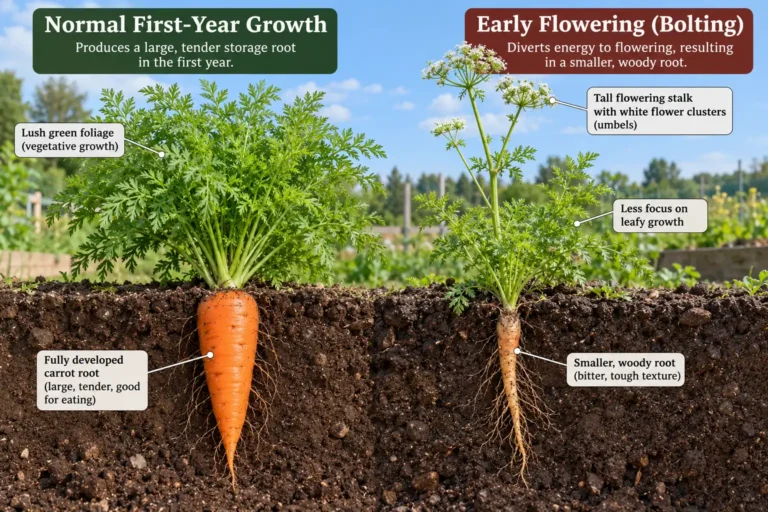
When do carrots germinate after planting? The answer depends on soil temperature, moisture, and planting depth. Carrots also look surprisingly similar to grass when they first emerge, making their earliest growth easy to overlook.
Carrot seeds usually produce visible seedlings 7 to 21 days after sowing. Very cool soil can delay emergence much longer. The first sprouts have two narrow, grass-like seed leaves, followed later by delicate, feathery true leaves.
How Long Do Carrots Take to Germinate at Different Soil Temperatures?
Carrots usually emerge within one to three weeks, but warmer soil generally speeds up the process.
Iowa State University Extension lists 7 to 21 days for carrot germination at temperatures between 50°F and 80°F.
The table below uses experimental seedling-emergence data from Oregon State University Extension. Its figures describe seeds planted 1/2 inch deep at specific soil temperatures.
| Soil temperature | Approximate days to emerge | What to expect |
|---|---|---|
| 41°F | 51 days | Extremely slow emergence |
| 50°F | 17 days | Slow early-spring growth |
| 59°F | 10 days | Moderate germination speed |
| 68°F | 7 days | Faster, more predictable emergence |
| 77°F | 6 days | Rapid emergence with adequate moisture |
These are experimental reference values, not guaranteed outdoor results.
Utah State University Extension gives a more conservative estimate of 14 to 21 days at its preferred 55°F to 65°F soil temperatures.
The recommendations differ because they describe different reference conditions. In practice, changing temperatures, uneven moisture, and soil crusting can extend the wait.
Also, germination technically begins below ground when the seed produces its first root. The times above primarily help predict when seedlings become visible.
What Do Carrots Look Like When They First Come Up?
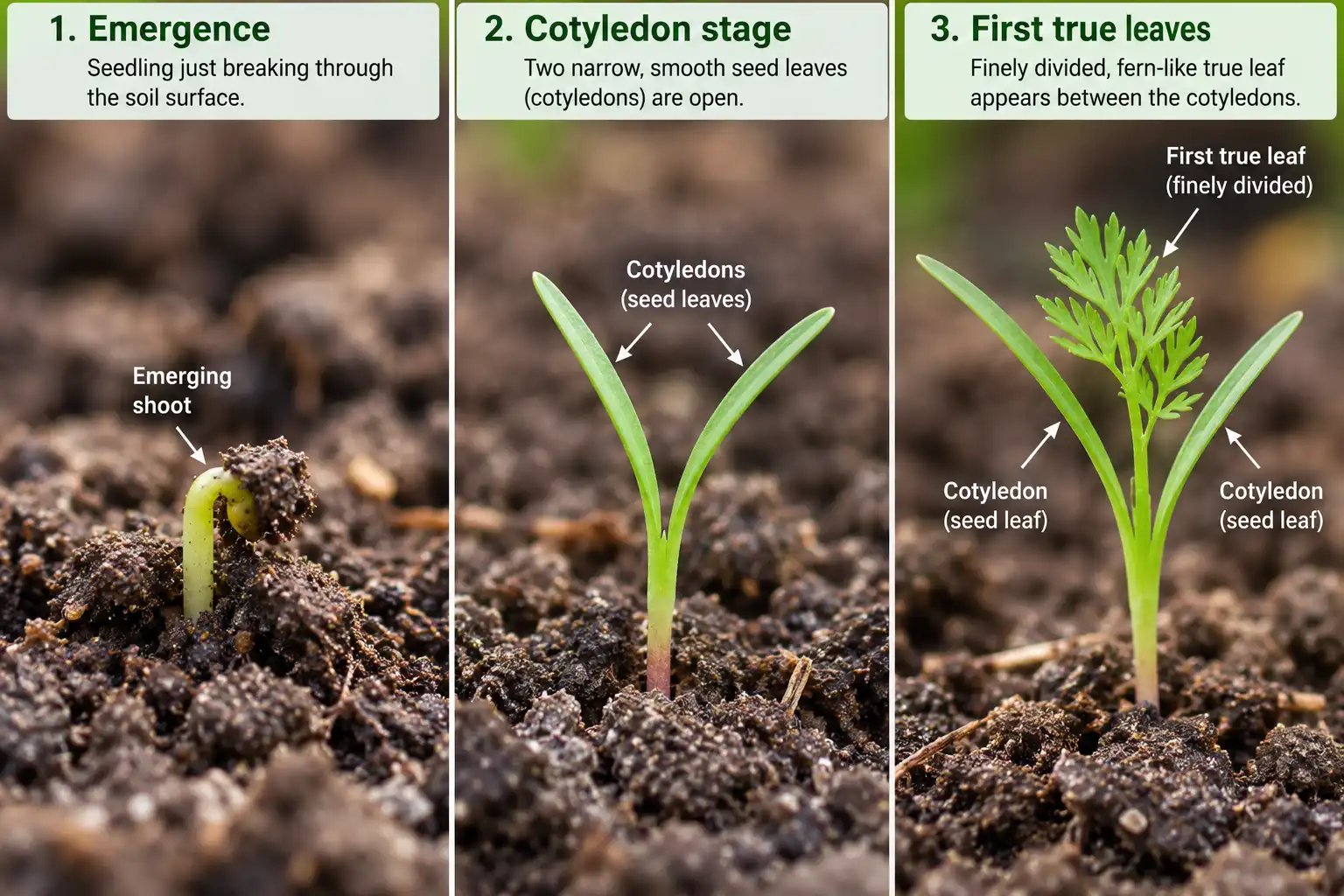
New carrot seedlings resemble tiny grass plants, with two long, narrow green leaves emerging from a thin stem.
These first leaves are called cotyledons, or seed leaves. They look different from the finely divided foliage associated with mature carrots.
According to the University of Minnesota Extension, newly emerged carrot seedlings have two grass-like leaves. The next leaves develop a frilly, fern-like shape.
How to identify a young carrot seedling
Look for three changes as the seedling develops:
- Initial emergence: A delicate green shoot pushes through the soil.
- Cotyledon stage: Two smooth, narrow seed leaves open on a slender stem.
- True-leaf stage: A small, feathery leaf grows from the center between the seed leaves.
UF/IFAS describes the first true leaf appearing approximately three to four weeks after sowing.
The same basic progression occurs in carrot types such as Nantes, Danvers, and Chantenay. Their mature root shapes differ, but their earliest seed leaves are not reliable variety identifiers.
How to distinguish carrot sprouts from grass and weeds
Carrot cotyledons occur as a matching pair. Grass seedlings generally begin with a single blade, although other weeds can resemble young carrots.
Check whether the seedlings follow your planted row. If identification remains uncertain, wait for the carrot’s feathery true leaves before removing nearby plants.
How to Help Carrot Seeds Germinate Successfully
Consistent surface moisture, shallow planting, and a loose seedbed give carrot seeds a better chance of emerging evenly.
1. Prepare a loose, fine seedbed
Break up large clods and remove rocks from the planting area.
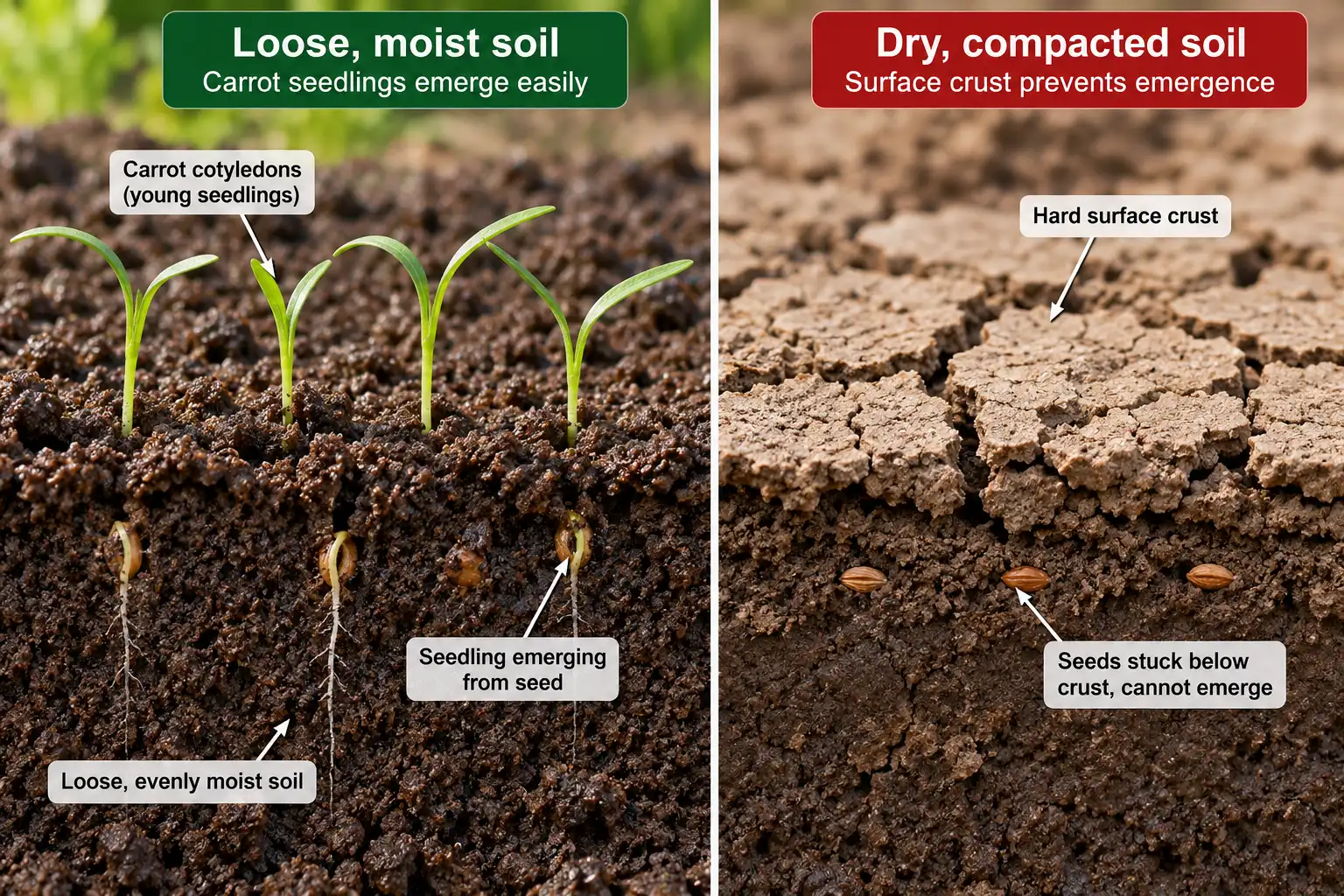
Carrot seedlings are delicate. A hard soil crust can prevent shoots from reaching the surface, even when seeds have started growing.
If the soil repeatedly hardens after rainfall, improving its structure before the next planting may help. Building organic matter is one part of improving garden soil naturally.
2. Sow seeds at the correct depth
Plant carrot seeds approximately 1/4 to 1/2 inch deep.
The University of Maryland Extension recommends this depth range for home gardens.
Cover the seeds with fine soil and gently firm the surface to ensure contact between the seed and soil.
Avoid burying them under a thick layer of soil or coarse mulch.
3. Keep the surface consistently moist
Water gently immediately after sowing.
Check the upper 1/2 inch of soil daily. Apply light irrigation whenever that layer begins drying.
The goal is evenly damp soil, not standing water.
On sandy beds or during windy weather, the surface can dry quickly even when deeper soil remains moist.
4. Prevent soil crusting
Heavy rain or forceful watering can compact the soil surface.
Utah State University Extension recommends covering planted seed with fine compost or sand to help seedlings establish in crust-prone soil.
If a crust develops, gently moisten it with a fine spray. Avoid disturbing the shallow seeds.
5. Mark the planted rows
Carrot seeds can take weeks to emerge, leaving bare rows that are easy to disturb.
The University of Minnesota Extension suggests planting a few radish seeds with carrots as row markers. Radishes emerge faster and can be removed before they crowd the carrots.
This method helps protect slow-growing carrot seedlings during early weeding.
When Should You Plant Carrots for Reliable Germination?
Planting time varies by region because carrot seeds respond to soil temperature rather than calendar dates alone.
Northern states and cold spring regions
Spring sowing generally begins when the soil is workable and warming.
For Minnesota, the University of Minnesota Extension recommends planting carrots from mid-April through early June.
Cold April soils may delay germination considerably. Soil temperatures closer to 50°F produce more predictable emergence than temperatures barely above 40°F.
Mid-Atlantic and temperate regions
Spring and late-summer plantings are practical options.
The University of Maryland Extension recommends spring sowing after soil temperatures reach at least 45°F. For fall carrots, it suggests planting approximately 10 to 12 weeks before the first frost.
Check soil conditions before sowing because late-summer beds can still be hot and dry.
Southern states with mild winters
Fall and winter planting often avoids extreme summer heat.
UF/IFAS Gardening Solutions gives carrot planting windows of August through March in North and Central Florida, and September through March in South Florida.
Utah State Extension also warns that soil temperatures above 80°F can reduce carrot seed germination.
Choose a cooler planting period when possible, particularly where summer soil temperatures remain high.
Why Are My Carrot Seeds Not Germinating?
If carrots have not emerged after three weeks, check soil temperature and seedbed conditions before assuming the seeds are dead.
The most common problems involve moisture, crusting, unsuitable temperatures, or planting depth.
| What you notice | Possible cause | What to do |
|---|---|---|
| No sprouts in cold soil | Germination is progressing slowly | Check soil temperature and allow more time |
| Soil surface repeatedly dries | Seeds lack consistent moisture | Water gently and check the top layer daily |
| Hard crust after rainfall | Seedlings cannot penetrate the surface | Moisten the crust without disturbing seeds |
| Sprouts appear only in patches | Uneven moisture or seed movement | Inspect irrigation coverage and reseed gaps if needed |
| No emergence after 21 days in warm, moist soil | Poor seed viability or incorrect depth | Inspect a small section and consider fresh seed |
How long should you wait before reseeding?
Allow approximately 21 days when soil temperatures remain within the normal germination range and the seedbed stays moist.
If nothing appears, gently uncover a small part of the row to check seed depth, moisture, and whether seedlings are trapped beneath a crust.
In very cold soil, waiting longer may be justified. Oregon State’s reference shows that emergence near 41°F can take approximately 51 days.
If the soil has been consistently warm and moist, but the row remains empty after three weeks, correcting the seedbed and sowing fresh seed is reasonable.
What Should You Do After Carrot Seedlings Emerge?
Once seedlings appear, protect their delicate roots, maintain soil moisture, and avoid pulling plants before identifying their true leaves.
Keep watering consistently
Continue gentle watering while the seedlings are small.
As roots become established, irrigation should moisten a deeper portion of the soil rather than only the surface.
Watering frequency depends on rainfall, weather, and soil texture. These factors also matter when calculating irrigation needs for growing crops.
Thin seedlings when they are established
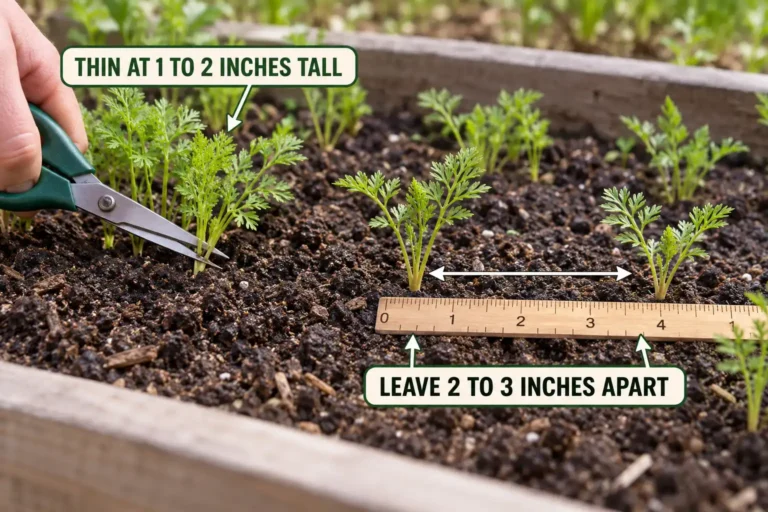
Carrots need space to develop straight, adequately sized roots.
Recommendations differ by growing system and desired root size:
- University of Maryland Extension: Thin plants to approximately 1 to 2 inches apart.
- University of Minnesota Extension: Thin seedlings when they reach about 3 to 4 inches tall, leaving roughly 2 to 4 inches between plants.
Follow the seed packet’s spacing guidance for your variety and harvest size.
Check emergence across the planting area
A few healthy seedlings do not necessarily mean the entire row has emerged evenly.
For example, at a final spacing of 2 inches, a 10-foot row has approximately 60 plant positions.
A 4-by-8-foot bed containing four 8-foot rows has about 192 positions at that spacing.
At field scale, 12-inch row spacing and 2-inch in-row spacing provide approximately 261,360 final plant positions per fully planted acre, before allowing for paths, wheel tracks, and stand losses.
These calculations estimate final spacing capacity, not the percentage of seeds that will germinate.
FAQs About Carrots Germinate
Do carrot seeds need sunlight to germinate?
No. Iowa State University Extension classifies carrots as seeds that require darkness for germination, so a thin covering of soil is appropriate. Plant seeds at the recommended depth and keep the surface consistently moist.
Can carrot seeds germinate in 40°F soil?
Yes, carrots can begin germinating near 40°F, but visible emergence may be exceptionally slow. Oregon State’s temperature reference shows approximately 51 days at 41°F, compared with about 17 days at 50°F.
Do pelleted carrot seeds germinate faster?
Pelleted carrot seeds are easier to see and space because their coating makes them larger. However, the coating does not guarantee faster emergence, and consistent moisture remains necessary for successful germination and seedling establishment.
Can you transplant carrot seedlings into empty spaces?
Direct sowing new seeds is preferable to moving established carrot seedlings. The University of Minnesota Extension explains that carrot taproots develop early, and transplanting can damage or redirect roots, resulting in misshapen carrots.
Can carrot seeds germinate in containers?
Yes. Carrot seeds can germinate in containers when the soil stays evenly moist and temperatures are suitable. Choose a container deep enough for the variety, with adequate drainage and room for root development.
Key Points for Your Carrot Row
Expect visible carrot seedlings within 7 to 21 days under suitable conditions. Keep the seedbed moist, check soil temperature before deciding seeds have failed, and identify the two narrow cotyledons before expecting the familiar feathery carrot leaves.