Can You Transplant Carrots? How to Avoid Forked Roots
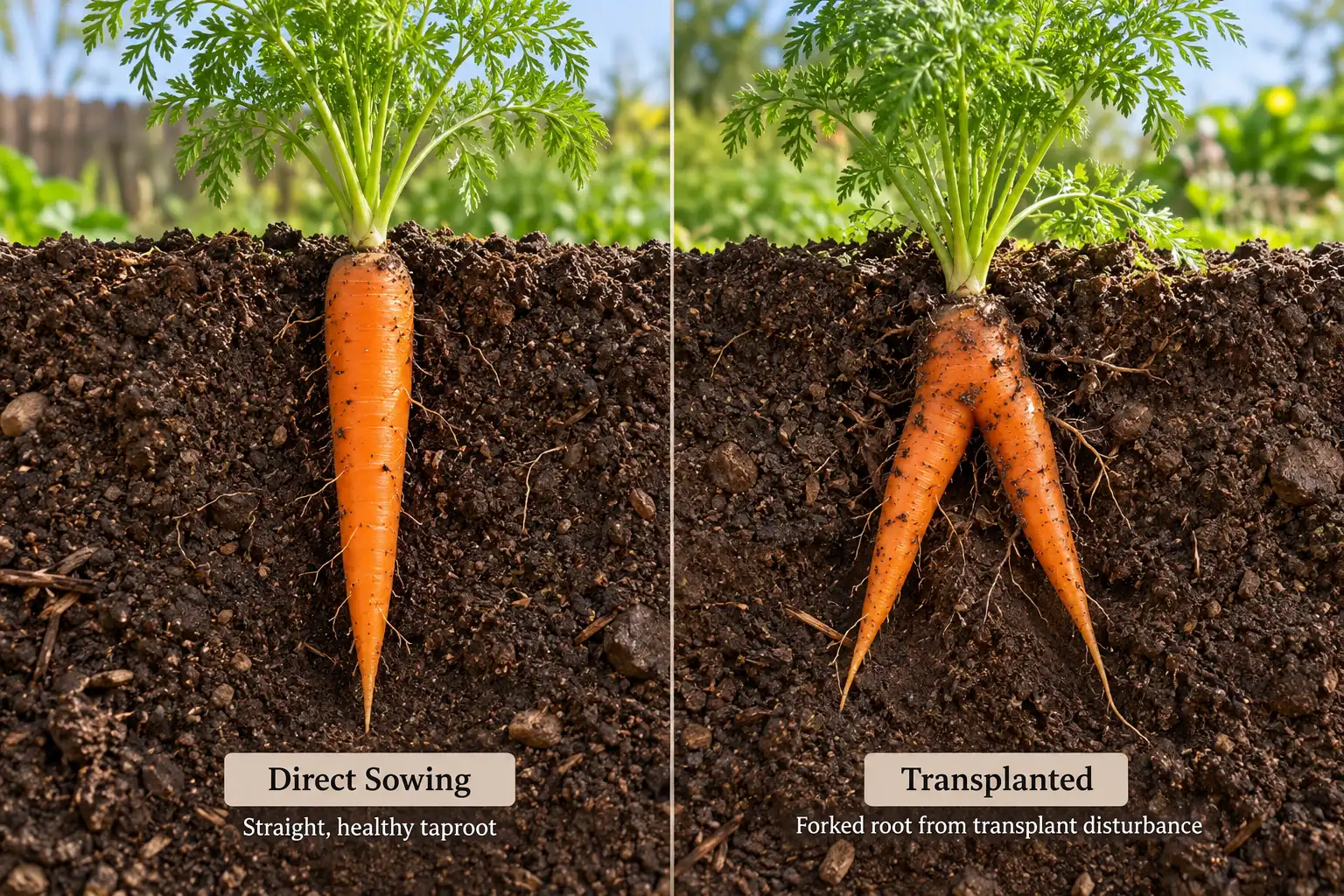
Can you transplant carrots if seedlings are crowded or already growing indoors? Yes, but moving them can damage the developing taproot. Some survive and produce usable carrots, while others become forked or misshapen. The method and timing matter more than whether the leaves survive.
You can transplant carrots, but you cannot guarantee straight roots afterward. Transplanting can bend or damage the taproot, causing forking and stunted growth. Direct sowing is safer. If necessary, move very young seedlings with their root plugs intact.
Why Do Carrots Develop Forked Roots After Transplanting?
Carrots develop forked roots when their growing taproots are damaged, redirected, or obstructed.
Unlike tomatoes or lettuce, carrots produce a long primary root that eventually thickens into the vegetable you harvest.
That root develops surprisingly early.
According to University of Minnesota Extension, carrot roots can reach their full length within three weeks after seedling emergence.
This creates three problems when transplanting:
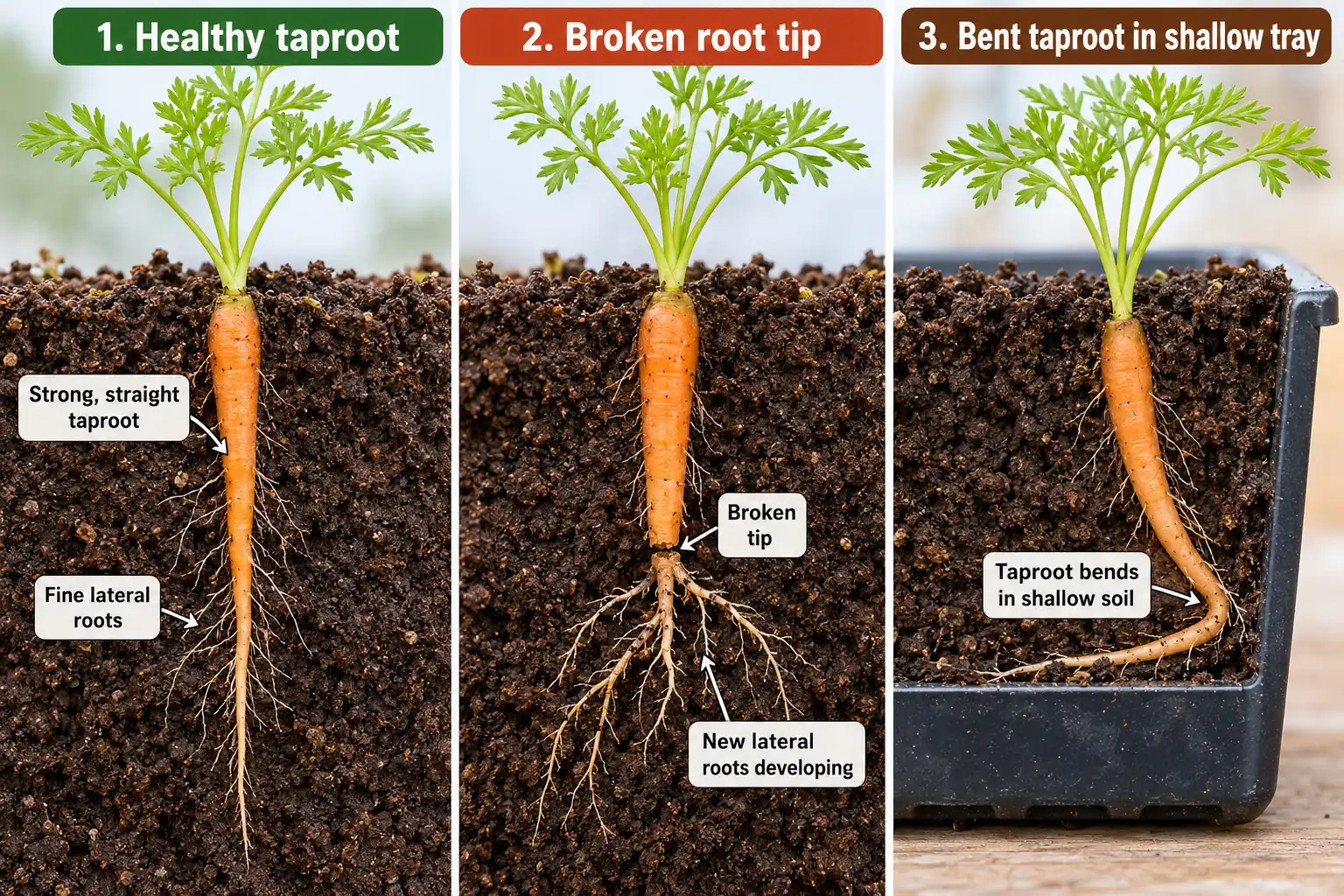
- Broken root tip: Damage can encourage secondary roots to develop, producing a forked carrot.
- Bent taproot: A root folded inside a planting hole may continue growing in an abnormal direction.
- Restricted root growth: A shallow seed tray or compacted soil can prevent normal downward development.
A transplanted carrot may still develop healthy green leaves. However, healthy foliage does not guarantee a well-shaped root underground.
Can You Transplant Carrots Without Forking?
Yes, some carrots can be transplanted without developing forked roots, but no method guarantees success.
Your best chance is to transfer a very young seedling before its taproot becomes restricted.
The Royal Horticultural Society identifies short-rooted carrot cultivars as possible candidates for careful transplanting. However, it still recommends avoiding the practice.
Which Transplanting Method Has the Lowest Risk?
| Method | Root-damage risk | Recommendation |
|---|---|---|
| Direct sowing into prepared soil | Lowest | Best for straight carrots |
| Moving an intact, young root plug | Moderate to high | Possible rescue method |
| Transplanting bare-root seedlings | High | Avoid when possible |
| Moving older, root-bound seedlings | Very high | Usually better to resow |
| Moving an entire permanent container | Low if roots remain undisturbed | Useful for container growing |
These are relative risk assessments, not measured success rates.
The important difference is whether the developing taproot stays straight and undisturbed.
Even a carefully moved seedling can fork if its root tip has already curled against the bottom of its container.
How to Transplant Carrot Seedlings With the Least Damage
If you already started carrot seedlings indoors, you can attempt to save them. Use the following method to reduce root disturbance.
Step 1: Check the Seedlings Before Moving Them
Choose small seedlings growing individually in deep cells or soil plugs.
The growing medium should hold together during removal. Roots should not be circling the container bottom or extending through drainage holes.
If the plug falls apart or the taproot is already bent, transplanting becomes riskier.
There is no reliable seedling age that guarantees successful transplanting.
Step 2: Prepare the Planting Bed
Choose loose, well-drained soil without stones or hard clumps.
Moisten the planting area before transplanting. Prepare holes deep enough to hold each complete root plug.
Avoid fresh manure and concentrated fertilizer near the roots.
Step 3: Remove Each Seedling Carefully
Water the seedling container before removal.
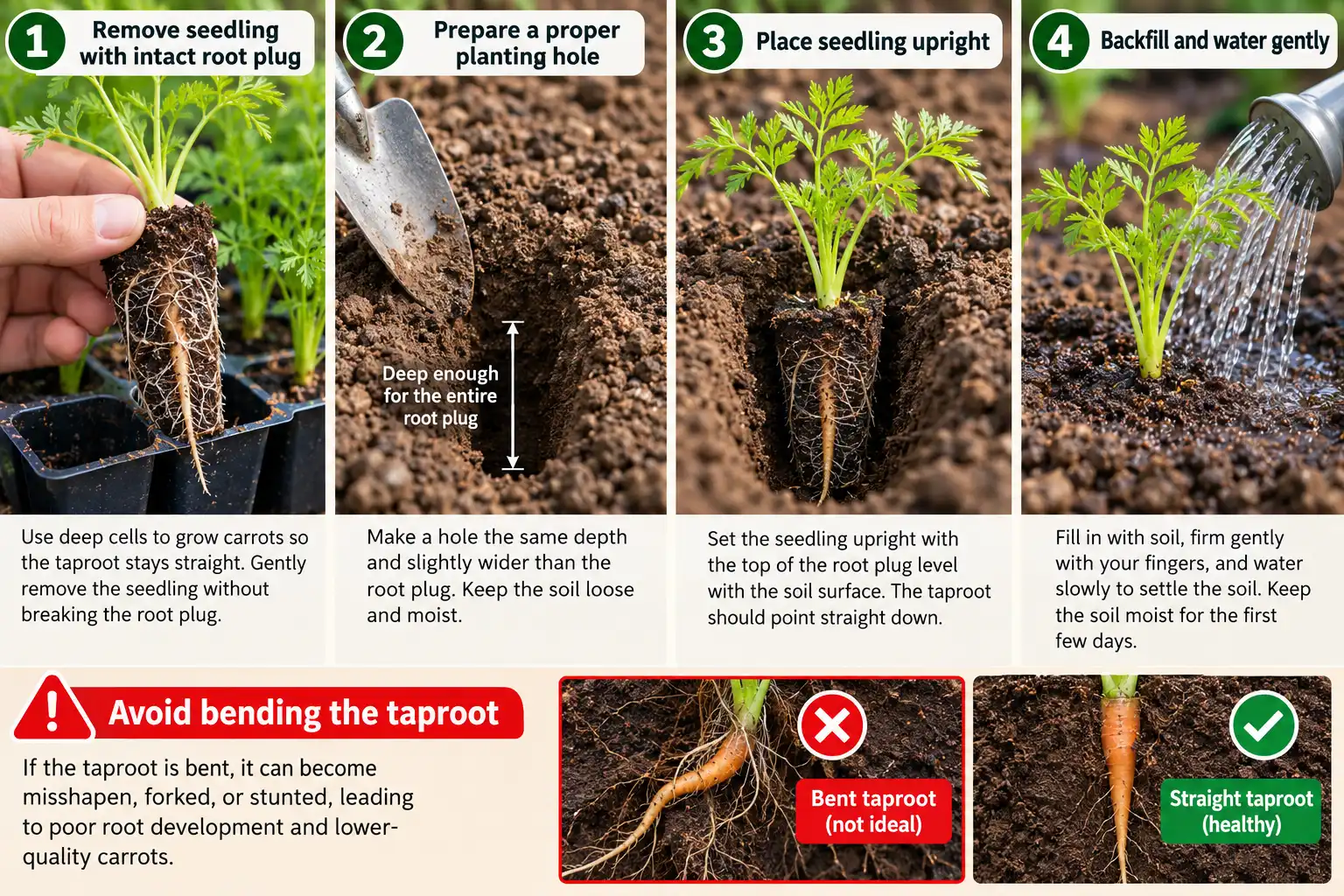
Slide the entire plug out without pulling the seedling by its stem or leaves. Keep the growing medium around its roots intact.
Do not loosen, trim, or straighten the taproot.
Step 4: Set the Plug Into the Soil
Lower the plug vertically into the prepared hole.
Keep the original soil surface approximately level with the surrounding bed. Fill empty spaces with loose soil and gently firm around the plug.
Do not fold exposed roots into a shallow hole.
Leave approximately 2 to 4 inches between plants for most home garden carrots.
Step 5: Water and Protect the Seedlings
Water gently to settle the surrounding soil.
If seedlings were grown indoors, acclimate them gradually to outdoor sunlight and wind before planting.
Use temporary light shade during strong afternoon sun if needed. Keep the soil evenly moist while seedlings establish.
Remember: These steps reduce handling damage. They cannot repair a taproot that was already broken or bent.
Can You Start Carrots Indoors?
You can germinate carrot seeds indoors, but starting them in trays for later transplanting is usually a poor choice.
The problem is not indoor germination. It is moving the developing taproot afterward.
A carrot seedling may establish its root system before it looks large enough to transplant.
When Indoor Starting May Work
A practical alternative is to grow carrots in their permanent container.
You can start the seeds indoors, provide sufficient light, and later move the entire container outside without removing the plants.
According to Oregon State University Extension, shorter carrot types such as Chantenay, Nantes, and Thumbelina are suitable for container growing. It recommends containers at least 12 inches deep.
For this approach:
- Use a container with drainage holes and sufficient root depth.
- Sow seeds directly into the final growing medium.
- Thin crowded seedlings without disturbing neighboring roots.
- Move the whole container outdoors when conditions are suitable.
A small nursery pot intended for later transplanting is not the same as a permanent growing container.
Best choice: If your goal is full-sized, straight carrots in garden soil, plant the seeds directly into that soil.
How to Direct Sow Carrots for Straighter Roots
Direct sowing allows the taproot to develop in its final position without transplant disturbance.
Iowa State University Extension recommends the following planting practices for home gardens.
| Growing requirement | Recommended practice |
|---|---|
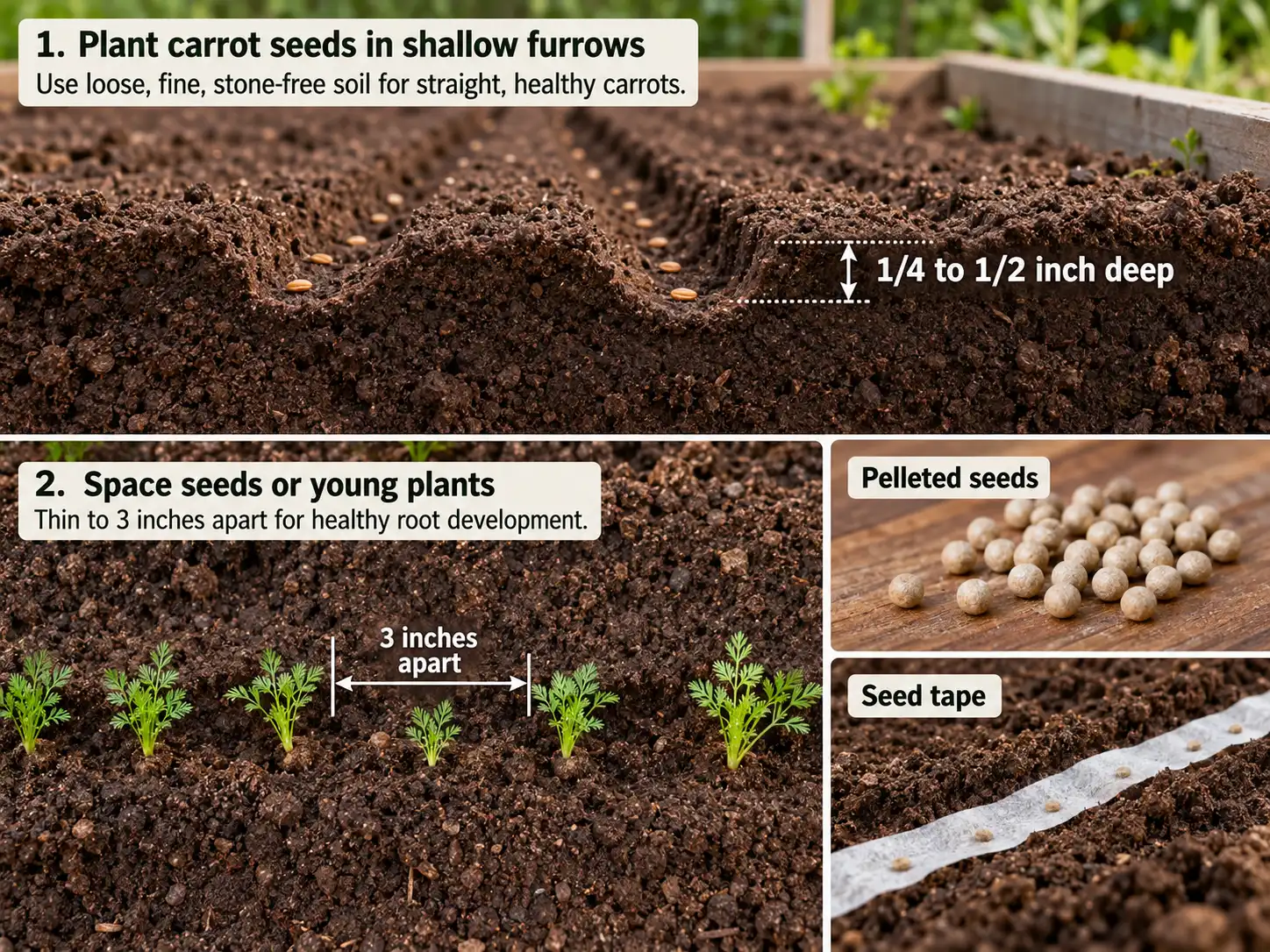
| Seed depth | 1/4 to 1/2 inch |
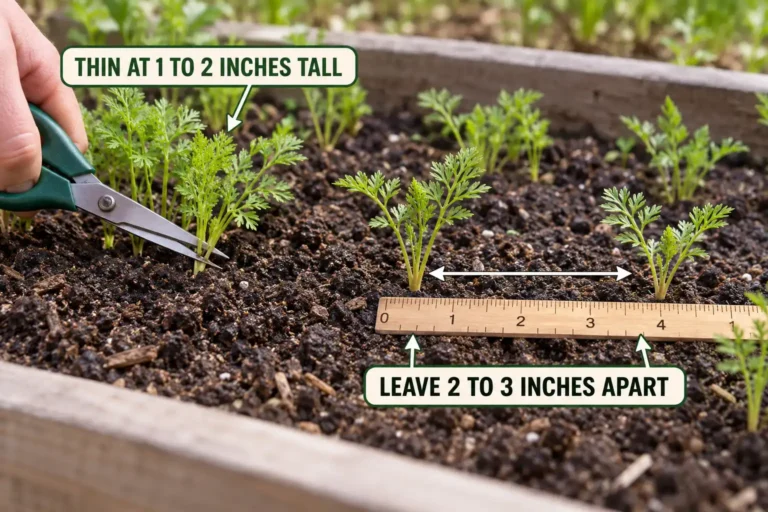
| Final plant spacing | 2 to 4 inches |
| Conventional row spacing | 18 to 24 inches |
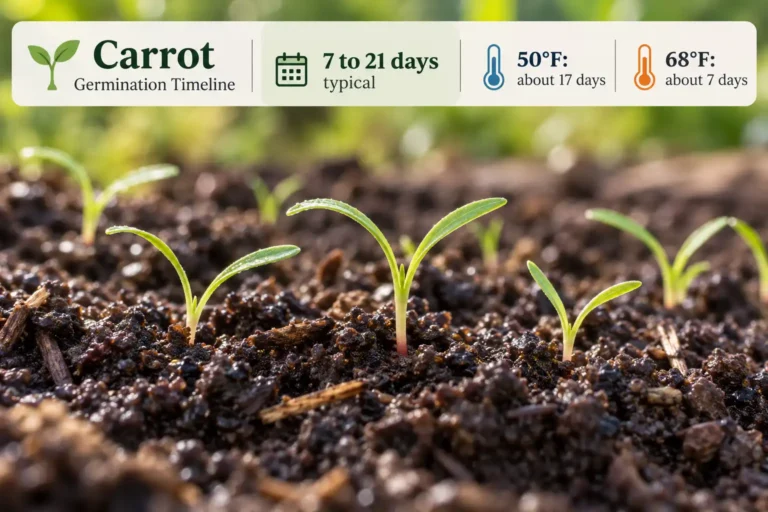
| Germination period | Up to 3 weeks |
| Thinning time | When seedlings reach 3 to 4 inches tall |
| Soil | Loose, moist, well-drained sandy loam preferred |
Prepare a fine seedbed before planting. Remove stones and break up hard soil clods.
Keep the seedbed consistently moist during germination. Carrot seeds can emerge slowly, especially in cool soil.
When plants become crowded, cut unwanted seedlings at soil level. Pulling them may disturb the roots of neighboring carrots.
Avoid Transplanting by Making Sowing Easier
Carrot seeds are small, which makes even spacing difficult.
Two options can help:
Pelleted carrot seeds have a coating that makes individual seeds easier to handle and space.
Carrot seed tape holds seeds at predetermined intervals along a paper strip.
Both reduce the amount of thinning needed. Neither eliminates the need for suitable soil and moisture.
When planting on a larger scale, accurate direct seeding is generally more practical than raising thousands of transplants.
When Should You Sow Carrots Instead of Starting Them Indoors?
Carrots grow best when their main growing period falls in cool weather. The suitable planting window varies considerably across the United States.
Regional recommendations from Iowa State University Extension, Oregon State University Extension, and University of Georgia Extension show why one nationwide planting date does not work.
| Region | Typical direct-sowing window | Regional consideration |
|---|---|---|
| Iowa, Upper Midwest | Early April, with the last practical planting around August 1 | Sow successive crops every 2 to 3 weeks |
| Oregon, Willamette Valley | March through August | Mild conditions allow a longer sowing season |
| Georgia, Southeast | Most commercial sowing occurs August 15 through October 31 | Fall establishment suits much of Georgia; north Georgia also has a late winter to spring window |
These dates come from regional extension guidance, including Iowa State’s carrot planting recommendations, Oregon State’s growing calendar, and University of Georgia’s carrot production guide.
They are examples, not universal state-by-state schedules.
In colder northern gardens, direct sowing in spring often removes the need for indoor starts.
In hot southern gardens, waiting for the appropriate fall planting period may provide better growing conditions than attempting to transplant summer-grown seedlings.
What Else Causes Carrots to Fork or Grow Misshapen?
Transplant damage is only one possible cause of forked carrots.
According to Utah State University Extension, compacted soil, root obstructions, excess nitrogen, fresh manure, and certain pest or disease injuries can also encourage branching.
How to Identify the Likely Problem
| Root symptom | Possible cause | What to change next time |
|---|---|---|
| Two or more thick root branches | Damaged taproot, stones, compacted soil, root injury | Prepare loose soil and avoid root disturbance |
| Curved or hooked root | Bent root during transplanting or an underground obstruction | Avoid root-bound seedlings and remove obstacles |
| Short, malformed root | Restricted soil depth, compaction, or early root injury | Improve rooting depth and choose shorter varieties |
| Long split along the carrot | Irregular moisture, especially in older roots | Maintain steady moisture and harvest on time |
Root shape alone cannot confirm one cause.
Soil and Fertilizer Problems
Carrots need adequate fertility, but adding more nitrogen is not always helpful.
Fresh manure and concentrated fertilizer near developing roots can contribute to abnormal branching.
Check nutrient requirements before adding fertilizer. Reading a soil test report helps identify pH or fertility problems before planting.
If soil structure is poor, focus on drainage, reducing compaction, and appropriate organic amendments. Improving soil fertility naturally provides additional context for managing soil amendments.
Inconsistent Watering
Uneven moisture can also reduce carrot quality.
University of Minnesota Extension recommends supplying irrigation when weekly rainfall is less than about 1 inch, while adjusting for soil conditions.
Sandy soil may require more frequent watering than heavier soil.
For larger plantings, calculating crop water requirements can help you plan irrigation around rainfall and growing conditions.
Is Transplanting Carrots Practical for Raised Beds or Larger Fields?
Direct seeding becomes increasingly useful as the planting area expands.
Consider an illustrative spacing of 3 inches between plants and 18 inches between rows.
| Planting area | Approximate planting positions |
|---|---|
| One 8-foot row | 32 |
| One 4-by-8-foot bed with two 8-foot rows | 64 |
| One 100-foot row | 400 |
| One acre at continuous 18-inch row spacing | 116,160 |
Calculation: A 100-foot row contains 1,200 inches. Dividing by 3 inches gives 400 planting positions.
The acre estimate uses 43,560 square feet divided by 0.375 square feet per plant.
These are theoretical positions, not expected harvests. Actual field populations depend on bed layout, alleys, germination, and production methods.
Commercial carrot systems may use substantially denser multi-row beds.
For a small bed, transplanting a few spare seedlings may be worth trying. For a field, direct seeding avoids extensive handling and root disturbance.
FAQs About Transplant Carrots
Can You Replant Carrot Seedlings Removed During Thinning?
Yes, you can try replanting carrot thinnings, but they often develop damaged or forked roots. The safest approach is to cut unwanted seedlings at soil level and allow the remaining carrots to grow undisturbed.
Will Transplanted Carrots Still Produce Edible Roots?
Yes, transplanted carrots can still produce edible roots even when their shape is irregular. Forking alone does not make a carrot unsafe to eat, although misshapen roots may require extra cleaning and trimming.
How Do You Know Carrot Seedlings Are Too Old to Transplant?
Seedlings are poor candidates when roots extend through drainage holes, circle the container, or become tangled together. A seedling’s height alone is unreliable because the taproot may already be much longer than its leaves.
Do Biodegradable Pots Prevent Carrot Root Forking?
No, biodegradable pots do not guarantee straight carrot roots. They may reduce handling during planting, but any restriction, bending, or injury to the developing taproot can still produce a misshapen carrot.
Can You Cut a Long Carrot Taproot Before Transplanting?
No, deliberately trimming a carrot taproot is not recommended when growing carrots for their roots. Removing the growing tip can encourage branching instead of producing the single, straight storage root most gardeners want.
Should You Replace Transplanted Carrots That Look Healthy?
Not necessarily. Healthy transplanted seedlings may continue growing and eventually produce usable carrots. However, green leaves cannot reveal root shape, so harvest a sample when mature to assess the results before changing future planting methods.
Key Points for Growing Straight Carrots
Transplant carrots only when saving existing seedlings is worth the risk. Keep young root plugs intact and never force bent roots into planting holes.
For reliable root shape, direct sow into loose, stone-free soil, thin carefully, and maintain steady moisture. Prevention is easier than correcting a damaged carrot taproot.