How Much Water Does Sugarcane Need Per Week and Season?
How much water does sugarcane need during a growing cycle? The answer depends on temperature, rainfall, soil type, and plant growth stage. Although sugarcane uses substantial amounts of water, applying the same irrigation volume every week can waste water or leave plants under moisture stress.
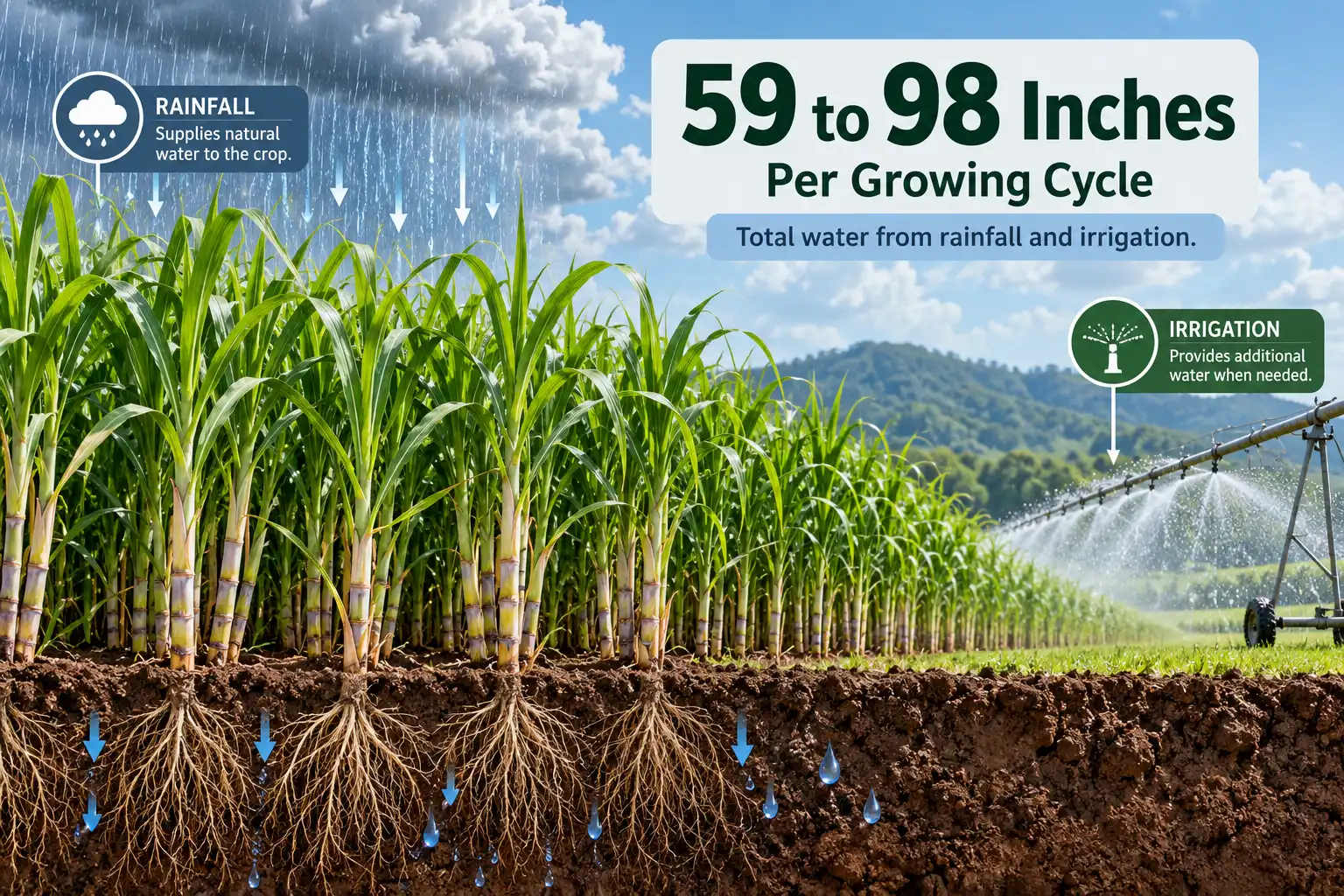
Sugarcane generally needs 59 to 98 inches (1,500 to 2,500 mm) of water per growing cycle, according to FAO. This includes rainfall and irrigation, not irrigation alone. Water demand is highest during active stalk growth.
What Does the 59 to 98 Inch Water Requirement Include?
The 59 to 98 inch range represents total water consumed during the crop’s growing period, not the amount you must supply through irrigation.
The Food and Agriculture Organization (FAO) identifies 1,500 to 2,500 mm as an approximate seasonal water requirement for sugarcane. Longer growing cycles generally require more water than shorter ones.
Three sources can contribute to that total:
- Rainfall: Rain that enters and remains in the root zone.
- Irrigation: Water supplied when rainfall and stored moisture are insufficient.
- Stored soil water: Moisture already available to roots, including groundwater contributions where applicable.
The total should not be interpreted as an annual irrigation requirement.
According to UF/IFAS Extension’s sugarcane production guidance, sugarcane is typically harvested after 9 to 14 months of growth in Florida. Longer cycles occur in other growing regions.
A shorter cycle, sufficient rainfall, or a shallow water table can substantially change how much supplemental irrigation is needed.
How Much Water Does Sugarcane Need at Each Growth Stage?
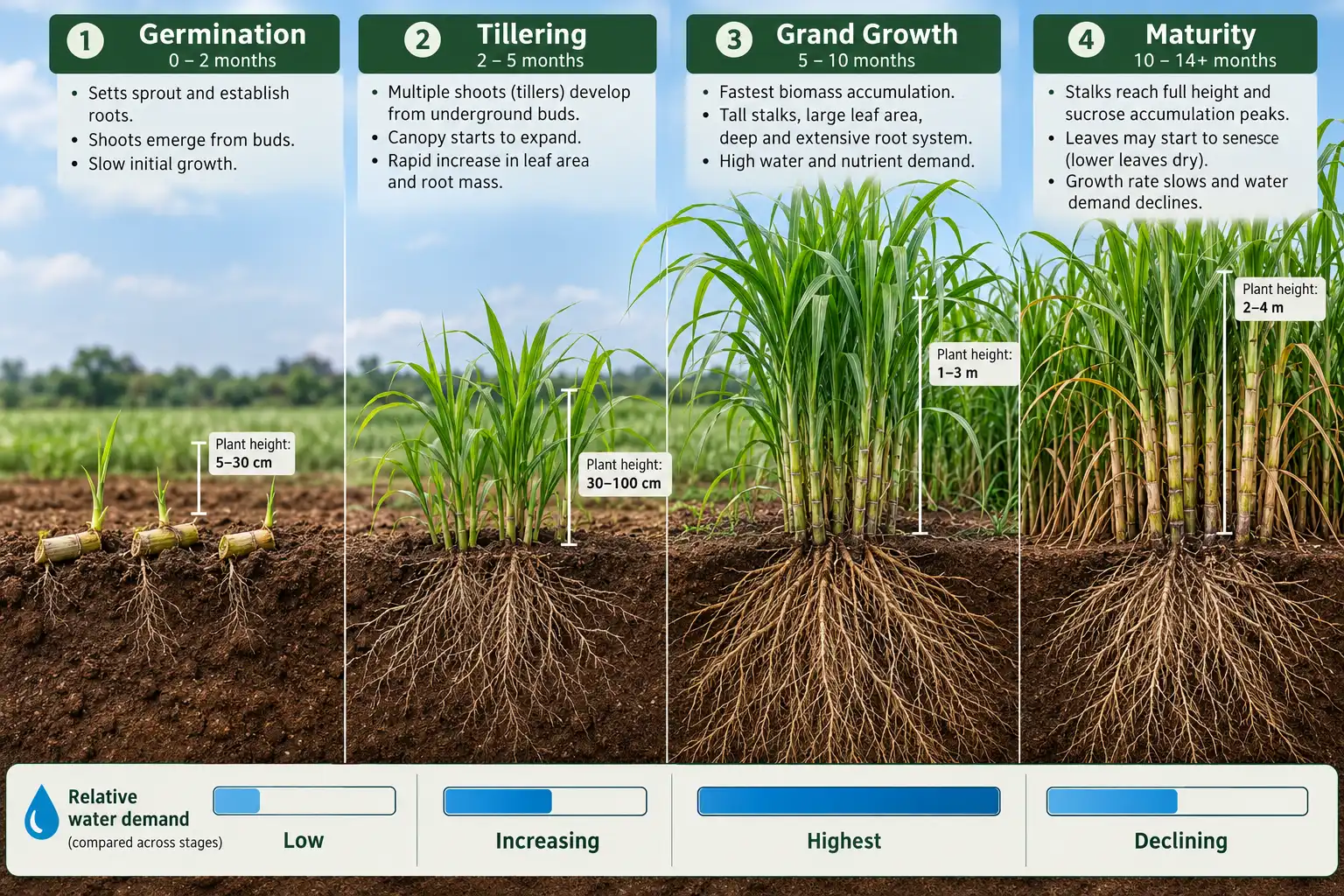
Sugarcane requires the most water during rapid vegetative growth, especially tillering and stalk elongation. Water demand is lower during establishment and generally decreases as the crop approaches maturity.
The FAO’s sugarcane crop coefficients describe how water use changes as the canopy develops.
| Growth stage | Relative water demand | Irrigation priority |
|---|---|---|
| Germination and establishment | Low | Keep planted cane pieces moist without saturating the soil |
| Tillering | Increasing | Prevent prolonged drying as new shoots develop |
| Grand growth and stalk elongation | Highest | Replace moisture losses before drought reduces stalk growth |
| Ripening and maturity | Declining | Reduce unnecessary irrigation while preventing severe moisture stress |
These are relative requirements, not fixed irrigation amounts. Weather, crop variety, planting date, and growing-cycle length affect each stage.
Plant cane grows from planted stalk pieces. Ratoon cane regrows from established stools after harvest. Their irrigation schedules differ because canopy development and root conditions differ.
How Much Water Does Sugarcane Need Per Day or Week?
There is no single daily or weekly watering amount that suits every sugarcane field.
The crop uses more water during hot, sunny, windy weather. Water use falls during cooler periods and when the canopy is small.
For comparison, consider two hypothetical daily crop water-use rates:
| Daily water use | Water used in 7 days |
|---|---|
| 0.15 inch | 1.05 inches |
| 0.20 inch | 1.40 inches |
| 0.25 inch | 1.75 inches |
| 0.30 inch | 2.10 inches |
These are calculation examples, not fixed sugarcane irrigation recommendations.
If a mature crop uses 0.25 inch daily, it consumes 1.75 inches over seven days. However, 1 inch of usable rainfall during that period would replace much of the water lost.
Actual irrigation depends on effective rainfall, available root-zone moisture, and system efficiency. Daily crop water use does not mean you must irrigate every day.
How Do You Calculate Sugarcane Irrigation After Rainfall?
The amount of irrigation needed depends on how much water the crop uses and how much remains available in the soil.
According to UF/IFAS Extension’s irrigation scheduling guidance, crop evapotranspiration (ETc) can be calculated using reference evapotranspiration (ETo) and a crop coefficient (Kc).
Crop water use = ETo × Kc
To estimate irrigation:
- Obtain local ETo data from an agricultural weather station.
- Multiply ETo by the appropriate sugarcane Kc for the growth stage.
- Subtract effective rainfall, accounting for changes in stored soil moisture and groundwater contributions.
- Adjust the remaining requirement for irrigation system efficiency.
Example: Calculating One Week of Irrigation
Assume an actively growing sugarcane field has:
- Reference ET: 0.20 inch/day
- Crop coefficient: 1.15
- Effective rainfall: 0.60 inch/week
- Drip irrigation efficiency: 85%
First, calculate weekly crop water use:
0.20 × 1.15 × 7 = 1.61 inches
Next, subtract usable rainfall:
1.61 − 0.60 = 1.01 inches
Account for irrigation efficiency:
1.01 ÷ 0.85 = 1.19 inches of gross irrigation
This example assumes no net change in stored soil water and no groundwater contribution. UF/IFAS lists 85% as an average efficiency for well-managed drip systems, although actual performance varies.
For different crops and growing conditions, the same approach applies when calculating crop water requirements.
How Many Gallons of Water Does Sugarcane Need Per Acre?
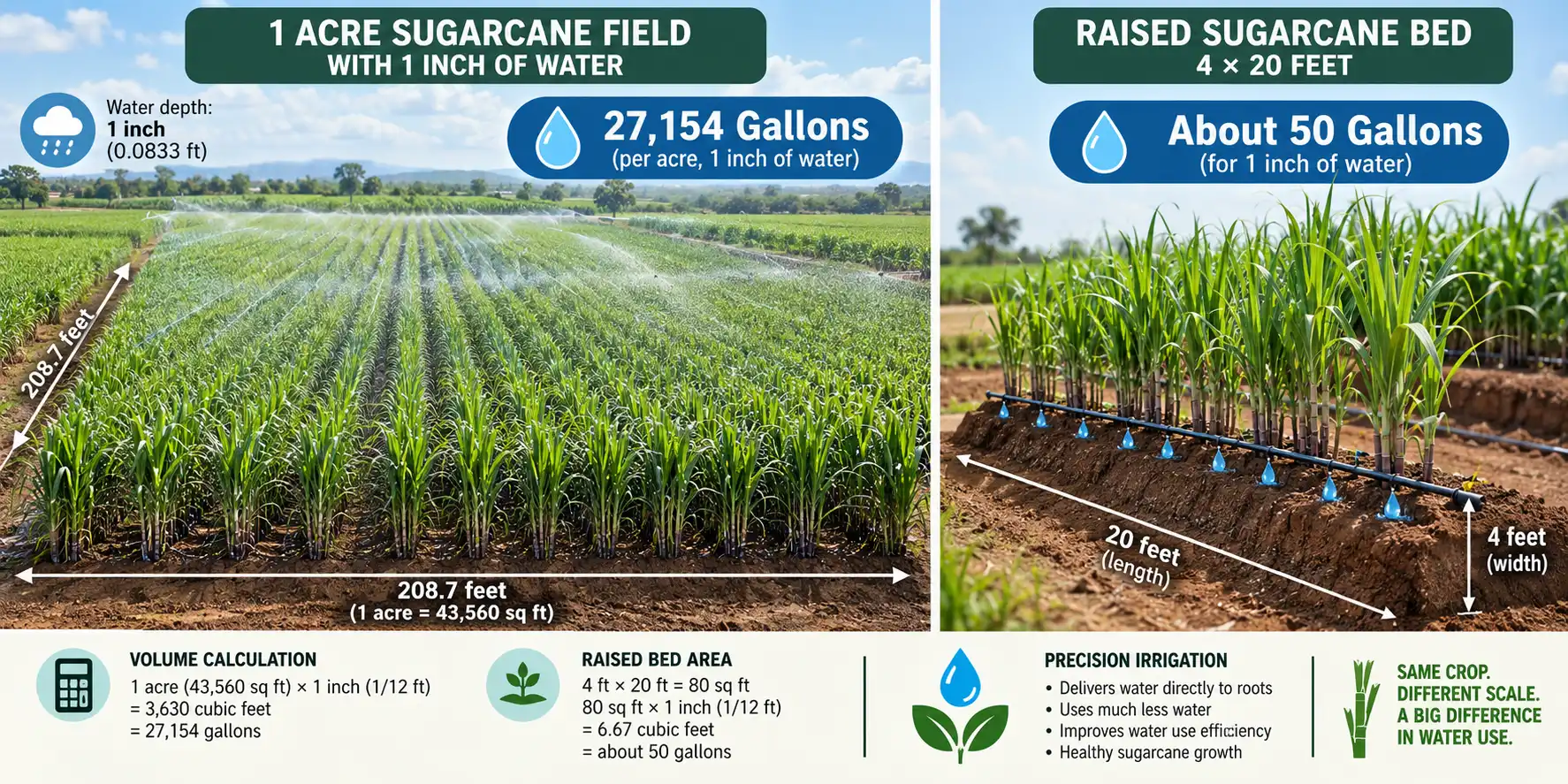
One inch of water spread across one acre equals approximately 27,154 gallons.
This conversion helps you estimate water volumes for commercial fields, garden rows, and small sugarcane plots.
| Water depth | Gallons per acre | Gallons for a 4 × 20 ft bed |
|---|---|---|
| 0.5 inch | 13,577 | 25 |
| 1 inch | 27,154 | 50 |
| 1.5 inches | 40,731 | 75 |
| 2 inches | 54,308 | 100 |
These values represent water volume over the measured ground area, not a recommended irrigation schedule.
Use this calculation for any field size:
Gallons = Area (square feet) × Water depth (inches) × 0.623
For the previous example, 1.19 inches of gross irrigation equals approximately 32,300 gallons per acre. The same application depth equals about 59 gallons across an 80-square-foot bed.
Actual pumping requirements depend on the area served, system efficiency, and water losses.
How Does Soil Type Affect Sugarcane Irrigation?
Soil texture determines how much water the root zone can store between rainfall or irrigation events.
Sandy Soil
Sandy soil drains quickly and stores relatively little plant-available water. Smaller, more frequent irrigation applications may be necessary.
UF/IFAS Extension reports that Florida’s sandy sugarcane soils have low water and nutrient retention, requiring careful irrigation and drainage management.
Adding organic matter can improve water retention over time. Improving soil fertility through organic amendments can support this approach.
Loamy Soil
Loam generally holds more usable moisture than coarse sand.
Irrigation can often be applied less frequently, provided enough moisture remains in the active root zone.
Clay and Organic Soil
Clay soils can store considerable water but may drain slowly. Overirrigation can reduce root-zone oxygen.
Florida’s organic sugarcane soils require specialized water-table management. Water is often controlled through canals and field ditches rather than conventional surface watering.
In every soil type, irrigate according to root-zone moisture instead of applying a fixed amount on predetermined days.
Do Sugarcane Irrigation Requirements Differ Across U.S. Regions?
Yes. Rainfall distribution, growing-season length, soil conditions, and water availability change irrigation requirements considerably.
Florida
Florida sugarcane is grown mainly in the Everglades Agricultural Area.
On organic soils, growers manage water tables for crop production, drainage, and soil conservation. Sandy mineral soils require closer attention to moisture losses.
Rainfall can supply substantial water during wet periods, while dry spells may require irrigation or water-table adjustment.
Louisiana
Much of Louisiana’s sugarcane production relies on rainfall rather than regular irrigation.
However, dry periods during active growth can cause moisture stress, especially where rainfall is less dependable.
The LSU AgCenter developed its Drought Irrigation Response Tool to estimate soil moisture using weather data, rainfall, and irrigation records. It supports Louisiana sugarcane fields using gravity irrigation.
South Texas
South Texas presents greater challenges where dependable irrigation supplies are limited.
In March 2025, the USDA Farm Service Agency reported that severe water shortages had ended commercial sugarcane production in the Lower Rio Grande Valley.
Reliable water availability should therefore be considered before planting sugarcane in dry locations. Matching crops to local growing resources is especially useful where irrigation water is limited.
How Should You Water Newly Planted Sugarcane?
Newly planted sugarcane needs consistent moisture around its buds and developing roots.
Sugarcane is commonly propagated from stalk sections known as seed cane, setts, or billets.
At planting, the soil should contain enough moisture to support sprouting. Keep the planting zone moist, but avoid prolonged saturation.
During establishment:
- Check moisture around the planted stalk pieces.
- Apply smaller amounts when the root zone begins drying.
- Avoid heavy watering that leaves planting furrows saturated.
- Increase irrigation as shoots develop and demand rises.
Once sugarcane enters rapid growth, monitor moisture deeper in the developing root zone.
After harvesting, ratoon cane regrows from underground stools. Irrigation demand generally increases as new shoots produce more leaves.
The interval between irrigations should follow crop growth, soil moisture, and weather conditions rather than a fixed calendar.
How Can You Tell If Sugarcane Is Getting Too Little or Too Much Water?
Check soil moisture before judging water stress from leaf appearance alone.
Signs of Insufficient Water
Common warning signs include:
- Leaves folding or curling inward
- Reduced production of new leaves
- Slower stalk elongation
- Dry soil within the active root zone
- Reduced tiller development during early growth
FAO’s irrigation scheduling guidance specifically describes stiff, inward-curled sugarcane leaves under severe water shortage. However, visible symptoms can appear after growth has already suffered.
Signs of Excessive Water
Watch for standing water, persistently saturated soil, poor drainage, and slow growth despite sufficient moisture.
Overirrigation reduces oxygen availability in the root zone and can promote nutrient losses.
For field irrigation, tensiometers or soil moisture sensors provide better scheduling information than leaf appearance alone. The LSU AgCenter’s irrigation scheduling guidance explains how to use soil moisture measurements to guide irrigation decisions.
FAQs About Sugarcane Irrigation Guide
Can sugarcane grow without irrigation?
Yes, sugarcane can grow using rainfall alone where precipitation and stored soil moisture meet its requirements throughout the growing season. However, extended drought during tillering or stalk elongation can reduce growth and final cane yield.
Does sugarcane need standing water?
No, sugarcane requires available soil moisture, but its roots also need oxygen for healthy growth. Although some Florida fields use controlled water tables, this does not mean that permanently saturated planting furrows are desirable.
How much water does one sugarcane plant need daily?
There is no reliable fixed daily gallon requirement for an individual sugarcane plant because water use depends on growth stage and surrounding conditions. Calculate irrigation using the planted area, rather than estimating gallons for each stalk.
Should you stop watering sugarcane before harvest?
Sugarcane generally uses less water as it approaches maturity, so irrigation requirements often decline during ripening. However, severe drought can still harm the crop, and watering decisions should reflect local soil moisture and harvest conditions.
Can too much irrigation reduce sugarcane yield?
Yes, prolonged saturation can restrict oxygen availability around roots, interfere with nutrient uptake, and reduce plant growth. Excessive irrigation can also cause nutrient losses through leaching or runoff, making water management important even for moisture-demanding sugarcane.
Is drip irrigation better than furrow irrigation for sugarcane?
Drip irrigation can distribute water near the crop row with relatively high application efficiency, but performance depends on design and maintenance. Furrow irrigation remains practical in suitable fields when water distribution, runoff, and drainage are carefully managed.
Key Points for Watering Sugarcane
Use the FAO’s 59 to 98 inch seasonal range as a starting estimate, not a fixed irrigation target.
Protect soil moisture during tillering and stalk elongation, when water demand is greatest. Subtract usable rainfall, check the root zone, and adjust applications for soil storage and irrigation efficiency.
The goal is to replace water the crop needs without allowing unnecessary runoff, deep drainage, or prolonged saturation.