Are Peanuts Genetically Modified? Facts for 2026

Are peanuts genetically modified? The peanuts currently sold in ordinary U.S. grocery stores come from conventional breeding. However, gene-edited peanuts reached field-scale planting in 2026. Understanding that development helps separate familiar peanut products from emerging biotechnology.
No genetically engineered peanut variety is established in the mainstream U.S. food market as of October 2026. Commercial peanuts are conventionally bred. Gene-edited peanuts entered field-scale plantings in Georgia in 2026, with developers targeting consumer products for 2027.
Are Peanuts Genetically Modified in the United States?
Peanuts sold as ordinary food in the United States are not genetically engineered varieties.
The USDA Agricultural Marketing Service maintains a List of Bioengineered Foods. It includes crops such as corn, soybeans, canola, and sugar beets. Peanuts are not currently listed.
That list identifies foods available in bioengineered forms worldwide for U.S. disclosure purposes. However, USDA also explains that an unlisted product can still require disclosure if a manufacturer knows it meets the legal definition.
In 2020, NC State Extension explained that genetically engineered peanut lines existed experimentally but were not commercial cultivars.
The situation has since developed. Gene-edited peanuts are now being evaluated beyond laboratory experiments, although they have not entered the established consumer market.
For shoppers, the distinction is straightforward: ordinary peanuts remain conventionally bred, while newer gene-edited varieties are a separate development.
How Are Peanuts Improved Without Genetic Engineering?
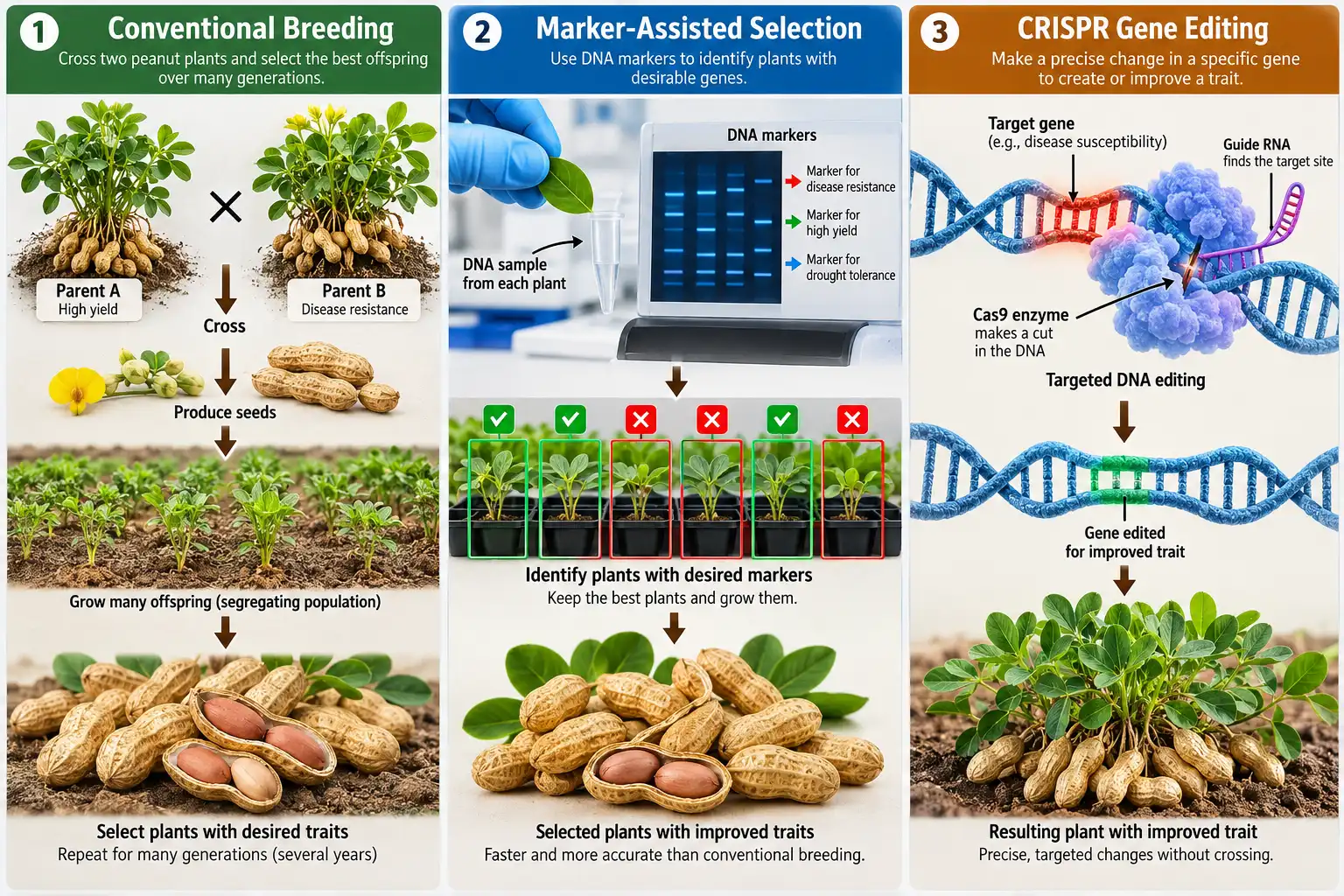
Peanut breeders improve varieties by crossing plants, selecting desirable traits, and using genetic markers to identify promising offspring.
These methods can change a crop’s inherited characteristics without directly editing its DNA in a laboratory.
The FDA’s agricultural biotechnology guidance distinguishes traditional selective breeding from genetic engineering.
Peanut breeding commonly targets:
- Resistance to diseases such as tomato spotted wilt and Sclerotinia blight.
- Higher yields and improved pod quality.
- Better adaptation to regional growing conditions.
- Higher oleic acid content for improved oil stability.
- Consistent seed size and processing characteristics.
The USDA Agricultural Research Service developed OLé, a high-oleic Spanish-type peanut variety, with Oklahoma State University collaborators. According to the USDA ARS variety announcement, OLé combines increased oleic acid with resistance to certain peanut diseases.
High-oleic characteristics do not automatically indicate genetic engineering.
Conventional Breeding vs. Gene Editing
| Method | How it works | Peanut example | Commercial status |
|---|---|---|---|
| Traditional breeding | Crosses and selects plants with useful inherited traits | Common runner, Virginia, and Spanish cultivars | Widely available |
| Marker-assisted breeding | Uses DNA markers to identify inherited traits during selection | High-oleic and disease-resistant breeding lines | Used in conventional variety development |
| Gene editing | Directly changes selected DNA sequences using technology such as CRISPR | Experimental lower-allergen peanuts | In development as of October 2026 |
USDA ARS research on marker-assisted peanut breeding documents how breeders combine high-oleic traits with resistance to diseases and environmental stresses.
What Changed in 2026 With Gene-Edited Peanuts?
In 2026, gene-edited peanuts designed to reduce certain allergenic proteins were planted in Georgia.
AgriNetica developed peanut lines using CRISPR technology. The project targets proteins associated with peanut allergies, including Ara h 2, Ara h 6, and Ara h 7.
On September 3, 2026, USDA APHIS recorded a regulatory inquiry concerning AgriNetica’s genome-edited peanuts for reduced allergen accumulation and altered composition.
The Institute of Food Technologists reported in August 2026 that these peanuts had been planted at field scale in Georgia.
Nurtured Nuts, the commercialization partner, is targeting 2027 for its first consumer products.
That is a development target, not confirmation that retail products are available or that reduced-allergen claims have completed food-safety review.
This changes an important part of the answer: genetically edited peanut plants exist and have been grown outdoors. They should not be confused with the conventional peanuts currently dominating U.S. grocery sales.
Are Gene-Edited Peanuts Considered GMOs?
Gene-edited peanuts can be described as genetically modified in the broad scientific sense, but U.S. regulatory terminology is more specific.
The FDA explains that genetic engineering can involve precise DNA changes. Conventional breeding, by comparison, selects genetic combinations through reproduction.
CRISPR can alter a plant’s existing genes without leaving DNA from another species in the final variety.
However, the USDA’s National Bioengineered Food Disclosure Standard uses a narrower legal definition. It considers the modification method, detectability of modified genetic material, and whether the change could occur through conventional breeding or naturally.
Consequently, not every gene-edited food necessarily qualifies for mandatory bioengineered disclosure.
USDA APHIS regulatory decisions also address plant biotechnology oversight. They should not be mistaken for a blanket FDA determination about a food’s safety or allergy claims.
The practical distinction is between how a peanut was developed, its regulatory status, and whether a product is actually available for consumers.
Can Peanut Butter Contain GMO Ingredients?
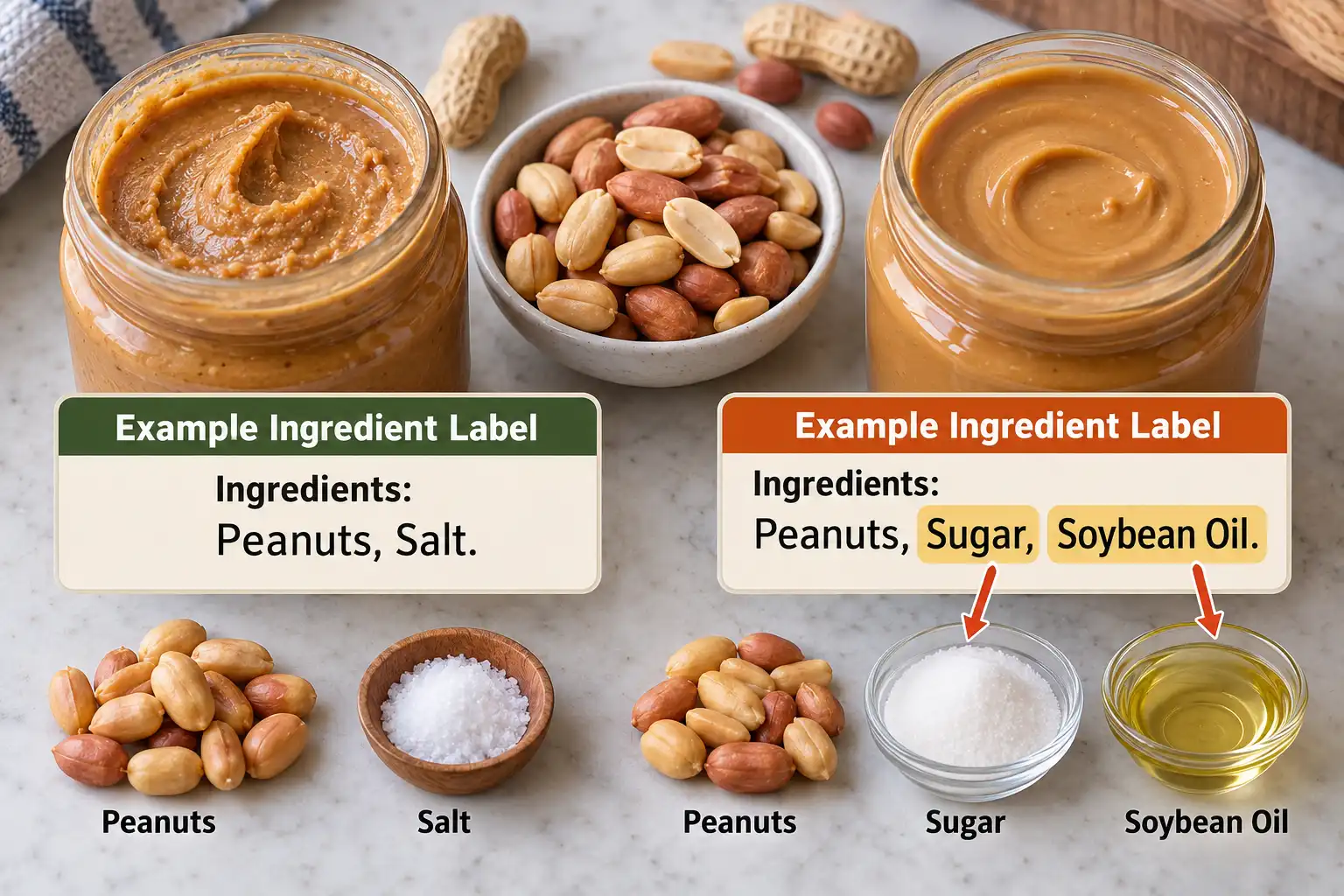
Yes. Peanut butter can contain ingredients derived from genetically engineered crops even when the peanuts themselves are conventionally bred.
A peanut butter made only from peanuts and salt has a simpler ingredient profile.
Other formulations may contain soybean oil, added sweeteners, or other ingredients sourced from crops available in bioengineered varieties.
The USDA list includes soybeans, corn, canola, and sugar beets. However, an ingredient’s presence does not prove that its source was genetically engineered.
For example, sugar may come from sugar cane or sugar beets. The word “sugar” alone does not identify the crop or its breeding history.
What to Check on Peanut Products
| Product | Peanut source | What to check |
|---|---|---|
| Plain raw or roasted peanuts | Conventional commercial varieties | Salt, seasonings, and coatings |
| Peanut butter with peanuts and salt | Conventional commercial varieties | Confirmation of the complete ingredient list |
| Sweetened peanut butter | Conventional peanuts | Sweetener sources and added ingredients |
| Peanut spreads with added oils | Conventional peanuts | Soybean, canola, and other oil sources |
USDA AMS explains that highly refined ingredients without detectable modified genetic material may not require a bioengineered disclosure.
Therefore, the absence of a disclosure does not establish that every ingredient came from a non-GMO crop.
What Do Non-GMO and Organic Peanut Labels Mean?
Non-GMO and organic labels describe different characteristics. They should not be treated as interchangeable.
Non-GMO refers to genetic engineering or bioengineering claims. Organic certification regulates a broader production system.
The USDA organic labeling rules prohibit excluded methods such as genetic engineering in certified organic production.
However, conventional non-GMO peanuts may still be grown with permitted conventional pesticides and fertilizers.
| Label | What it means | What it does not guarantee |
|---|---|---|
| Non-GMO | A claim that the product or ingredients meet the stated non-GMO criteria | Organic production or no pesticide use |
| USDA Organic | Certified production under USDA organic requirements, including restrictions on genetic engineering | All pesticides are prohibited or the food is allergy-safe |
| Bioengineered food | The food meets applicable U.S. bioengineered disclosure requirements | That the peanut ingredient specifically was engineered |
| No bioengineered disclosure | No mandatory disclosure appears | Complete absence of ingredients derived from bioengineered crops |
USDA does not operate a general non-GMO certification program under its Bioengineered Food Disclosure Standard. Non-GMO claims may be voluntary or supported by separate verification programs.
For peanut-only foods, a non-GMO label typically confirms what is already true of conventional commercial peanut varieties.
For processed foods, examine the complete ingredient list and the scope of any certification.
Does Genetic Modification Cause Peanut Allergies?
Peanut allergies occur in people exposed to proteins naturally present in conventional peanuts. Genetic engineering is not required for those reactions to occur.
The FDA identifies peanuts as a major food allergen. Ordinary, non-GMO peanuts can cause severe allergic reactions.
This matters because the emerging gene-edited peanuts aim to reduce specific allergenic proteins.
Reducing some proteins does not establish that a peanut is safe for someone with a diagnosed peanut allergy. Other allergenic proteins may remain, and clinical evidence is needed to evaluate actual risk.
The 2026 lower-allergen peanut project should therefore be viewed as developing technology, not an established allergy-safe food.
People with peanut allergies should continue following their medical care plans and avoiding peanuts when advised to do so.
A non-GMO, organic, or gene-edited description does not replace allergen warnings.
What Should Peanut Growers Know About GMO Seed?
Growers should select peanut seed by documented cultivar traits and local field requirements, not simply by a non-GMO claim.
Commercial peanut varieties differ in maturity, disease resistance, seed size, and fatty acid composition.
Regional priorities also vary.
For example, USDA ARS identifies Sclerotinia blight as an important concern for peanut production in Oklahoma and Texas. Breeding programs in Georgia also emphasize tomato spotted wilt and root-knot nematode resistance.
When evaluating seed, check:
- The cultivar name and seed source.
- Locally documented resistance to important diseases and pests.
- High-oleic or normal-oleic characteristics required by the intended market.
- Maturity and adaptation to the growing region.
- Seed treatment, germination information, and supplier documentation.
These considerations also belong in the broader process of choosing crops for farming.
Do not assume peanut seed has the same herbicide-tolerance traits as genetically engineered soybean or corn varieties.
For any herbicide, follow the registered product label and verify that the application is permitted for peanuts.
FAQs About Peanuts Genetically Modified
Are imported peanuts genetically modified?
Imported peanuts are not automatically genetically modified. USDA’s bioengineered food list does not currently include peanuts, but the list is not a guarantee for individual shipments, so buyers needing verified sourcing should request supplier documentation.
Are high-oleic peanuts genetically modified?
No, high-oleic content alone does not indicate genetic engineering. Conventional peanut breeders use inherited fatty acid traits to develop high-oleic varieties, including commercial cultivars with improved oil stability and storage characteristics.
Does roasting or boiling peanuts make them genetically modified?
No, roasting and boiling do not introduce genetically engineered traits into a peanut plant’s genome. Processing may change the food’s chemistry and DNA detectability, but it does not change how the original peanut variety was developed.
Can farmers buy GMO peanut seeds?
Gene-edited peanut lines exist in development, but they are not established as ordinary commercial seed options for growers in October 2026. Farmers should verify cultivar identity and availability rather than assuming experimental field plantings represent public seed sales.
Why do peanut packages say non-GMO?
Manufacturers may use non-GMO labeling to communicate ingredient sourcing and meet consumer preferences. On plain peanuts, the label generally does not distinguish them from a widely grown GMO alternative, because established commercial peanut varieties are conventionally bred.
How will consumers know when gene-edited peanuts reach stores?
Consumers should look for confirmed product launches, ingredient information, and applicable regulatory disclosures. USDA bioengineered labeling requirements depend on legal definitions, so a missing disclosure alone may not identify whether a future ingredient was developed through gene editing.
What to Remember About Peanut Genetics
Ordinary U.S. peanuts remain conventionally bred. For peanut butter and other mixed foods, check all ingredients rather than relying only on the peanut’s GMO status.
Gene-edited peanut research is advancing, but field planting does not equal established retail availability or proven allergy safety.